Showing posts with label ECOT Scandal. Show all posts

Thursday, March 12, 2020

Ohio Bill to Ban For-Profit Charter School Operators Bipartisan

Yesterday, a bipartisan bill to address Republican House Speaker Larry Householder's desire to make all charter school operators non-profit shops was introduced.

This has been a long time coming. Only a handful of states allow for-profit companies to run charter schools. Yet more than 57% of all Ohio charter schools are run by a for-profit company -- among the largest percentages in the country.

When I was in the House, we tried to eliminate the profit motive in 2009, but couldn't thanks to a reulctant Republican Senate. It's been an issue I've brought up for years. The profit motive has inspired disgusting levels of charter school campaign contributions and allowed Bill Lager to fleece Ohio taxpayers to the tune of more than $1 billion while his for-profit management company drove ECOT into the ground.

But don't worry, he's living in a $4 million mansion in Key West and has paid back a slight fraction of the more than $100 million his school was paid to educate kids they never had, which in turn was a slight fraction of the number of phantom students the school "educated" over the previous 18 years.

The profit motive allowed former Ohio Charter School Kingpin David Brennan to have two waterfront homes in Naples next door to each other -- one for living and one for entertaining politicians.

Most of the worst performing charter schools in the state are run by for-profit operations.

However, you really don't see the damage a profit motive causes a school until you look at the schools' expenditures. For example, even though the average for-profit charter school spends $11,005 per pupil, which is $1,260 less than the average school district, for-profit charters spend an incredible 44% more on non-instructional administrative costs. Charters run by non-profit outfits spent only 9% more than the average school district.

Remember that charters generally do not receive direct locally raised tax dollars, which tells you just how generous the state is to these schools. I digress.

What does this mean? It means that our tax dollars are paying for nice cars and houses for for-profit bigwigs instead of students. Take a look at this:

The average for-profit charter spends $776 less on instruction than the average school district. Yet it spends $761 more on non-instructional administrative costs -- an almost perfect 1:1 ratio.

These schools could spend what school districts do in the classroom if they weren't so busy pocketing profits.

This bill is a nice counter to the problematic My School, My Choice questionnaire I discussed in detail yesterday. The bill demonstrates where the clear mainstream on school choice is today in Ohio. We want accountability and to remove the profit motive from charter school operations so tax dollars can more efficiently reach the classrooms and students who need those resources.

It's time for us to pay for education, not cars and houses for well-heeled political contributors, don't you think?

Friday, October 26, 2018

Data Suggests Far Worse Fake Student Problem at ECOT

New state funding reports indicate that ECOT had nearly 8,000 fake students in its last full year of operation. According to the Ohio Department of Education, its last year of operation, ECOT couldn't account for about 20 percent of its students. However, the monthly finance reports ODE puts out suggests the number may have been closer to 55 percent.

First of all, the last year ECOT was fully operational was in the 2016-2017 school year. So I'm using that as a baseline for comparison.

In the 16-17 school year, ECOT received $103.6 million for 14,208 students. This year, it's zero dollars. A lot of news stories have tried to figure out what happened to all those students. One of the challenges appears to be that they may not have actually had all those students.

Follow me here.

Looking at the changes in charter school funding and enrollment between the 16-17 year and the most recent funding report available from the Ohio Department of Education from this month shows that Ohio e-school enrollment is down 9,851 students. However, enrollment in Ohio's brick and mortar charter schools is up 2,060 students.

So overall enrollment in Ohio's charter sector is down 7,791 students.

Assuming the vast majority of those students came from ECOT, perhaps those 7,791 students may not have actually ever been there.

Why?

Because school district enrollment is down 21,860 students from 2016-2017. If those 7,791 students returned to school districts -- the most likely landing spot -- one would expect school district enrollment to have showed an increase. But it's dropped a good deal.

To be fair, without seeing actual head counts, it's tough to explain why. Was there a big graduating class in Ohio school districts in 2016-2017 that would help explain this?

ECOT graduated about 2,000 students in 2017, but even subtracting out those students from the 7,791 "missing" students means 40 percent of the ECOT total is unaccounted for -- about double the rate that was found by ODE.

So there seems to be something going on here.

I would sure like to know how many, if any of the 7,791 students ECOT claimed it had in 2016-2017 that aren't in charter schools anymore were actually ever there to begin with. Because it looks like the state's 20 percent assessment may be significantly lower than first thought.


Wednesday, August 8, 2018

Ohio Supreme Court: ECOT can't get money for kids it doesn't educate. Really.

Well, like all courts before it, the Ohio Supreme Court came to the pretty common sense conclusion that the Electronic Classroom of Tomorrow should have to prove it's actually educating kids before taxpayers pay them to educate kids.

Really. It took an Ohio Supreme Court ruling to establish the pretty common sense idea that eschools should have to prove they are educating kids before taxpayers pay them in Ohio.

Amazing.

Here is the core of the Court's ruling that was handed down this morning. I remind my friends outside of Ohio that the fact the state's highest court had to write this sentence indicates just how far we need to come on eschool policy.
"We determine that R.C. 3314.08 is unambiguous and authorizes ODE to require an e-school to provide data of the duration of a student’s participation to substantiate that school’s funding."
What's more amazing is this: Two of the court's 7 Justices ... disagreed!

Ohio Supreme Court Justice Terrence O'Donnell speaking at ECOT's
2013 graduation ceremony. He was 1 of 2 Justices who ruled today
that ECOT should be paid to educate kids it couldn't prove it
was educating
Two Ohio Supreme Court Justices said it's fine for taxpayers to pay ECOT to educate kids it can't prove it educated. But we are living in Ohio. Oh, and does it surprise anyone that one of those two was Justice Terrence O'Donnell who spoke at ECOT's 2013 graduation -- in his Justice's robes no less -- and bragged about how ECOT founder and massive campaign contributor Bill Lager had a direct line to his office?

I digress.

But there are very interesting tidbits in the dissent. For example, it explains over and over again that when the Ohio General Assembly established the state's charter school system, it never intended for the Ohio Department of Education to figure out whether kids going to these schools were actually being educated in them. I swear. That's what the dissent said.
"It is telling that the legislature addressed many of the concerns motivating this litigation—i.e., that e-schools should have to maintain records documenting student participation—without expressly linking state education funding to the duration of online participation."
The dissenters are correct here: It is telling that the Ohio GA wouldn't tie any of this to funding at e-schools. In fact, it's pretty clear that the reason ECOT was ever held to account wasn't because of the Ohio General Assembly, or the Ohio Auditor of State, or the Ohio Attorney General. It was because the Ohio Department of Education asked ECOT a very simple question: Prove you're educating these kids.

When they couldn't, ODE asked for taxpayer money back.

Did ODE have statutory authority to do that? The Ohio Supreme Court ruled today that it did. But don't misconstrue this. The reason the court let ODE do this was because of common sense. As Chief Justice Maureen O'Connor said during oral arguments when ECOT claimed that the school should be paid even if kids enrolled there do no work: "How is that not absurd?"

But the dissent makes a good point, and lays bare one of the core issues with Ohio's highly political eschool policy: The politicians who have taken money from ECOT founder Bill Lager and OHDELA founder David Brennan for more than 20 years created a system where those two guys could be paid billions of dollars and never have to educate a single kid.

Absurd as it may be, that is exactly the system Ohio's politicians set up for their contributors.

And it is a system that finally may be changing as its absurdity is revealed and those enablers begin to be held to account.

Wednesday, July 11, 2018

Did State Policymakers Create Fund that ECOT Used to Pay Students to take Tests and Attend Graduation?

There's been plenty of justifiable outrage over the news that the Electronic Classroom of Tomorrow used taxpayer money to pay $25 to $50 for students to take state-mandated tests and attend its much ballyhooed graduation ceremonies, which often had powerful state politicians speaking.

However, missing in the reporting has been this little nugget: In the 2015 budget, for the first time ever, Ohio e-schools like ECOT were granted $25 a student for "facilities funding" -- funding e-schools still get, by the way. You might wonder what a school whose hallmark is that it's not in a building gets money for buildings like schools that are actually housed in buildings.

And you'd be right to wonder.

Here's what the Ohio Alliance of Public Charter Schools -- who in 2015 was the largest charter school advocacy group -- said about this change in 2015:
"Also provides a first time supplement for E-schools in each fiscal year of $25 per-pupil to aid with testing and counseling centers"
So the money was to be used to assist with finding testing and counseling centers.

That $25 sure matches with ECOT's policy to pay students $25 to take tests, doesn't it? So perhaps ECOT was simply taking the path the state legislature, who relied on campaign funds from ECOT founder Bill Lager, cleared for them with this crazy facilities funding.

Since it was passed, ECOT collected $873,281 in facilities funding. How much of that do you want to bet ended up paying for kids to take tests or attend graduation?

It was stunning, frankly to see in NBC 4's report that Ron Packard -- who has a history of funding some pretty smarmy stuff -- now says he's offended ECOT made these payments. But let's not kid each other here: the state legislature who was so dependent upon Lager's political largess did him a solid by kicking him $25 a kid for "testing facilities", which it looks like ECOT simply turned into money for students to take tests all kids in Ohio are required to take.

Imagine if a local public school district had done this. Imagine the frog marches for that district's public officials. Amazing.

Friday, June 8, 2018

The ECOT Myth that Won't Die: Money Following the Child

In the devastating aftermath of the criminal ECOT scandal, many charter proponents are saying it's not quite as simple as saying that $591 million left school districts for ECOT. That's because (as the myth goes), the district didn't have to educate those kids, so wasn't that a savings?

In a word, "No it is not." I guess that's four words. But whatever.

See, here's the thing. Generally, if kids leave a district for ECOT, the district still has the same fixed costs. They run the same number of buses to the same areas. They operate the same number of buildings. They still have the same number of teachers. They still need the same number of lunch ladies and secretaries. The costs for the district simply do not disappear because ECOT took a kid from the district.

However, they will, on average, have $7,288 fewer in state money to educate the kids who remain.

Where this may get complicated is in districts that lose a lot of students to ECOT. But even in these districts (like Columbus, for example), those students are spread across 12 grades. So Columbus may lose, perhaps, 10-12 teachers across the district to accommodate the 1,500 lost students (because those kids aren't all in one class or something). However, the other fixed costs remain the same. Same lunch ladies, buses, etc. So ECOT takes about $10 million a year from Columbus. Columbus does not realize a $10 million savings from that deduction. Maybe $1 million of that is reduced teaching staff. But the remaining costs are exactly the same. Period.

As Columbus School Board Member Dominic Paretti put it: if ECOT hadn't taken all that money from Columbus, the district would not have needed to go for its last two new money levies.

In the overwhelming majority of districts that lost money to ECOT, there were zero staffing impacts. So you have the same number of teachers, lunch ladies, buses, etc. with far less state money to do it.

The bottom line is this: Even if the "savings" were actually there, which they're NOT, but let's assume they are, it's not beneficial for districts. Because ECOT got about $3,000 more per pupil from the state (on average) than the district would have received for the same student, local districts have to use substantially more local revenue to cover those fixed costs that remain, even if the ECOT student doesn't. That means the districts become more reliant on local property taxes to pay for schools. This is unconstitutional. The Ohio Supreme Court has ruled that way four times.

Claiming that districts somehow benefit financially from having to go for more frequent and sizable property tax levies is simply not true. So don't let anyone claim it is.

Thursday, May 24, 2018

ECOT: The Scandal of All Time

I've been off for about a week. And what a week it's been. ECOT has officially become a criminal investigation. Formerly supportive Republican legislators can't give back their ECOT money fast enough, yet some remain stubbornly reluctant to do so.

In the meantime, the media have correctly identified ECOT and its more than $1 billion boondoggle as a crippling political albatross firmly wrapped around the Ohio GOP's neck.

Added to this is the outrage of the ostentatious auction of former ECOT personal property (including an outrageously opulent chair for founder Bill Lager to sit upon like a throne).

But there is one bit of misinformation floating around out there that I want to address and (hopefully) squash right away. And that is the idea that because Ohio Democrats were in charge of the Governor's mansion and House of Representatives in 2009 and ECOT continued to operate that somehow Ohio Democrats aren't clean on this scandal.

Since I was actually there during the 2009 budget process and was intimately involved, I thought I should clear up some things about what happened about 10 years ago.

It's very simple. Gov. Strickland's budget that year called for a 70 percent cut for Ohio eSchools. That's right. If Gov. Strickland's budget had passed unamended, ECOT funding would have been cut by 70 percent, effectively ending the school 10 years before it actually shut down, which would have saved Ohio taxpayers about $700 million that went to the school since then. Not to mention the lives of thousands of students ECOT failed to graduate.

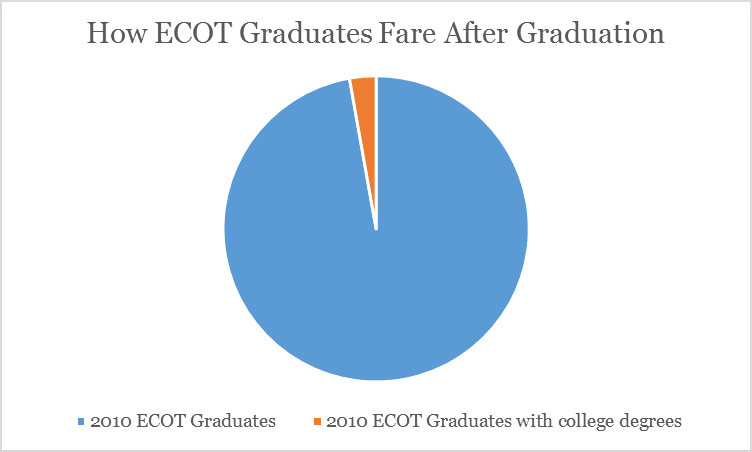
By the way, of the 3,794 students who actually did graduate ECOT the first year of the 2009 budget, only 109 have college degrees today. Just by way of reference.

However, Ohio Republicans still controlled the Senate during the 2009 budget. I was in those budget negotiations and I can tell you that we were told in no uncertain terms that if the 70 percent cuts stayed in the budget, there would be no budget for the 2009 session -- severely crippling Ohio's potential economic recovery from the Great Recession.

Don't believe me? Here's what he Ohio Association for Public Charter schools said at the time about the ultimate budget package (which did pass with ECOT funding restored, in exchange for our economic recovery and the implementation of the Evidence Based Model of school funding that put us on the path to a constitutional school funding system for the first time in our state's history):
“The Ohio Alliance for Public Charter Schools is deeply grateful to policy-makers – particularly the Senate Majority leadership team – for preserving charter school funding.”
The next year, 2010, I was up for re-election. A shadowy group spent about $500,000 to defeat me. It was funded by eSchools like ECOT, who funded my opponent that year, Todd McKenney. Their tactics were so outrageous (harassing my family and 5-year-old son at his Trick or Treat trail, for example), the New York Times profiled them.  If we went so easy on eSchools, why was I targeted when, ostensibly, I restored their funding?

Because ECOT and other eSchools knew that I and others like me were onto their scam -- a scam that was allowed to grow exponentially under Gov. John Kasich (who spoke at ECOT's graduation in 2011) until the Ohio Department of Education started asking very basic questions about ECOT's enrollment in 2016 and 2017.

So please, pile on all you want. But do not for a second believe that we didn't try to fix the ECOT problem 10 years ago. Because we did. And Senate Republicans were willing to jeopardize our state's economic recovery, not to mention the funding for the 90 percent of Ohio students not in charter schools, to save this horrible school.

Wonder if they regret that stance today, given the scandal's mushrooming scale?

Monday, April 23, 2018

ECOT: Now it's criminal. Literally.

Mens Rea.

I believe it was the first (or one of the first) legal terms of art I learned in law school. It means "state of mind." In other words, in order to commit a crime, you have to have the proper state of mind to fit the requirements of the crime.

Why do I bring this up now? Because it now appears that we have a smoking gun indicating that officials at the Electronic Classroom of Tomorrow formed the necessary mens rea to be charged with crimes.

According to an Associated Press story today (which ran all over the place, but I'll link to my former employer's version), people at ECOT -- at one point the largest single school in the nation -- were ordered to deliberately inflate enrollment so the school could keep getting paid $100 million plus to "educate" children, even if those children weren't actually at ECOT.

ECOT infamously did a remarkably poor job of educating those who were, by the way. How poor? Only 109 of 3,794 ECOT graduates from 2010 earned a college degree within 6 years of graduating. But I digress.

Back to the school's potential crimes.

According to the whistleblower who made this claim and worked for the software company that handled enrollment for ECOT, "school officials ordered staff to manipulate student data with software obtained following the state’s demand that it return $60 million in overpayments for the 2015-2016 school year."

That's right. ECOT was so arrogant that it ordered people to artificially inflate enrollment ... after the state had fined the school $60 million for inflating enrollment.

That's right. No question what the offenders' states of mind were. They knew it was wrong. They had been fined for doing it the previous year. And they did it anyway. Imagine what they told people to do before they were caught???? (Though, technically, they were caught in their first year of operation and on several other previous occasions, but not for as much money.)

Why the arrogance? Because ECOT's founder, Bill Lager, and other employees had invested $2.8 million in Ohio politicians since they started operations in the 2000-2001 school year.

Current Ohio Secretary of State and Lt. Gov. Candidate Jon Husted receives only known honorary degree from ECOT as Ohio Speaker of the House in 2007. Husted was one of several prominent Ohio Republican politicians who spoke at ECOT's graduation ceremonies, including Gov. John Kasich, Ohio Auditor David Yost, disgraced House Speaker Cliff Rosenberger and Ohio Supreme Court Justice Terrence O'Donnell. 


It wasn't that long ago that people went to prison for inflating enrollment figures at Columbus City Schools. What do you want to bet that the politicians who have taken a bunch of money and kudos from ECOT will do the same thing to that school's officials?

The taxpayer money involved here, if the enrollment overinflation that's been found over the last couple years is extrapolated over the course of ECOT's entire lifespan, is north of $500 million. By way of comparison, the infamous Coingate scandal from 2005-2006 ended up costing taxpayers about $50 million.

So ECOT and Lager's ripoff could be 10 times that of Tom Noe, who spent about 2 years in federal prison.

Now that we have insiders spilling the beans on the real mission of ECOT -- making money by ripping off taxpayers -- ECOT's top bananas certainly seem much closer to taking a trip up the river.

Because we now know their state of mind.

And it sure seems criminal to me.

Monday, March 12, 2018

House Bill 512: ECOT's Revenge

Last week, I testified against House Bill 512 -- the political takeover of the state's education system. During that testimony, I mentioned how HB 512 seems an awful lot like payback against the Ohio Department of Education for forcing the Electronic Classroom of Tomorrow to return about $80 million to Ohio taxpayers for kids the former virtual school giant charged taxpayers for educating, but they couldn't prove actually participated.

It reminded me of when you buy an embarrassing item at a store and try to hide the purchase with a bunch of other, innocuous things. Yeah, you might be buying 50 things. But you're really just buying the one thing.

So, I decided to look at the political contributions from ECOT founder Bill Lager and other ECOT-affiliated people to co-sponsors of the legislation. And you'll never guess what I found. ECOT people gave 5 of the 8 HB 512 co-sponsors more than $74,000 in campaign contributions in the 2014 and 2016 election cycles.

Reineke is the primary sponsor of the bill. Blessing is the chairman of the Government Accountability and Oversight committee, which is holding hearings on the bill.

Interestingly, Koehler just announced he is no longer supporting HB 512, even though he is currently listed as a co-sponsor -- never a good sign for your legislation.

If you are trying to argue that this is a bill about kids and not punishing adults, it becomes increasingly more incredible to say that once you see just how supportive ECOT has been to the adults sponsoring this legislation.

Monday, February 19, 2018

ECOT Bills State for Students ... AFTER IT CLOSES

The Electronic Classroom of Tomorrow told the Ohio Department of Education on Jan. 23 that it still had 5,580 students, and the state should pay them for educating those students. Trouble was, the school closed Jan. 19 -- four days before that payment was sent to the department.

That's right. It appears ECOT wanted to be paid for students it said it was educating after the school had closed.

To the Department's credit, they issued no taxpayer money to the state's once largest virtual school based on their Jan. 23 request. But the fact that ECOT, even after the end had come, demanded taxpayer money for educating kids everyone knew weren't there because the school had closed, put a rather tight, ironic bow on this school's sordid history.

Remember, it was the fact they couldn't prove they educated $80 million worth of students over the last two years, which then the state demanded they repay, that led to the school's abrupt closing last month.

But that closure didn't stop ECOT from continuing to demand taxpayers give them money. According to department reports, ECOT's February monthly payment to charter schools is based on data received by the state Jan. 23 -- four days after the school officially shut down. 

Fortunately for taxpayers, the school only billed the state for 5,580 students -- not the 11,876 students the school claimed it had enrolled on Dec. 24, 2017 -- the last date ODE looked at prior to the school's closure.

So that meant that the school, if it only had 5,580 students, had been overpaid by about $11 million because the state had paid the school for educating about twice as many students for the first half of the school year. So the school only needed $41.3 million to educate those students all year. However, the state had already paid the school $52 million through January based on the larger enrollment.

And that doesn't include the $30 million payment the school was supposed to cough up in return for charging taxpayers $60 million for students the school couldn't prove it actually educated in the 2015-2016 school year (another $20 million in overpayments was discovered later by ODE for last school year).

So while the state did its job and didn't pay ECOT for kids it claimed it educated while it was closed, the fact that ECOT actually charged taxpayers for this is incredible.

What a scandal. 

Monday, February 12, 2018

ECOT argues in Supreme Court tomorrow that it should be paid for educating kids it can't prove it educated. Really.

Tomorrow, ECOT will argue before the Ohio Supreme Court that even though it can't demonstrate that more than 60 percent of the students it charged taxpayers for educating actually engaged in educational activity, it should still receive taxpayer money because they could have been educated by them. 

The state forcing the school to re-pay taxpayers $80 million for kids it can't prove ever engaged in any learning experiences at ECOT is eventually what led to the Educational Service Center of Lake Erie West to drop the mega-virtual school last month, forcing the school to close and leaving hundreds of staff and thousands of families in a lurch -- a lurch caused by ECOT founder Bill Lager's love of money and fancy houses (owned under the name NestEgg Development, LLC. I can't make this up)


And while it appears that finances will be what shuts down the state's first and largest online school (though in a welcome departure from pure finances, apparently the Insight School of Ohio, run by K-12, Inc., which also runs the Ohio Virtual Academy -- currently the state's largest online school -- will be shut down for failing kids rather than accountants), ECOT's academic performance for the kids it actually did educate was not much better than those it didn't.

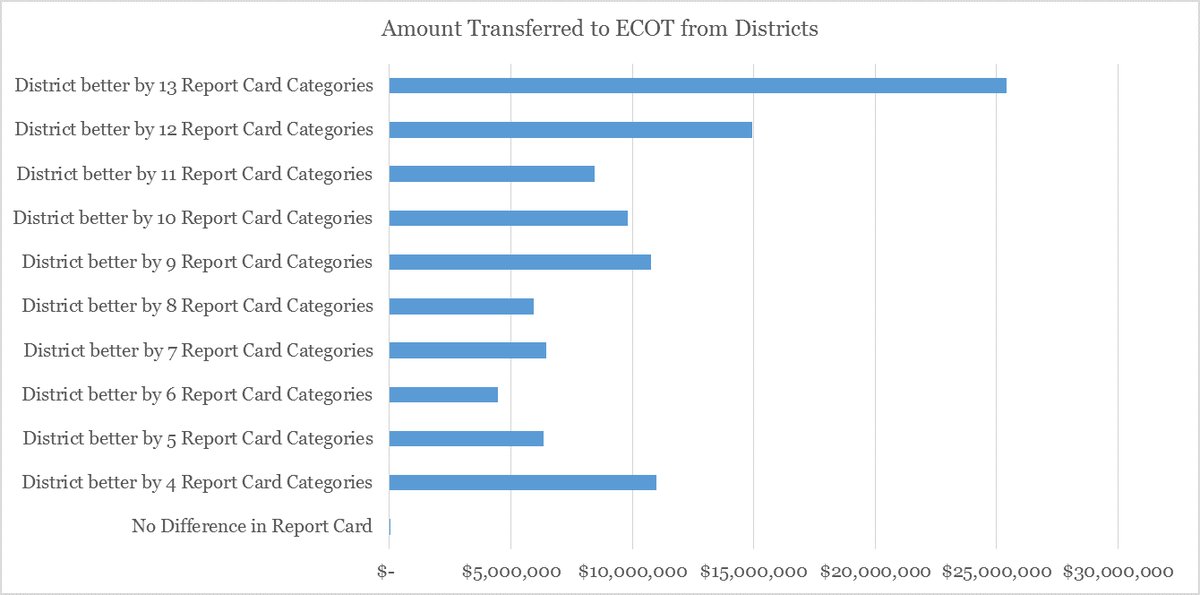
According to state data from the 2016-2017 school year, every penny sent from a school district to ECOT last year (which was more than $100 million) came from a district that outperformed the online giant by at least 4 of 13 state report card categories. And an astonishing 1 out of every 4 dollars sent to ECOT came from a district that outperformed ECOT on every comparable measure.
This is not to say there weren't success stories at ECOT. There were. But in the vast, overwhelming majority of cases, ECOT simply did not provide a better academic option for students than the districts they left.

And while they did graduate large numbers of students, they failed to graduate about twice as many as they actually graduated. Some of ECOT's paid supporters like posting impressive photos of their Schottenstein Center graduations. They never post a filled Fenway Park, which holds about the number of students ECOT failed to graduate since its opening.

One telling metric of the school's long-term impact on kids is how many ECOT graduates have a college degree within six years of graduation. 

When coupled with the fact that ECOT was charging taxpayers tens of millions of dollars to educate kids that never participated in learning at the school, it's clear that this school was not living up to expectations academically or financially.

As I wrote before, ECOT has generally not performed well on state metrics and have been unable to account for the children's learning experiences, but they have until recently been protected by powerful friends in the Ohio General Assembly and state government who benefited from ECOT founder Bill Lager's political largess.

And now the Supreme Court will decide, essentially, whether the school should be paid for educating kids it can't prove it educated and therefore remain open forever. 

Monday, January 22, 2018

ECOT's political patrons are many and vast

Now that the Electronic Classroom of Tomorrow (ECOT) is closed, it pays to step back and understand why a school that the Ohio Department of Education didn't approve in 1999 because it didn't think ECOT could effectively account for its students was shut down 18 years later because ... it couldn't effectively account for its students.

A major reason that this 18 year, more than $1 billion in state taxpayer funded operation was allowed to continue, despite repeated signs they weren't keeping track of their students. (One of those signs included an audit by then-Auditor Betty Montgomery that showed ECOT had overbilled taxpayers every year between 2001 and 2005.)

A big reason was ECOT founder William Lager's political contributions, primarily to powerful Republican lawmakers. According to www.followthemoney.org (which tracks state and local campaign contributions from the early 1990s to present), Lager himself gave more than $1.2 million to primarily legislative candidates since 2000, less than 5 percent of which went to Democrats.

Included in those contributions are current Attorney General Mike DeWine and Secretary of State Jon Husted. They are now running for Governor and Lieutenant Governor. 

Another recipient has been current Auditor Dave Yost, who is running for Attorney General. Another is Keith Faber, who is running for Auditor.

The list includes Speakers of the House, Presidents of the Senate and chairmen and chairwomen of powerful legislative committees.

And while the school is now shut down, what is clear is that the reason it remained open as long as it was was because the school had powerful allies and protectors in state government. In fact, Lager often complimented the recipients of his largess at ECOT graduations (where many of the largest recipients spoke) and thanked them for stopping efforts to close or "harm" the school. 

Here is a list of the recipients who received more than $10,000 from Lager:


Wednesday, January 17, 2018

ECOT in receivership? ECOT paid more to for-profit companies owned by political donor than its teachers

So now the Electronic Classroom of Tomorrow's sponsor, the Educational Service Center of Lake Erie West, wants to put ECOT in receivership to ensure the business can be properly wound down.

I'm fascinated by this "ECOT has no money" claim. Because by all counts, they should have plenty. Why do I say this? Because, as I have written before, even after ECOT loses its monthly, $2.5 million repayment (because it billed taxpayers for $60 million more than it should have in the 2015-2016 school year), the state pays ECOT $4,831.30 per pupil. That’s more than the state pays to educate kids in 265 of Ohio’s 613 school districts.

Yet ECOT is a virtual school. So no buses, janitors, lunch ladies, etc. So the school could pay the 597 teachers it had in the 2016-2017 school year their average $37,527 salary, provide brand-new MacBook Pros from Apple at $1,299 each and still clear about $20 million, or 34 percent.

However, it still has to pay its for-profit companies that run the school and provide the software for the school's operations. These companies are run by William Lager -- the big-time political donor.

How much is that? Well, in the four most recent state audits, Lager's companies end up receiving about $20.9 million a year.

Ah ha. So that is the problem! See, Lager needs to have his cut. And if Lager can't get his cut, well, forget the kids and parents, the school must close.

Here's the amazing thing. Between 2012-2013 and 2015-2016 (the school's most recent audited school year), Lager's for-profit companies received $83.6 million in public funds. Meanwhile, ECOT only paid $82.9 million for its teachers during the same period.

This is the problem with for-profit companies running schools. The schools end up paying more to the companies than the teachers.

Perhaps if Lager had settled for less of a cut or profit, ECOT parents wouldn't be scrambling today? Of course, that would have meant fewer potential donations to Ohio politicians. And we can't have that now, can we?

Thursday, January 11, 2018

If ECOT Closes, It Will Be Because It Failed Accountants, Not Kids

There is certainly a buzz about the Electronic Classroom of Tomorrow now. The Columbus Dispatch reported late yesterday that ECOT’s sponsor – the Educational Service Center of Lake Erie West – has decided to drop the school from its portfolio, which means the school may close by next week.

And while I’ve seen this action hailed as an “about time” moment, I want to remind everyone why the ESC decided to drop the school. Is it because ECOT can’t graduate even 4 out of 10 kids and contributed more dropouts than any other school in the nation?

No.

Could it be because since Ohio went to an A-F report card 46 of the school’s 53 Ohio Report Card grades were Fs?

No.

According to the Dispatch story, it’s “due to the online school’s growing financial troubles.”

Frankly, I don’t get it. ECOT’s financial woes, I mean. 

Hear me out. 

Even after ECOT loses its monthly, $2.5 million repayment (because it billed taxpayers for $60 million more than it should have in the 2015-2016 school year), the state pays ECOT $4,831.30. That’s more than the state pays to educate kids in 265 of Ohio’s 613 school districts.

Yet ECOT is a virtual school. So no buses, janitors, lunch ladies, etc. So the school could pay the 597 teachers it had in the 2016-2017 school year their average $37,527 salary, provide brand-new MacBook Pros from Apple at $1,299 each and still clear about $20 million, or 34 percent.

So what’s the problem?

Especially since it was also reported that ECOT laid off about 350 staff this year. Assuming 300 of those were teachers, that would leave ECOT with a 53 percent margin after paying its teachers and providing new MacBook Pros to every one of its students (which it does NOT do, I might add).

Now, according to state audits, William Lager – ECOT’s founder, who runs the for-profit Altair Management, which runs the school – collects about 4 percent of the funding the school receives from the state. Even with the lower margins, though, that still leaves ECOT with about $16 million to pay its management and software people.

Whatever the case, it’s clear ECOT has utterly failed its kids for years. Yet only when it fails the bottom lines for the adults involved does the school sponsor care enough to shut down this operation.

But this isn’t unusual. Of the 260 closed charters in Ohio, most have closed for financial viability. Closures for academic reasons are relatively rare.

Perhaps they should become less so.

I guess, though, in a way, we’re seeing the free market answer to education with the ECOT situation. Just as when a restaurant can’t pay its bills, it shuts down, regardless of whether it's great or bad at preparing food. 

Likewise in the free market education world, a school’s success is predicated on its ability to pay adults. Not educate kids. While this is becoming less so around the country, and even in Ohio to some extent, the fundamental fact remains that in much of Ohio’s Charter School World, the adults are running an operation for the adults, not the kids.

And that, my friends, is a crime.

Monday, November 6, 2017

ECOT Enrollment Down 20 Percent. Charter Enrollment Down for 4th Consecutive School Year.

It appears that the Electronic Classroom of Tomorrow -- the state's first and (maybe) largest online school and nation's largest dropout factory -- has adjusted its enrollment figures to adapt to the Ohio Department of Education's newfound interest in verifying their students.

ECOT was found to have overinflated its student counts by 60 percent in the 2015-2016 school year and 20 percent last school year. The state now says ECOT owes taxpayers more than $80 million in back payments for those two school years.

However, it does appear that this year's enrollment drop, which came after after ECOT's annual October headcount performed by the Ohio Department of Education, matches up with what ODE determined was last year's enrollment inflation at ECOT.

Prior to October's count, ECOT was being funded for 14,209 students. After the October count, that number dropped to 11,382. ODE has not posted the detailed, grade-level October headcounts yet for this year.

These detailed data have increased importance this school year for ECOT because they have a preliminary "Dropout Recovery and Prevention" status, which grants them much easier accountability standards, allowing them and their sponsor -- the Educational Service Center of Lake Erie West -- to keep operating and collecting large sums of taxpayer funding with little consequence for the school's putrid performance.

However, the school has to show that more than half of their students are older than 16 and enrolled in a dropout prevention or recovery program or are in "crisis". Previous years' counts show that ECOT likely would not have met the requirement because it had too many students younger than 16. The October count could clarify whether the school would meet the requirements for the lower academic standards.

The enrollment drop means that ECOT, which was slated to receive $73.6 million after paying back taxpayers for the overbilling issue, will now receive $53.9 million.

In 2015-2016, ECOT received $109 million.

ECOT is suing the state to keep ODE from clawing back the $80 million it took from taxpayers for kids it couldn't prove were actually participating in education programs at ECOT. The school has said that if it is forced to make the payments, it will have to shut down in December.

In a side note, overall charter school enrollment is listed at 110,187, the sector's lowest level since the 2011-2012 school year and what would represent the fourth consecutive year of overall charter school enrollment has dropped from its high of 120,894 students in the 2013-2014 school year.

Thursday, October 26, 2017

Are Ohio charter schools public schools? They sure don't act like it.

A recent story in the Columbus Dispatch revealed just how averse to public scrutiny the Electronic Classroom of Tomorrow is. While I can't say I was shocked, this did strike me as odd, given how much public heat ECOT has been receiving lately. Surely they are savvy enough to be as open and forthright with the public and the media as possible during their time of great duress.

But no.

Instead, they held an ostensibly "public" meeting that it appears the security guard didn't even know was going on. They initially wouldn't allow a member of the media into the board's committee meeting. Then they went into an executive session during their full meeting -- an executive session I'm willing to bet didn't comply with the notice requirements (24-hour posting and inform the media) under Ohio's Open Meetings Law.

And when the meeting was over, the school's top official wasn't able to give the reporter a copy of the documents produced for the ostensibly "public" meeting. I remind you this is a virtual school. They probably have email.

Oh, but the school's "posh" headquarters (the Dispatch's description) had plenty of pictures of politicians up in the hallways, including Ohio Supreme Court Justice Terrence O'Donnell, who is currently hearing a case against ECOT.

I often hear from Ohio charter school defenders that charter schools are "public schools". If so, why don't they act like it? Perhaps this is why the National Labor Relations Board -- the entity that works out labor disputes in the private sector has asserted jurisdiction over labor disputes in Ohio charter schools.

But lest you think this secrecy is restricted to ECOT, in 2014, the Akron Beacon Journal called 294 charter schools and asked them the following questions:

  • Who runs the building?
  • Who is that person’s supervisor?
  • Who is the management company in charge?
  • How does one contact the school board?
  • When does the board meet?
Want to guess how many refused to give all the information? If you guessed 3 out of 4 charter schools, then you win a cookie.

That's right. Only 80 of 294 charter schools willingly gave all the requested information to the Beacon Journal. This information is pretty basic and minimal.

Again, this is not how public agencies are supposed to operate. 

I ask you another question: If any group of public entities -- schools, cities, townships, villages, counties -- were this poorly responsive to you, the taxpayers that pay their bills and salaries, would you stand for it? 

And would you let them get away with calling themselves "public"?

I don't think so.

Thursday, October 19, 2017

Ohio GOP Legislators: Pay schools even if kids aren't there

Well it's come to this: Former Ohio legislators are now telling the Ohio Supreme Court that the state should pay schools for kids the schools says are there, even if they really aren't.

The filing was made on behalf of five former Republican members of the Ohio General Assembly earlier this month in a case that could well determine the very existence of Ohio's largest virtual school and the nation's largest dropout factory.

Does it surprise you that these legislators (according to Follow the Money) have received more than $50,000 in campaign contributions from Electronic Classroom of Tomorrow founder William Lager, and nearly $135,000 total from Lager and David Brennan -- Ohio's charter school Godfather?

In fact, the lead legislator on the filing is William Batchelder -- one of the longest serving state legislators in history who was Brennan's bag man on Ohio's school voucher legislation in the mid-1990s. Batchelder left the legislature in 2014. Shortly after that, he fell into a new job -- lobbying for Bill Lager. Makes sense. Lager had paid him $45,000 (not to mention the tens of thousands he paid to the Ohio House Republican Caucus during Batchelder's time as Speaker of the House). Batchelder collected $67,000 from Brennan, and even more if you include Brennan's wife, Ann.

The second legislator named is Chuck Calvert, who left the legislature the year I was elected, so I never really knew him. But he was the powerful chairman of the House Finance Committee for years. He collected $6,000 each from Lager and Brennan.

Then there's Mike Gilb -- a lawmaker from Northwest Ohio who took $4,000 from Brennan.

Jim Trakas is next, who collected $5,000 from Brennan and is now running dropout recovery schools in Cleveland that graduated 26 of 142 possible students last year.

Finally, Bryan Williams, who is now the Summit County Republican Party Chairman, replacing longtime Chairman Alex Arshinkoff. Here's a profile of Williams on the 3rd Rail Politics website, which has deep connections with ECOT and its officials. Williams took money from Brennan during his time in the legislature, which ended in 2004.

But this isn't the only issue here. What these legislators are saying is when they developed the state's nationally ridiculed charter school funding and accountability system, they didn't mean for the Ohio Department of Education to check whether the kids charter schools were claiming to educate were actually being educated. All that mattered was whether the schools claimed that the students were there.

I kid you not. These former legislators are all arguing that they meant for ECOT to get their money regardless of whether the student was even participating in an educational program at ECOT.

What an indictment of our state's charter school regime.

Oh, did I mention that four of the seven Ohio Supreme Court Justices hearing the ECOT case have taken money from Lager (Justices O'Connor, O'Donnell, French and DeWine)?

Is it any wonder why Ohio's charter school funding system feels so rigged against taxpayers? And why schools like ECOT, which perform so poorly yet are paid so richly, are such a subject of national scorn?

One more interesting and telling thing about the filing: No current legislators signed onto it.

Friday, October 6, 2017

ECOT's Dubiously Claims it will Close in December

Call it a hunch, but I'm betting dollars to donuts that the Electronic Classroom of Tomorrow's claim in a court filing today that it will close in December if a case doesn't go its way is a bluff to get the Ohio Supreme Court to rule for the school.

According to ECOT's filing, the state's $60 million clawback of taxpayer money ECOT was paid for kids it couldn't prove it had during the 2015-2016 school year will force the school to close in December.

Here's the thing, though. The money "crunch" ECOT is claiming will kill it in December should be there right now. In other words, if that $2.5 million per month deduction the state is taking from ECOT was so onerous, it would have forced the school to close already. Yet the school's already paid back $5 million of their misbegotten money.

But the fact is this: Even with the school's $30 million payment to ODE this school year (ODE split the $60 million into two years of monthly payments), they will still be receiving $73 million, or $5,183 per student from the state. That's still more than what 52 percent of Ohio's school districts receive from the state.

I remind you that ECOT doesn't have buildings, HVAC, busing, lunch ladies, etc. Yet the state pays them more per pupil than more than 1/2 of school districts that do have those costs.

Only in Ohio.

Anyway, that $73 million ECOT would still receive would allow them to pay their teachers, give $2,000 laptops to every student this year (which they do NOT do) and still clear a handsome profit. Just not quite as handsome as its politically connected founder, Bill Lager, is used to receiving. And that's assuming it actually has 14,000 students, which is a dubious proposition given the state's continued inability to find that the school has anywhere near as many kids as it bills taxpayers for educating.

How else do I think it's a bluff? Because according to ECOT's own academic calendar, (at left) they are not just preparing for life after December, but they already have their summer school session laid out for 2018.

I've gone over all this before. But suffice it to say that if ECOT closes in December (which I'm not buying right now), it likely will be because the train can't provide enough gravy. As with most everything about ECOT, the issue won't be about whether it can educate kids. It will be about whether it can further fatten the wallets of the adults ECOT enriches.

Ohio Stars (Again) in National Report about Charter School Fraud

Man, I am getting sick of this. How many times do national publications have to do the Ohio Department of Education and Ohio General Assembly's work for them before real changes are instituted here about charter schools?

This time it was USA Today and Pro Publica that broke the news yesterday that Ohio charter schools consistently bill the state for students that simply are not there. And you know who knows about this and does nothing? The Ohio Department of Education. How do I know this? Because the data Pro Publica used was from the Ohio Department of Education!!!!

My God. ODE knows on certain days a handful of kids show up at a dropout recovery school that is charging taxpayers for educating hundreds of kids? Yet they do nothing. Not. A. Thing.

This isn't all ODE's fault. From the very beginning, state regulators' authority over charters has been neutered by an Ohio General Assembly that has been in the pocket of the guys who profit off the absent kids in our state's charter schools. Don't believe me?

How about this in an Akron Beacon Journal story from 2014:
"In 2003, legislation sponsored by then Rep. Jon Husted, now the secretary of state, created a buffer between the Department of Education and charter schools by placing control in the hands of “sponsors,” or “authorizers,” who generally were school-choice advocates.
They, not the Ohio Department of Education, were in charge of approving new charters, and enrollment surged from 30,000 in 2003 to 125,900 today. And they have an incentive to open more schools rather than close them because their revenue is based on the number of children in the schools they oversee."
Husted, who now wants to be Governor, wasn't done.

A 2005 report completed by the Ohio Association of Public Charter Schools found that
"The most ambitious evaluations of charter school characteristics and performance in Ohio come from a series of reports produced by the state’s independent Legislative Office of Education Oversight (LOEO) from 2000 to 2004.
LOEO’s most recent report, issued in December 2003, specifically focused on academic performance and accountability of charter schools, and found that many Ohio charters fall significantly short of meeting their promise to improve academic achievement. By and large, LOEO found that charters were doing no better than traditional public schools, and that a large minority were doing substantially worse than comparable district schools.
I ask you, dear reader, what is different from the LOEO analysis from 2003 and the analysis completed more than a decade later by the generally charter school supporting Center for Research on Educational Outcomes that found 40 percent of Ohio's charter schools were in "urgent" need of improvement and kids in Ohio charters often did far worse than their local public school counterparts?

Nothing.

We've known Ohio's charter schools in general were in trouble from the very beginning of the program. Yet little has changed in terms of overall charter school performance or oversight. This is what drives me crazy about many in our state's newfound concern over charter school performance.

Where have all these people been living? Ohio's charter schools have always been worse performing, scandal ridden and profit centers for people motivated to buy nice houses in far off places, not educate kids.

What USA Today reported is nothing new.

Perhaps things would have been different if Ohio's charter schools had continued to be evaluated by a strong state oversight agency like the LOEO.

Well, charter school cheerleader Husted couldn't have that.

So, in the landmark House Bill 66 -- the 2005 state biennial budget bill that began Ohio's recent obsession with tax cuts -- soon-to-be-House-Speaker Husted had inserted into the House version of the bill an amendment that killed the LOEO. Tellingly, the Ohio Senate took out that amendment, but it was reinserted into Conference Committee.

So the state agency that had been sounding the charter school alarm for the first years of the program -- and could have shamed Ohio lawmakers into action sooner -- was dead.

ODE got the message. Loud and clear. Cross charters and you die.

So they don't cross charters. At least not in major ways. While the department's current effort to claw back $60 million the Electronic Classroom of Tomorrow owes taxpayers for overbilling them in the 2015-2016 school year plus another $20 million from last school year is a hopeful sign, ODE's weak response to ECOT's effort to become a dropout recovery school is simply more of the same.

I guess I'm just exhausted, though. I started working at the Akron Beacon Journal in 1997 -- the same year the state adopted its charter school law. Over the last 20 years, I have seen every major non-partisan, objective examination of Ohio's charter schools come to the same conclusion: they simply don't, on the whole, offer better options for kids and parents.

Of course a few do. But ladies and gentlemen we have now spent nearly $11 billion on charter schools since I entered my professional life. And we have maybe 40-50 charters that account for a small fraction of that $11 billion that are worthy of being compared with Ohio's local public schools.

That's a horrible return on taxpayer investment. When will legislators and political leaders in this state act to really fix this. Not just nibble around the edges, or hope that non-profits with powerful financial motives to not fix it instead ignore those motives and fix it. But actually purge the innumerable scofflaws from our state.

This is embarrassing. Not because we had a charter school fraud story published in a national newspaper. But because this story has been written about Ohio's charter schools for 20 years.

And our elected leaders simply do nothing. Yet we keep electing them.

Thursday, September 28, 2017

Shocked. Shocked, I Tell You. ECOT Owes Taxpayers MORE Money.

Put this in the Perfectly Predictable bin. Looks like the Electronic Classroom of Tomorrow (ECOT) could only account for about 81 percent of the students it billed taxpayers for "educating" last school year. And this was in a year when ECOT should have been extra careful because the year before it could only account for 40 percent of the students it billed taxpayers.

So now the school, which produces more high school dropouts than any other school in the nation, owes another $15 million ON TOP of the $60 million it already owed taxpayers. All I can say is the school should be grateful the state isn't going back for the previous 15 years of enrollment figures because if they did, ECOT would likely be shown to have fleeced Ohio taxpayers to the tune of more than a half billion dollars.

All while top state officials spoke at their graduation ceremonies -- ceremonies that included not even four out of 10 kids who were eligible to walk across the stage.

This comes on top of the news that not a single of the $103 million that went to ECOT last year from Ohio's public school districts came from a district that the school outperformed  on the state report card. And nearly one in four dollars sent to ECOT came from a school district that outperformed ECOT in every available measure.

A few more nuggets:

  • A spectacularly low 2.9 percent of ECOT's 2010 graduates had a college degree within 6 years of graduation. Only New Miami Local in Butler County had a lower rate among Ohio's 613 school districts.
  • An even more spectacularly low 0.3 percent of ECOT students attained an industry recognized credential. Most of the 24 school districts with the same or lower rates are districts like Hudson and Dublin that are wealthy and whose students are geared toward college, as that group's 40 percent rate of attaining college degrees within 6 years indicates (as noted above, ECOT's rate as 2.9 percent)
  • Their Performance Index score -- the accumulated index the state uses to determine  proficiency -- was lower than any district
  • The school's student growth index was -39.5. A score between -1 and 1 is considered a year of growth
  • ECOT -- a virtual school without walls, buses, lunch ladies, or janitors -- received $7,291 per pupil in state funding last school year -- an amount greater than 85 percent of school districts. And if they did not educate 19 percent of their students as the Ohio Department of Education now claims, their per pupil funding for the kids that they did "educate" jumps to $8,923 -- an amount greater than 96 percent of Ohio school districts
This school is an embarrassment to this state. And even to this nation. The Ohio General Assembly has allowed this hog to wallow far too long. It's time to shut down this school. I'm sorry. I'm sure some kids have been saved at ECOT. I'm sure some parents love it. It's these parents and kids who should be most upset with ECOT's continued bumbling and malfeasance, though, not we who report its existence. 

All I lost were my tax dollars. 

But every time ECOT does something like this, it harms these students' diplomas and what I'm sure was a lot of hard work. But remember this is not these kids' or parents' fault; it is the fault of Bill Lager -- the politically connected ECOT founder and for-profit operator who Ohio's taxpayers have made a millionaire many times over; it is the fault of the Educational Service Center of Lake Erie West, who could instantly solve this issue by canceling its oversight of the school, but instead has pushed to give the school an easier report card; and it is the fault of compliant politicians who thought it was more important to keep a campaign finance gravy train going than it was to stand up for kids.

State Auditor David Yost, for example, has been coming down hard recently on ECOT. But here's what he said just two short years ago (remember, I and we at Innovation Ohio reported as far back as 2011 that ECOT and Ohio's other eSchools were a problem):
"It's not your failure that defines you. It's the success that flowed from your decision to enroll in ECOT ... You tell them I'm the employee you're looking for. I'm organized and I'm disciplined and I get the job done because that's the way we do it at ECOT."