Share it

Friday, May 17, 2013

Private Schools Praise Ohio's Massive New Voucher Proposal

As many of you are probably aware, state Sen. Peggy Lehner has introduced an idea to provide $100 million in vouchers for poor kids to attend preschool.

This would be the largest single Voucher program in the state, outstripping Cleveland, EdChoice and the Jon Peterson Vouchers by a wide margin. It would provide 22,000 vouchers for poor children in Ohio to go to preschool to the tune of $100 million. The state's largest voucher program currently, EdChoice, only has about 14,000 participants.

As you know, Dear Reader, I am a strong advocate for the importance of preschool for every kid, regardless of income. But it can be especially important for those in greatest need.

However, something about this didn't seem right to me. Well, then it was confirmed for me in the Dayton Daily News story about the idea:

Saying it would promote economic opportunities that lead to stable, traditional families, a group of Ohio pastors and Christian educators on Thursday urged state lawmakers to put more money in pre-kindergarten education.

The group, organized by Shepherding the Next Generation, a Washington, D.C., based organization of evangelical pastors and ministry leaders, put their support behind an effort to get $100 million set aside in the state budget to fund vouchers for public and private preschool education for 3-year-olds from low-income families.

They cited research that showed children who first attended pre-kindergarten were more likely to succeed in school and get jobs later in life, and less likely to have out-of-wedlock children.

The program would save taxpayers long-term by making it less likely the kids would eventually end up on public assistance or get involved with the criminal justice system, said Gary Gepfrey, director of Bridge Ministries Marriage Enrichment Center in Dayton.

“We don’t have any disposable children in this nation, in this state,” said Finn Laursen, executive director of the Westlake, Ohio-based Christian Educators Association International. “And need to invest in them up front so we’re not doing catch-up, and so we’re not ushering them in as school dropouts who have bigger challenges outside in our culture.

The most vocal group supporting this idea is the one that is set to profit the most from it. There aren't tons of public preschools popping up in Ohio these days. The overwhelming number of preschools in Ohio are private, in fact.

According to the Ohio Department of Education, there were 1,364 licensed preschool programs in Ohio last year serving 64,849 preschool aged children. The new Voucher program would provide 22,000 vouchers at a cost of $4,500 each. I don't see 22,000 slots opening up anytime soon -- an effective 33% increase in the availability of preschools. Like other Ohio voucher programs, this will mostly fund kids who are already in the private preschool, not open up more opportunities for children to enter these schools.

I agree with Finn Laursen and others quoted throughout these new Voucher stories about the importance of preschool. It's just odd that when I was in the legislature, I don't remember them coming before my finance subcommittee being equally as passionate. Only now, when they have a shot at huge sums of public money do they come out of the woodwork.

It wouldn't take much more money to have universal preschool in all our most struggling districts (in fact, it's a cornerstone of the Cleveland Plan, remember). One could fund this simply by removing money from Charter Schools that take kids from districts that perform better on the state's two major performance measures. I mean, Oklahoma, of all places, did universal preschool.

Diverting more public money to private entities is doubling down on an idea that has demonstrated time and again that it won't benefit children, but will benefit the adults running private schools. Let's invest in all our kids, not just provide another windfall for private entities.

If the plan is adopted, it would mean that Ohio would spend more money on Vouchers and Charters in a year than the Department of Defense spends on Science and Technology Research and Development.

Sunday, May 5, 2013

Fiscal Times Messes Up

The Fiscal Times -- normally a fine publication -- really messed up when they published their 11 Worst Graduation Rates for Public Universities recently. It's a perfect example of an outside publication trying to make an overly simplified argument -- that public universities are a rip off because people don't graduate.

Four of the 11 schools are Ohio schools. Before you flip out, consider this story of my wife's path through Kent State University's Nursing Program. She wanted to get through the 5-6 year program in less than 4. The task was impossible if she attended classes only at the main Kent campus. However, it was possible if she sprinkled in some time at branch campuses. She took classes at Kent's Salem, East Liverpool and Ashtabula campuses. And as a result, she graduated from the Main Campus in 3 1/2 years. Within four years, she was managing the mother-baby units at University Hospitals' MacDonald Women's Hospital -- one of the top 5 women's hospitals in the country.

Which brings me back to the Fiscal Times report. See all four of Ohio's so-called "poor graduation rate" public universities are branch campuses -- two each from Ohio and Kent State universities. The Ohio branches are in Ironton and Chilicothe; Kent's are Tuscarawas and East Liverpool, which ranked third overall on the rankings.

What the Fiscal Times doesn't understand is that in Ohio, where public tuition is among the highest in the country, students frequently spend a couple years at branch campuses, keeping their tuition down, but end up graduating from the main campus. And they do it in areas that traditionally have not valued higher education, such as rural Appalachia, which is where the four Ohio campuses serve. The role of the branch campus in Ohio is to reach out into these areas of need and provide lower cost options to students who otherwise would be unable to afford the million dollar dream of a college education.

What lists like the Fiscal Times put together do is try to suggest that is a bad thing. Of course these branch campuses' graduation rates are low. My wife graduated from Kent main, but took a couple semesters at branch campuses. So technically she didn't graduate from East Liverpool, but that wasn't the point. The point was her experience there permitted her the ability to do great things and eventually become a nursing instructor herself.

The Fiscal Times should have gotten their heads out of their Excel spreadsheets and made a couple phone calls to find out what these branch campuses couldn't graduate students. Instead, they undermined their entire effort by their sloth.

I sincerely hope no one at Kent State or Ohio University takes any heat for these rankings. Because in the case of these two schools, the rankings are bunk. These branch campuses are providing an invaluable service to folks who otherwise couldn't afford or reach an area of higher learning.

Shame on the Fiscal Times for casting aspersions on such noble work.

Thursday, May 2, 2013

Ohio Charters Spend Far More on Administration Than Publics

Since today is Charter Day in the Ohio Senate -- the day when Charter Schools testify about the state's biennial budget -- I figured now would be as good a time as any to look at how efficiently Charter Schools are spending the now $828 million Ohio taxpayers are sending them, according to their April payment report.

Looking at the Ohio Department of Education's Power User reports, I was able to get a breakdown of all expenditures for the 2010-2011 school year for Charters and Traditional Public Schools, located here and here, respectively.

The average Charter School (including brick-and-mortar and virtual schools) spends four times as much per pupil on administrative costs as the average public school building, and about twice as much as the average district.

As a result of these much larger percentage expenditures being spent on administration, Charter Schools spend a lower percentage of their money than Traditional Public Schools on instructional services, staff and pupil support, as well as building operations. Charters spend a much lower percentage of their money on pupil support (4.4% vs. about 10% in the Traditional Public Schools) and operations (about 9% vs. about 19% for Traditional Public Schools).

And overall, once again, Ohio's brick and mortar Charter Schools spend $54 more per pupil than the average public school, according to the Ohio Department of Education.

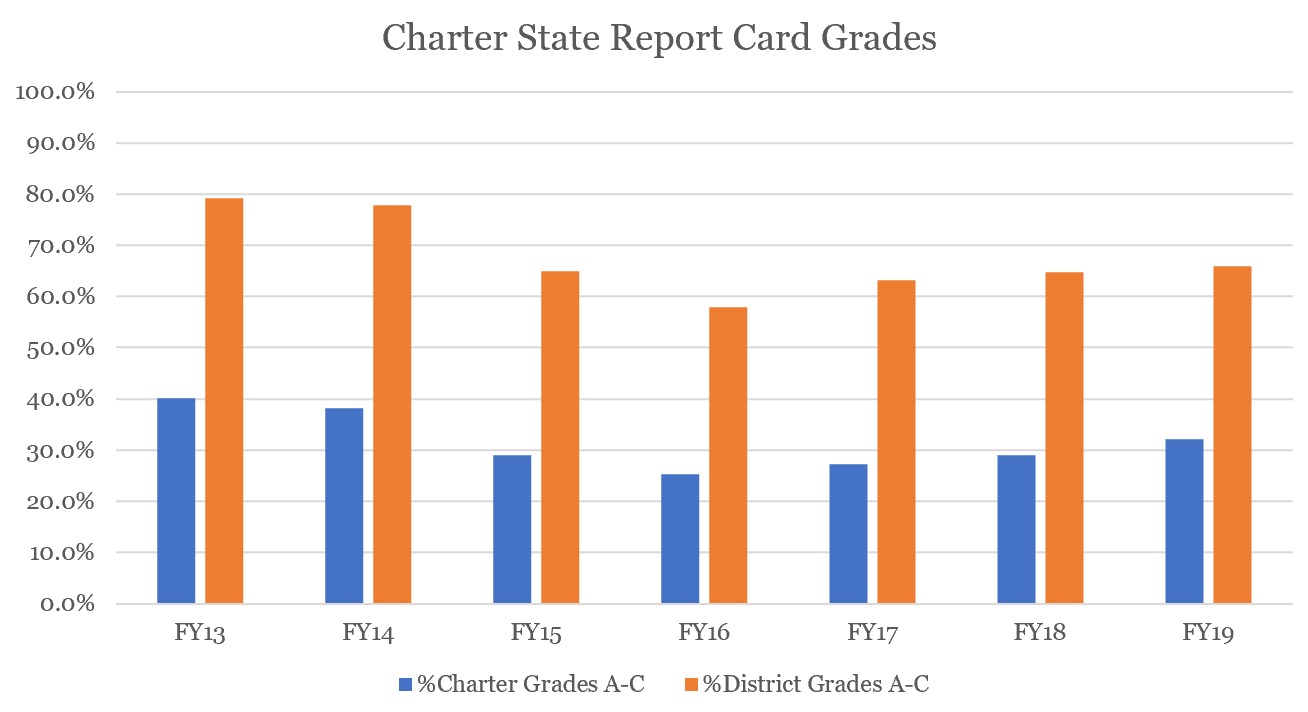
If Charters were performing better, perhaps you could overlook some of this. However, when every child in Ohio is receiving, on average, 6.5% less state revenue because of how Charters are funded, all while 3 out of 4 Charters are slated to receive Fs on the new state report card, and 40% of the money sent to rated Charters last year went to Charters that rated worse on both of the state's major performance measures than the districts from whence they received their money and kids, well, there needs to be serious revision of this program.

I don't imagine much of this was discussed at the Charter Day in Columbus. Here's hoping it will be discussed at some point.

Monday, April 29, 2013

Study: State Cuts Force Local Cuts

From the Obvious File, Policy Matters has done its now annual survey to determine how districts are coping with state budget cuts. Not surprisingly, districts are cutting way back.

Just a few examples:

Eighty-four percent said they reduced or froze compensation;
Eighty-two percent said they reduced staff;
Fifty-seven percent cut materials, supplies, textbooks or equipment;
Forty-three percent reported larger class sizes;
Twenty-three percent had reduced course offerings;
Twenty-two percent introduced pay-to-play for extracurricular activities, or reduced extracurricular offerings.
So for those who think districts should make cuts before asking for additional local revenue, they clearly are doing both, actually. My district passed a new money levy a couple years ago, which meant they only let go of two dozen rather than 80 teachers.

It is, frankly, sad that Policy Matters and Innovation Ohio have to do research proving the obvious -- that state budget cuts mean greater cuts and higher taxes at the local level. Last week, IO released my latest look at the statewide total ask for new operating money at the local level -- an amount that's up to $1.3 billion since May 2011.

Yet there remain folks in Columbus who think their actions don't result in real-world consequences. It is clear that they do. Let's hope this latest information allows them to snap back to reality here.

For, as Policy Matters noted in its work, if Ohio had simply kept pace with inflation since the DeRolph case was dropped by the Ohio Supreme Court in 2002, Ohio's kids would have $1.2 billion more in state money than they would in the last year of this budget as currently constituted. That's fewer cuts, lower property taxes and better-educated kids.

How, exactly, can one be against all that? Perhaps it's time some in Columbus were asked that question. 

The Coventry Conundrum

The Akron Beacon Journal published another strong story about school funding this weekend. The story tells another complicated tale among the school funding forest -- that of the property wealthy, income poor districts.

These districts tend to abut lakes. The Beacon story focuses on Coventry, which encompasses most of the Portage Lakes -- among the most popular summer fun spots in the state. But they could have also written about Danbury on Lake Erie.

Again, these districts' property values are sky high, primarily because they have a lot of lakefront property. However, they do not have wealthy people living there. So when the state assumes they can raise certain amounts of money, they really can't because they simply don't have folks of great means living there.

The state can make adjustments to offset this problem. And this is actually something the Kasich education plan attempted to get at through a couple different ways. Probably the best way is to develop an index that takes into account multiple factors when analyzing the challenges different districts face.

For example, in the Evidence Based Model, we had the Education Challenge Factor, which looked at a district's property wealth, income and education attainment levels. As a result, the EBM would have reduced the need for Coventry residents to raise more than 10 mills in local property taxes. Danbury, though, would have received slight cuts, which speaks to the extreme disparity in Danbury between the wealthy and poor sections of the community.

A fully funded version of the House passed education plan would effectively cut revenue to the district, because of the House's decision to include transportation dollars in the formula now, which Gov. Kasich did not in his version. Kasich's plan would have given Coventry about a 10% bump overall. However, that was primarily because it really undervalued property wealth for districts that had a lot of property wealth, though the plan did try to do a better job of recognizing that Coventry's property wealth did not reflect the district's true wealth.

I think the best thing to do would be develop an index that incorporates more environmental and outside-the-classroom factors that we know impact student learning, which would bring more equity to the formula, regardless of the district. Then there should be an adjustment made to districts that have dissonance between property and income wealth, like Coventry and Danbury, to account for the district's true ability to contribute local property taxes.

In the meantime, though, districts like Coventry will have to continue asking for more money from folks who cannot really afford it. Or else, their children will suffer from a lack of opportunity. Once again, the state's inability to live up to its constitutional obligations has really forced a district's hand.

And it doesn't help that every kid in Coventry loses 5.7% of his or her state revenue to Charter Schools -- 100% of which perform worse on both the state report card and performance index score than Coventry.

Sunday, April 28, 2013

eSchools Claim Shipping Explain High Costs

One of the more amazing things that appeared in an AP story today about eSchools was the industry's explanation for why -- despite not having to pay for bricks and mortar, or feeding children, or busing them -- eSchools don't realize a ton of cost savings for Ohio taxpayers.

In the middle of the story is this little nugget:

Jamie Callender, a former Republican lawmaker whose Cleveland-area law firm specializes in charter school issues, said a review of state audits would show that e-schools incur almost all the same costs as traditional public schools.
"There are 50 pounds of books for each of these kids. There's the cost of that mailing," he said. "Obviously, there's a cost to socialization. Socialization is very important for kids, and there has to be some mechanism to make up for that."
Fifty pounds of books explains why the state pays eSchools twice as much per pupil as  they do traditional schools? Really?

So I decided to take a look at this claim. Here's what I found: Shipping 50 pounds of books to every child in an eSchool (only looking at the major statewide eSchools, which have about 95% of all eSchool kids) would cost a grand total of 1.8% of the amount the state sends to eSchools. And that's if the eSchool sends it FedEx First Overnight -- the most expensive way to FedEx a package.

In other words, shipping books cannot explain how eSchools have enough money to provide 15:1 student-teacher ratios, give every kid a $2,000 laptop and still clear 30-40% profit, yet only provide 34:1 student-teacher ratios and don't give kids $2,000 laptops.

I think eSchools might help some kids in special circumstances. However, when the average major Ohio eSchool graduates 45% of its kids, rates in the bottom 12% of the state's 3200 school buildings on the performance index score, all while spending a mere 18% of its state revenue on teacher salaries, serious questions must be answered.

Questions like, "Why are we doing this in this way?"

Don't forget, eSchools got a carve out in the Ohio House's version of the state budget so they can now collect career-tech money. That's right. eSchools can now collect money meant to teach kids how to make outside mitre cuts.

No kidding.

Wednesday, April 17, 2013

My Take on House Omnibus Amendment

Yesterday, the Ohio House Finance and Appropriations Committee considered and passed a massive amendment to their previous massive amendment to Gov. John Kasich's Budget, including the Education Plan. Here are my takes on each of the amendments dealing with education. While some of them may seem snarky, they probably are. But I think it's important for people to realize just how cynical some of these provisions are. So I'm trying to meet cynicism with snark.
 
HC1862 – Increases 200-550, Foundation Funding by $250,000 each year and earmarks that amount for home-schooled students to take Post-Secondary Enrollment Options Program courses.
As I said earlier, it's great they're increasing the Foundation Funding line (which was cut from Kasich's budget), but giving the money to homeschoolers so they can take advantage of a public school program to allow public school kids to take college classes early is not so good. Since it's in the foundation now, I'm thinking that money will come out of the amount intended for the homeschooler's district of residence, which in all likelihood has never seen the kid before. Yet one more cut for school districts. Great.

 
HC2016-3 – Appropriates $5 million per year for a new line item, Ready to Learn, and directs the Department of Education to contract with public and private early childhood education providers to fund early childhood education for children below 200% of the federal poverty level.
I'm excited that the state is actually putting money into early childhood education. Two major concerns: 1) $5 million isn't even close to the amount needed to do universal pre-k, which is what would be the most beneficial thing this state could do, which even deep-red Oklahoma decided to do recently. But it is better than nothing. 2) Giving more public money to private entities to do something that is a state, public responsibility. I know this crowd loves the private sector, but I'm always curious which business they want schools to run like? Wal-Mart? Amazon? Betty's Flowers? I mean let's look no further than Charter Schools. They pay their teachers 40% less, don't have to bus kids and are exempt from about 270 sections of Ohio Revised Code, and the average brick-and-mortar Charter School still costs $54 more per pupil than the average public school. Now THAT's efficient!
 
HC1590 – Permits an e-school that serves at least grades one through eight to divide into two schools as long as the sponsor agrees and the division is accomplished in either the 2013 – 2014 or 2014 – 2015 school year.
 My hunch is this will allow one or both of two things to happen: 1) e-Schools to separate out their higher and lower performing schools and 2) e-Schools to collect more money. I'm becoming more and more impressed with William Lager -- the head of the Electronic Classroom of Tomorrow. He is fast becoming the state's new David Brennan, giving big checks to politicians accompanied by nice budget carve outs.

 
HC1729 – Includes gifted unit funding in the list of core funding components.  Requires a school district to use the funding it receives for gifted coordinator services or gifted intervention specialist services only for that purpose.  Permits a school district to assign its gifted funding units to another education entity as part of an arrangement to provide gifted services.
 
The first time that gifted funding was included as a core element of a school funding model was under the Evidence-Based Model (which has become a four-letter word in Columbus these days). So I'm glad at least one element of EBM survived, I suppose. I believe that funding gifted education should be a core tenet of any funding formula. However, the big difference between what we did in EBM and this provision is this: EBM did not force spending on any of the elements until one of two things happened: 1) The system was fully funded, or 2) a district was struggling academically. Everything else, even the all-day kindergarten spending requirements were effectively waived through the early parts of the formula's implementation. Why? Because if you phase in a formula, you can't mandate expenditures that will necessarily impact other programming. This House provision does the opposite. It underfunds a formula (with no plans to fully implement it, it's not being phased in, unlike EBM), then mandates Gifted Education spending without any additional state revenue to fill the budget hole. What's that mean? Another $160 million cut to schools over the biennium, putting the total number of districts to see cuts versus this school year to about 200, up from 127. One way to do this without hurting districts' bottom lines is to do what we did in EBM -- create finance reports where districts have to show how they spent money that the formula designated for certain areas. Then the public can see that a district received $500,000 for gifted funding, but spent it all on lacrosse or something. Shame can be just as powerful a reform driver as a heavy-handed, unfunded government mandate.

 
HC1622-1 – Allows the Superintendent of Public Instruction to create an academic distress commission for any district found by the State Auditor to have knowingly manipulated student data with the intent to deceive.
So let me get this straight. If you manipulated data, you will be assumed to have been in Academic Emergency (an F on the state report card) for several years. And as punishment, we're going to have the guy responsible for creating the most inequitable school funding system in Ohio history run your district? What a great idea. I'm sure it will work just fine.

 
HC1658-1 – Provides that an e-school is eligible to receive career technical education funding in addition to the core opportunity grant and special education funding. 
Once again, kudos to William Lager for getting e-School hands into another pot of public money! While Career-Tech money only constitutes about $120 million over the budget cycle, it will only add to e-School profits. I mean, what better way to learn woodworking than over a computer! I know watching those YouTube demonstrations of how to cut outside mitres have really helped my carpentry. Ask my wife!

 
HC1859 – Removes the requirement for the State Board of Education to revise minimum operating standards.
Why doesn't the House want the State Board to revise operating standards? I don't know this, but I suspect that this is because with huge funding cuts, districts are struggling to meet these standards. So if the state doesn't lower them through a revision, then the districts will be ripe for a takeover, or at least the opening of more school choice options. Again, I hope I'm wrong, but I'm always pretty cynical whenever I see this stuff inserted into a bill at the last minute with no debate.

 
HC1599 – Permits a community school to charge tuition to a student who is not an Ohio resident.
 I suppose that Black Holes eventually swallow all nearby space objects. Why should Ohio Charter School funding be any different? On the bright side, maybe this will help offset the losses kids not in Charter Schools currently suffer from this insane funding system. I mean all kids not in a Charter School see their state funding cut by an average of 6.5% because of the Charter funding system. So, perhaps I should be more hopeful. Again, this is not a slam at Charter Schools per se. It's a slam at how this state has funded them and how much that harms kids not in Charters. The state should be ashamed.
 HC1634 – Prohibits the teaching of sexual education coursework that endorses student non-abstinence as an acceptable behavior or promotes sexual gateway activity.
Innovation Ohio had a great post about this yesterday. About the only thing abstinence-only education prevents is kids avoiding unwanted pregnancies. Think about it. I thought this budget was called "Jobs 2.0"? What does this have to do with creating jobs, again?

 
HC1725 – Provides that a school district may charge tuition for a student enrolled in all-day kindergarten as long as the student is counted as less than one full time equivalent student.
Hey, I'm thrilled that more all-day kindergarten options will be available. However, I'm saddened that the only way it seems the state is interested in creating all-day kindergarten is by forcing parents to pay for it, on top of the higher property taxes the state's education divestment has forced.
I tried to keep the snark to a minimum, reserved mostly for the most cynical power grabs. But I have to say that it is becoming increasingly difficult to be an optimist about public education in this state. All I see is state leaders investing more in school choice options while giving up completely on the same public schools that primarily educated these elected leaders.

My kids are 4 and 8.

I fear for their futures.

And that's not snark.

That's a father's cry for help.