Showing posts with label Mike DeWine. Show all posts

Thursday, May 7, 2020

State Hides the Ball on K-12 COVID Cuts

This is why I think people are driven nuts by government.

A couple days ago, Gov. Mike DeWine announced a $300 million cut would be coming in this school year for Ohio's K-12 school districts due to the COVID crisis. Very understandable. Absent the feds granting states flexibility on CARES Act stimulus money and doing another COVID rescue package for education, states and local governments, big cuts like what DeWine announced are expected.

We'll leave the debate over the state's $2.3 billion rainy day fund for another day.

But when DeWine's Office of Budget and Management (OBM) listed the district-by-district cuts ("runs" is what we call it in the biz), the percentage cuts didn't look all that bad. Between 1% and 2.8%. Given that $300 million is about 4% of the state aid handed out this last school year, that didn't jibe to me.

That's when I noticed that OBM was comparing the amount of money cut to all money being spent in a school district. That's all money spent. State, local and federal. So, yeah, it looks like the cut isn't that bad when you look at it that way.

But it's completely misleading. Why? Because the state has zero say in how much federal and local money is spent or raised in a district. So the state is taking credit for money it didn't send to or raise in the district.

I can honestly say I've never seen a district-by-district run expressed this way. Every other run I've seen has compared how much state money districts were receiving and how much they will be receiving now.

In fact, it's how DeWine put out his district-by-district runs last year during the budget. He compared his state funding increase (from wraparound services money) with the state funding schools received the prior year. That makes the percentage increase look bigger. If he compared it with a district's overall spend, the increase would have seemed smaller.

It's a budgetary parlor trick.

On the Surface, these Cuts Look Fair

So what's the real state cut, in terms that have always been used?

The average Ohio school district will get cut 5.9%, with some getting cut 55%. Half of districts will get cut more than 3.8%. Half get cut less.

But there is a silver lining to this. The largest percentage cuts are disproporitionately in wealthier, suburban communities. The smallest percentage cuts are in poorer communities less able to withstand them. So that 55% cut? It's in Rocky River in Cuyahoga County, which doesn't get much state funding anyway because it's so wealthy. Other major percentage cuts are in Upper Arlington (53.6%), Independence (51.4%) and Inidian Hill (47.9%). All tolled, suburban and wealthy suburban districts will absorb 41 percent of all the costs, even though they only make up about 17.7% of the state's foundation funding.

In Ohio's major urban districts (Akron, Canton, Cincinnati, Cleveland, Columbus, Dayton, Toledo, Youngstown), the typical cut will be 1.8%. The poorest, rural districts will get an average 3.1% cut.

So while those cuts in Ohio's most vulnerable communities will be less, they will still be meaningful. There just isn't enough money being sent to the wealthiest schools to Robin Hood the cuts for very long.

But Ohio's Most Vulnerable Districts Still Get Disproportionately Hurt

While the percentage cut in Ohio's most vulnerable communities is less than its wealthiest ones, because there just isn't enough money being sent to the the wealthiest districts to absorb all the cuts, the relative amount being cut in Ohio's most vulnerable communities is actually higher.

Let me explain.

The way education funding works in Ohio is the state figures out how much it should cost to educate kids in your district, then determines how much of that cost you should be able to pick up based on your property tax values. The state then picks up the rest. And while there are serious problems with the way Ohio does this because the state formula for determining the cost isn't an actual formula, that's the calculus.

The issue though is everything hinges on the ability to raise local money through property tax levies. Districts that raise more ("wealthier"), have less state money coming to them. Those that raise less ("poorer"), have more state money coming. (And there are districts that aren't "wealthy" that are classified as such, like Coventry and Danbury, but that's another topic for another post).

The problem with this system is when state cuts come to districts, poorer districts' budgets are far more sensitive to state funding losses because they raise so much less locally. So a relatively modest cut in a poor, rural Ohio district could mean that district now has to go out for a larger levy (which won't likely pass) or cut services. Meanwhile, even a larger cut in a wealthier district won't have the same impact because they could raise even a tiny additional levy amount to cover it.

So even though 40.9% of all the money being cut is coming out of wealthier districts, the relative cut is worse in Ohio's poorer communities.

For example, on average, Ohio's poor, rural districts would have to raise 15% more local money to make up for their cut than the average welathy, suburban district. Likewise, the average major urban district would have to raise a 36% larger levy to replace its lost state revenue than the wealthy, suburban district.
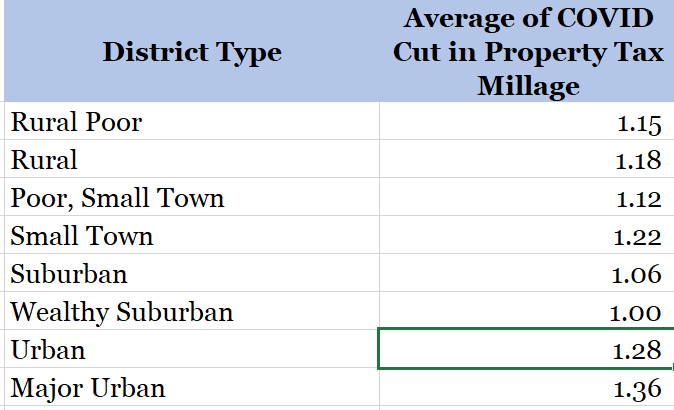


Rocky River's seemingly massive 55.2% cut? In actuality, they would have to raise a 0.88-mill levy to cover that loss. Meanwhile, even though Trimble Local in tiny Noble County only gets cut by 0.7%, -- the state's smallest percentage cut -- they would need a 1.55-mill levy to cover the cost. That's nearly double the levy needed to cover state costs from a community with a 40% lower median income than Rocky River.

Younsgtown would have to come up with nearly 2 mills of local levy money to cover their 0.8% cut. Lorain needs 1.55 mills to cover its 1% cut.

You get the idea.

Any Education Cut Hurts Vulnerable Kids Most. Period. Thats' Why We Need Federal Stimulus. Now!

So while DeWine did an admirable job trying to deflect a large chunk of these cuts onto the districts that could shoulder them best, because there simply isn't enough money being sent to the state's wealthier districts, the seemingly palty percentage of state funding cuts in Ohio's most vulnerable communities are still disproportionately burdensome to them.

It's simply a function of local ability to raise revenue to replace the state money.

This is why we need a real state formula and investment in education funding -- a task that seemed so possible pre-COVID and now seems like a pipe dream.

The other issue is timing.

These cuts, assuming they go through shortly, would be deducted from payments the state will be making to districts in May and June. There are 4 payments made in these two months, with one scheduled to be made tomorrow.

So over 3 payments, districts will have to absorb all the cuts.

While it's tough to do a district-by-district anylsis of this impact quickly, overall, the bi-monthly state payment to districts is about $336 million. So this cut will mean that instead of three bi-monthly payments at the end of this school year, districts will essentially only get two.

That could mean serious logistical problems for districts, which may have already made purchases or paid salaries that the payments were expected to cover. Now that they won't, what will happen?

This will be a quite concerning offshoot of these cuts.

And again these cuts are only for this school year. Next school year, expect more. And next biennial budget expect even more.

Unless the feds step in and free up CARES Act money and pass additional stimulus money. And the state taps its significant rainy day fund.

Until then, look out. Take cover. And pray.


Monday, March 18, 2019

DeWine Higher Ed Budget: Where there's hope ...

As we move forward with what could be the most consequential Ohio biennial budget for higher education in a generation, I want everyone to keep in mind the graphic on the left, courtesy of the Education Trust. What it shows is quite simple: It is twice as expensive for Ohioans to attend college in Ohio than it is for Californians to attend college in California (Ohio is the yellow bar; California is the smallest bar on the right).

That's right. Even with California's cost of living being through the roof, it is still half the relative cost of attending college in Ohio.

Why do I bring this up? Because this budget has the potential to make a serious dent in our status at the 8th most expensive place to attend college in the United States. Gov. Mike DeWine and his Lt. Gov. Jon Husted have put a lot on their efforts to get more Ohioans with degrees and high-quality credentials.

But if their budget is any indication, there is still work to do for Higher Education Subcommittee Chairman Rick Carfagna. I'll go through some highlights.

Micro Degrees

Both DeWine and Husted touted their efforts to allow Ohioans to accumulate certificates in as little time as a few weeks (their words), calling these "microdegrees." It's a trendy new movement in education -- quickly attainable certificates that show employers you can do the job you're being considered for. See, here's the problem. What happens when the job leaves, or if the student doesn't end up liking the job? Do those with a microdegree in, say artificial intelligence now have to go for one in data science? How many of these microdegrees will students have to attain in order to succeed in a work environment where they may change jobs 15-20 times?

As I've always said, it's more efficient and effective to educate someone once than train them 20 times.

I'm not saying microdegrees won't be a key component in a state's higher education portfolio. But when investing in them is a state's big play in higher education, I'm not so sure.

Ohio College Copportunity Grants and State Share of Instruction

This is where Ohio could make the biggest dent in the cost issues outlined above. Currently, OCOG provides a pittance, relative to the cost of college --  the result, frankly, of the state cutting the program during the recession and not returning it to its pre-recession level.

But its greatest shortcoming isn't necessarily in the amount of money it provides students; it's how many students can receive these state-level Pell-like Grants. First of all, the expected family contribution limit is $2,190. The EFC for Pell recipients is more than double that. So simply increasing OCOG eligibility to that of Pell would increase the number of OCOG recipients by about 35,000 students.

Also, OCOG has so many limits on it that students end up receiving far less than they should, if any at all. Because it's a Pell-first program, all of a student's Pell award is counted against their OCOG award. And it's all based on tuition. So if a student's Pell award is big enough to cover tuition, their OCOG could be zero. In addition, because of this rule, no student at an Ohio community college or technical school qualifies for OCOG, even though students attending community colleges are the most economically challenged in the state. Finally, OCOG students can only spend the money on tuition and books. However, GI Bill recipients can spent their OCOG awards on more life costs. So there's already a recognition that OCOG could help balance a student's many life costs.

DeWine's budget increases the amount of an OCOG grant by $500 at a cost of about $60 million. But it appears there is no change in who qualifies or what it can be spent on. Instead of spending $50-60 million more on OCOG to give a limited number of students a few hundred dollars more, the state should instead use that additional revenue to bring more students into OCOG. Allow them to get their money, regardless of Pell. Let community college students qualify. And let OCOG be spent on more than just tuition and books.

As for SSI, this is the main source of revenue for Ohio's colleges and universities. DeWine boosts the amount by 1 percent a year in each year of the biennium, which is far short of inflation. Then he tells schools they have to freeze tuition for all incoming students as they progress through the school. So if you pay $10,000 your freshman year, that's what you pay for all four years. Here's the issue: most Ohio colleges and universities already do this, only under this budget they can't make up for these tuition guarantees with additional tuition or fee adjustments, forcing colleges and universities to cut costs somewhere.

Beefing up SSI and OCOG are the two best ways for Ohio leaders to see that yellow bar above slide to the right. As of right now, I fear this budget won't budge that line too much.

STEM Investment

The DeWine budget boosts the Choose Ohio First STEM scholarship from $16 million to $40 million. This is a program to try to get more Ohio students to choose STEM disciplines and only pays for freshman year. My understanding is even at $16 million, Ohio struggles to find enough students for the program. I'm still waiting to see the plans to engage more students for the more than doubling of the program.

Also, DeWine's budget flat funds medical education investment and gives a middling 1 percent increase to Nurse education grant programs. Again, nursing is perhaps the most in-demand STEM discipline in our state's largest employment sector -- health care. It makes sense to invest heavily in this profession.

Over the next few days and weeks, we'll hear testimony about ways to make post-secondary options more accessible and affordable for more Ohioans. I look forward to working with everyone to improve on these efforts. Because our students and economy are counting on us to get this right.

DeWine K-12 Budget: Holding Pattern for the Real One.

While Gov. Mike DeWine's budget was rolled out Friday, the K-12 stuff wasn't nearly as exciting as some other areas of the budget. That's because the heavy lifting on K-12 funding will be done next week by state Reps. Cupp and Patterson in what's the most highly anticipated school funding reform plan since mine in 2009.

But that doesn't mean there wasn't interesting stuff in DeWine's budget. I'll go through a few of them.

$300 million a year more for wraparound services

This is a good effort to try to bring more mental health and other services to poor students, though as I've written, it didn't help that DeWine misled the public by calling this a $550 million increase. Every district would get at least $25,000, even if the district has only a handful of poor students. And the funding could get as high as about $250 a student, which could make a difference. However, given Cupp and Patterson's work, my concern would be if this is a substitute for more funding for schools overall. Kind of like this: "there's not enough money to do a school funding overhaul, so let's try a couple programs for poor kids instead." Our students deserve the investment the state simply hasn't made for 30 years. And every kid deserves that commitment. Yesterday.

$30 million for high performing charter schools

Again, this may be a worthwhile effort. However, DeWine will be taking this out of the state's lottery fund, forcing cuts in lottery money headed to school districts. At the end of this two-year budget, nearly $50 million will be headed to charters from the state's lottery fund, which was supposed to go strictly to school districts. Again, we need to be creating a charter school market that rewards success. But taking it out of funds voters created for school districts seems counterproductive.

Another big increase for vouchers

DeWine is continuing the misguided increases to the EdChoice, income-based voucher. EdChoice has actually been shown to harm student achievement. Why he would continue to pour about $24 million or so into this program that has hurt the kids who take the vouchers makes no sense to me.

Early childhood education funding flat funded

I was shocked with this, actually. Ohio's struggles with early childhood education, given how even conservative states like Oklahoma have created Universal Pre-K has been stunning, actually. There has been talk of doing a ballot initiative or designating new money for early childhood education initiatives. So I hope DeWine is just waiting for those options to shake out. If not, this is truly disappointing.

Significantly more charter school oversight

DeWine increased the budget for ODE's charter oversight office from $2.5 million to $7 million. That's good. Still not enough to oversee an $889 million a year program. But better. It also seems to fly in the face of the "House Bill 2 has fixed everything so give us more money" mantra coming recently from charter school proponents. If HB 2 fixed everything, why do we need to nearly triple the sector's oversight?

Overall, this is what I'm calling the "meh" budget. Yes, there are some small benefits. And a few districts may see significant increases to address the challenges of their most needy students. But overall, it's not enough money to overcome the needs of poor students in every district. Meanwhile, charters more than double their money from lottery funds, vouchers research has shown will hurt student achievement continue their march toward $1 billion a year and early childhood education is ignored.

So. Yeah.

Sunday, March 17, 2019

DeWine Misleads on Commitment to Poor Kids. It's Not Unusual.

This is why the public doesn't trust politicians.

During Gov. Mike DeWine's news conference about his biennial budget (up almost $20 billion from the budget I worked on in 2009), he made a big deal about providing $550 million for poverty fighting measures in his K-12 school plan. And he claimed it was new money.

I was skeptical when I heard this because it's never new money. But I digress.

Anyway, when I added up the total increase, it only reached $300 million additional in the second year of the budget. Where did this $550 million come from?

An old state budget trick.

See, in the 2019-2020 school year, DeWine provides $250 million more for poverty based aid in the form of wraparound and other services. So that's $250 million more. Then in the 2020-2021 school year, he adds in another $50 million. So at the end of the day, districts will have an additional $300 million two years form now to spend on these wraparound services.

However, because $250 million more was spent in 2019-2020 and $300 million was spent in 2020-2021, DeWine added those together to get his $550 million figure.

But when he made the claim, it sure seemed like he meant that in 2020-2021, districts would have an additional $550 million to serve poor kids.

Instead, it was $300 million, which Columbus Dispatch reporter Jim Siegel explained in a tweet during Friday's budget frenzy (after I pointed this discrepancy out on Twitter myself):
"Upon further review...Gov. DeWine's budget provides $300M more for schools over two years. We feel that is a more accurate number than the $550M figure. (It's a $250M increase in from 2019 to 2020, and then $50M more from 2020 to 2021.)"
This is a very misleading tactic Governors and Legislatures of both parties have used for years and it drives school district treasurers and superintendents nuts. Because they think that they're getting $550 million more by the second year of the budget, but it's only $300 million. So then they have to explain to their parents why they didn't get quite the windfall the Governor proclaimed, so those programs that could have helped their kids won't be able to happen.

I don't understand why state officials do this stuff. I really don't. It's not like $300 million is insignificant. Why fib on the $550 million claim? One would think that given Mr. DeWine's substantial government experience, he could have pushed back on his staff's claims here.

Oh well.

Thursday, September 6, 2018

DeWine-Husted Education Plan: We'll Fix our Failures. Trust Us.

Mike DeWine and Jon Husted have had a heavy hand in determining the Ohio's current state of public education policy.

DeWine was on the conference committee that determined what the final version of the No Child Left Behind Act would look like in 2001. That law ended up creating the high-stakes testing structure we have in place and has received a lot of recent pushback from nearly everyone in the education community as incentivizing test taking over critical thinking.

Likewise, in 2001, then state Rep. Jon Husted served as the Vice Chairman of the Primary and Secondary Education Subcommittee on the House Finance and Appropriations Committee -- the most important committee of any sort at that time. In 2003, he became chairman of that subcommittee -- a position I would hold 6 years later.

When Husted was Vice Chair, the P&S subcommittee was the most important committee of any type in the legislature because it was the committee handling school funding. At the time, the Ohio Supreme Court had ruled twice that the way the state funded schools was unconstitutional because it didn't equitably or adequately provide a thorough and efficient education for our children. After Husted's attempts to fix the system during the 2001 biennial budget, the Court ruled not one, but two more times that the way Husted's system provided funding for students was unconstitutional.

So it was kind of surprising to me to read DeWine and Husted's education plan, which was just released today as part of their gubernatorial campaign. In it, DeWine and Husted said they want to reduce testing and find an equitable funding system.

Here's what it said about testing: "Standardized tests are limiting educator’s creativity and forcing them to a teach to a test."

Here's what it said about Ohio's school funding system: They "will create a more equitable funding system that directs state resources toward supportive services for children most in need."

So, the architects of the nation's high-stakes testing regime and Ohio's unconstitutional funding systems want to fix their previous failures.

I swear.

That's what they're saying.

Not only that, but there is almost zero detail about how they plan on doing this. On the testing, the Ohio Department of Education and State Board of Education have presented a promising change in Ohio's report card system that would de-emphasize testing. Are DeWine and Husted saying they want to do that? Will they get rid of certain tests? Will they eliminate the test-dependent accountability system?

Who knows?

On funding, it looks like they will be putting more money into support services for economically disadvantaged students. But will that be additional revenue? Or will it be taking money from somewhere else to fulfill that obligation? Will this be additional money for wraparound services? Or will it mean more teachers and smaller classes? Will it mean a dedicated element of the school funding formula dedicated to psychologists or other support staff?

Again, who knows?

But I find it awfully interesting that one of the key architects of the law that created our high-stakes testing system now wants to de-emphasize tests (as opponents of NCLB have said for years). And the architect of our unconstitutional funding system now wants more equity in the funding system (using the same language I and others have used for years).

I'm glad that these two men are now acknowledging that the last 17 years in which they have led Ohio and America down their education policy paths has essentially failed. But it sure seems like they're saying, "I know we tried this before and screwed it up, but trust us, we won't screw it up again."

Fool me once...