Wednesday, June 24, 2020

What If Ohio Re-Focused on Education away from Prisons?


I know I haven't done much on the historic protests around the country. But I wanted to kind of put in Ohio budget terms what their goals about de-emphasizing law enforcement spending could mean for our communities.

So I dug into some spreadsheets.

The Ohio Legislative Service Commission (one of Ohio's finest bureaucratic institutions) puts out a spreadsheet every year tracing Ohio revenue and spending since the 1974-1975 fiscal year. So it's possible to trace the historic legislative appropriations patterns for the last 35 years.

What's amazing to discover is that while Ohio's commitment to K-12 and (especially) higher education has dropped since 1975, the percentage of the state budget going to corrections has skyrocketed from 5 percent in 1975 to nearly 15 percent of the non-human services budget in 2021.

I am excluding human services because spending there has exploded due to changing Medicaid rules and state spending requirements over the last 35 years.

And while K-12 has dropped by about 3 percentage points, most of the transfer in priority to corrections has come from the state's higher education budget, which has dropped in state commitment by 25 percent. These are the two areas of the state budget that can actually prevent incarcerations.

The state has decided to triple the commitment to its prisons and drop the value it places on preventing people from going to prison by more than 10 percent.

What does this mean?

Very simply, it means that we have more prisoners. Which shouldn't shock anyone.

What if we changed the focus, though, and spent the same relative amount on education and prisons as we did 35 years ago?

The results are stunning.


That's right. Another $875 million for higher education and $518.4 million for K-12. 

What could that buy?

Let's look at higher education first.

An additional $875 million would:
  • Cover every student's tuition at every community and technical college in the state, plus every student's tuition at Central State and Shawnee State
  • Cover every student's tuition at Ohio State University and Cleveland State University
  • Allow for a flat, 29 percent tuition cut at every 4-year public university in the State of Ohio
Now K-12.

An additional $518.4 million would:
  • Allow school districts to cut property taxes on the typical Ohio home by more than $100 a year, on average
  •  Nearly pay for all the social-emotional, security and community liaisons called for in the Cupp-Patterson school funding model currently sitting in the House Finance and Approrpriations Committee
  • Pay for every teacher in Akron, Canton, Cincinnati, Cleveland and Columbus under the Cupp Patterson model
You get the idea. It would get us a lot. Without a single additional tax increase or new revenue stream. With simply the same budget priorities we had 35 years ago. 

Re-focusing away from incarcertaion and back on education, as we did 35 years ago, would provide tremendous benefits for our kids and communities. 

This is exactly what the protestors are asking us to do -- stop investing so much in law enforcement and instead invest in what we know reduces the need for law enforcement.

They have a point.

Re-emphasizing education as a funding priority would grant more folks greater opportunities at the American Dream, regardless of where they come from. That's what we should all get behind.

Wednesday, June 17, 2020

Private School Enrollment Drops 14 percent since 2008. Why has their funding jumped 135 percent?


If you ever wondered what power looks like, I give you Ohio's private school lobby. Why do I say that?

Because on what other planet, in what other universe, in what other industry would increasing investment by 135 percent over 11 years in a service that lost 14 percent of their customers over the same time be tolerated?

Because that's exactly what's happened here in Ohio with your money.

Here's the data: In October 2008, the Ohio Department of Education counted about 171,319 students in Ohio's non-public schools. Meanwhile, in October 2019, ODE reported 146,054.

That's a 14.7 percent enrollment drop.

Meanwhile, in the 2008-2009 school year, Ohio taxpayers sent $291,530,743 to private schools through busing, administrative cost reimbursements, auxiliary services and vouchers (SEE note below on what these are). This year, that number will balloon to $685,853,844.

Graphically speaking, here's what that increase looks like vs. the commensurate enrollment drop.

Crazy, right?

'Well, that's all driven by voucher funding, Steve. The funding for non-vouchers is actually pretty in-line with enrollment," you might say.

And you would be wrong.

Yes, the busing, administrative cost reimbursment and auxiliary services lines haven't exploded the way vouchers have (from $58 million in the 2008-2009 school year to more than $420 million today), but the increase is still significantly greater than what private school enrollment would seem to dictate.

That increase to serve fewer kids seems to not make much sense.

"Yeah, but what about public school kids, Steve. We've seen an increase in funding to public school kids since then too and their enrollment hasn't increased," you might say.

And you would be incredibly incorrect.

First of all, the Ohio Constitution requires the state to fund a publicly accountable education system -- a system that was found to be inadequately funded by the Ohio Supreme Court four different times. 

Nothing in the Ohio Constitution requires the state to provide a plug nickel to the state's private schools, which are not audited or held to nearly the same accountability standards as public schools.

But even ignoring that, in October 2008, there were 1,679,369 students enrolled in Ohio's public schools. In October 2019, there were 1,659,251. So there was an enrollment drop of 1.2 percent, which considering how many more students take vouchers and attend charters today than 2008, is kind of impressive.

And given that, funding for those students has basically kept pace with inflation. Meanwhile, public funding of Ohio's private schools has way outstripped inflation, even though enrollment has dropped in those schools by more than 12 times.

What has this meant on a per pupil basis?

In the 2008-2009 school year, Ohio taxpayers sent the equivalent of $1,702 per private school student to private schools. This school year, that number will be $4,696 -- or about $600 more than the state sends every kid in Cincinnati, Columbus, Northern Local in Perry County (the school funding lawsuit district), the average small town Ohio school district, and 46 percent of all Ohio school districts.

It's true. Not every private school student benefits from all this money.

Which is kind of worse.

It means that private school students who do get public funding receive substantially more than even the numbers I'm quoting here. And I remind you that the overwhelming majority of the schools receiving this money are religiously affiliated.

Not to open up that can of worms.

So how can the state justify a more than doubling of the investment in Ohio's private schools when enrollment in these schools is significantly falling?

Call your legislator. Ask them. See what they say. And as much as I bristle at referring to education in business terms, I would like to use the pro-privatizer language here to make a point: See how they justify taking your money and putting it into a business that's hemhorraging customers, especially in a business where we can't even find out how that money is being spent.

I'll be waiting for their responses.

Eagerly.

Note: Ohio Department of Education enrollment data is not an exact science. If the headcount is above zero and below 10, the department reports "<10". So the exact enrollment count can't be easily discerned. What I did was take the median figure of 5 for every "<10" in the enrollment count sheet. But, like the U.S. Census, the actual enrollment count is a fairly narrow range of about 10,000 or so students. I used the same methodology for each year I examined. Also, transportation funding spreadsheets at ODE did not go back to the 2008-2009 school year, so I used the earliest one I could find for the 2011-2012 school year. Administrative cost reimbursements and auxiliary services have been Ohio budget line items for years. Administrative cost reimbursement is described by ODE as "the actual mandated service administrative and clerical costs incurred by such school during the preceding school year". Auxiliary services are costs for physicians, psychologists, and other additional services that are borne by the private school and taxpayers subsidize.

Wednesday, June 10, 2020

Ohio Gets National Credit for Fair School Cuts. But is it Warrented?

I can't tell you how many calls I've gotten from national news outlets about Ohio's school cuts. Especially about how "fair" they have been compared with the generally flat cuts other states have done. And while I have contended that Ohio at least tried to be fair, school districts with the most needy kids still get hurt the most.

All while protecting Charter Schools and vouchers, but that's another blog for another day.
 
Compounding the issue is the fact these cuts have come over the final three state payments to school districts from this year. So that's about $100 million off each payment for each of the final three payment periods.

That's a roughly 30 percent loss during the last three bi-monthly payments. Prior to the cuts, districts typically got about $336 million in their bi-monthly payments. Now it's about $236 million.

So that means districts have had to deal with essentially a 30 percent drop in their expected state aid during the height of the pandemic. That's bad for all districts and kids.

But if you want to see why the cuts still disproportionately harm kids in Ohio's neediest communities, look at the districts that lose the most money relative to their ability to offset those cuts using local revenue. A district-by-district spreadsheet of these cuts exists here. 

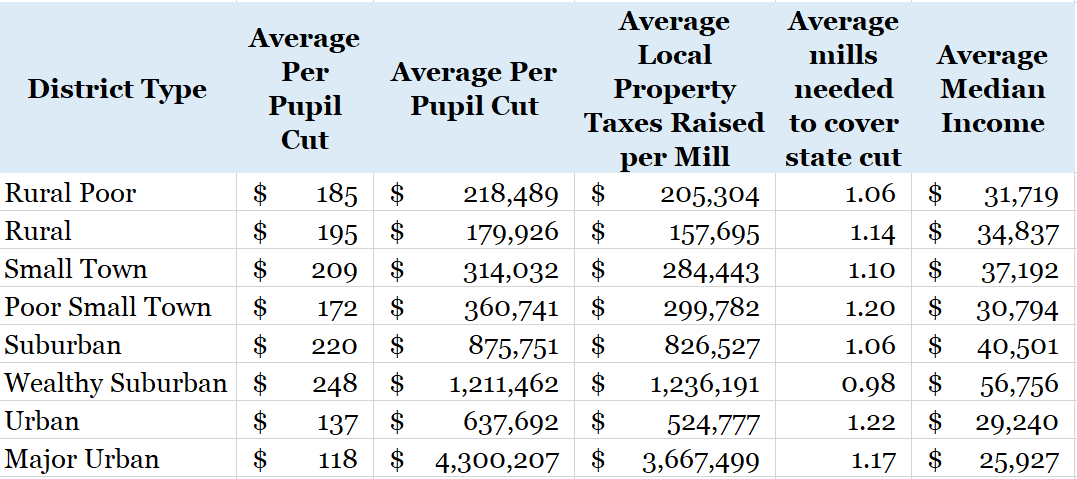
As you can see from the chart I've put together, the average wealthy suburban district loses more per pupil funding and almost double the total funding of the average urban district. Seems fair, right?


Yet in order to cover that loss, the urban district has to come up with almost 25 percent more local funding than the wealthy district. And they have to come up with that money by asking folks who barely make half as much money.

Same goes for major urban districts -- Akron, Canton Columbus, Cleveland, Cincinnati, Dayton, Toledo, and Youngstown. Even though folks living there make substantially less than half of what folks living in wealthy suburban districts earn, they have to tax themselves at about a 20 percent higher rate than the wealthy communities do to cover the state losses. 

Which community do you think has a better shot at recovering their lost state revenue with local revenue? That's a rhetorical question.

Is this outcome better than it could have been? 

Absolutely. 

The governor's office should be commended for doing what they could to try to make this distribution as fair as possible. But I think what this demonstrably proves is that there simply isn't enough money in wealthy districts to offset the disproportionate pain felt by our state's poorer communities when cuts come. And with more cuts expected for this coming school year, not to mention next year's biennial budget, the urgency of federal intervention to protect kids in our most vulnerable communities because clear and obvious.

In our poorest rural, small town and urban districts, folks who make substantially less money than folks in our wealthiest districts have to come up with substantially more local revenue to offset any state cuts -- regardless of state efforts to soften the blow.

This is why we need a school funding formula that makes sense and relies less on local revenue to fund schools. This is why the Ohio Supreme Court was absolutely correct when it ruled four times that the way Ohio funds schools is unconstitutional.

And, unfortunately, this is exactly why the system remains so 18 years after the final court ruling.

But on the immediate, COVID-emergency horizon, it speaks to the absolute necessity of federal funding to help alleviate this pain that will be felt in our most needy communities. 

Congress -- specifically the Senate -- must act. 

Now.

Tuesday, June 2, 2020

Confronting EdChoice: A Chance for Public Education to Protect their Kids

You know I don't typically toot my own horn on this blog. I like to do my analysis, make my point (or points) and move on.

However, there is a crisis facing public education in Ohio. And that crisis is the EdChoice Voucher program. This is a program that when I left the legislature in 2010 cost taxpayers $60 million. It is now about $150 million, and it's only growing.


Unlike Charter Schools, when taxpayer money is used by private schools to subsidize their tuitions, the state doesn't audit how the money is spent.

But even worse than that, it hurts kids who don't take the voucher -- kids who tend to be less well off, less white and with more special needs.

Every kid in 3 of 4 Ohio school districts receive less state and local revenue because of this and other voucher programs. 

This is not just an issue for large, urban school districts. Only 1 poor, rural or small town district lost any money to EdChoice vouchers in 2010. It's now throughout our rural communities and the money has jumped from $10,400 in 2010 to more than $850,000 today. 

As districts face huge budget cuts in the coming school years, it behooves them to defend every dollar they can so their students have all they need to succeed. That's why the folks at Real Choice Ohio, which fought for years to help districts cope with charter school losses to great success, have started a series of workshops to help districts educate and inform parents nd their communities about the dangers of the EdChoice vouchers to their kids and other kids' futures.

The first pillar of these conferences deals with the overall problem facing districts and the kids theiy serve. I am helping to lead this pillar, complete with Power Point presentations and I will be moderating an all-star panel on the EdChoice and voucher problem next week.

Signing up is easy and cheap -- $100 for all 4 pillars, which covers 5 participants. I would urge any school district officials, teachers and parents who are concerned with the threat these voucher pose to public education to sign up and join us.

We must push back. Together. I look forward to working with all of you.


Wednesday, May 27, 2020

Vouchers Especially Hurt Poor Kids

As has been recently reported in the Columbus Dispatch and other places, a group of public education advocates is looking to sue the state over the EdChoice voucher system -- an argument I've been making for years.

But in the article, pro-voucher forces make a curious argument -- that those seeking to undo the harm voucher do to primarily poor and special need kids are actually trying to hurt those kids.

“It’s an all-time low for government school activists to try to rip low-income and special-needs students out of their schools right now,” said Aaron Baer, president of Citizens for Community Values. 

“It’s clear that this special-interest group cares less about what’s best for kids, and more about their own narrow social agenda. Ohio’s EdChoice program is a lifeline to tens of thousands of families. It allows underprivileged and underserved children the opportunity to find an education that best meets their needs.”
First of all, it's not "government school"; it's "public school", which means our school. None other than Thomas Jefferson described it this way in the Land Ordiannce of 1785. "Public school" were Jefferson's words.

But I digress.

Here's the problem. Yes. It's true that poor and special needs students get vouchers and attend private schools using them. However, in order for that to happen, poor and special needs students in the public schools who don't take the voucher are left with fewer resources for their educations because the vouchers exist.

This is why, for example, as a state legislator I always voted against the special needs voucher that eventually became the Jon Peterson Voucher program. Because it set aside 1/3 of the money the state spent on special needs students to serve 3 percent of the special needs kids. So the voucher program would leave 97 percent of special needs students with only 2/3 of the money they needed.

Let's look at Parma with its 47% economically disadvanatged and nearly 2/3 minority populations.

Prior to losing voucher money and students, kids in Parma were slated to receive $13,663 per pupil in state and local funding for their educations. However, once all the vouchers were removed from the district, along with the students, kids in Parma only got $13,426. That's a $236 per pupil loss in total aid, which means there wasn't enough locally raised revenue to make up for the revenue these kids lost to the state's voucher programs.

So while some poor and special needs students certainly got vouchers, far more poor and special needs students in Parma got $236 less than they needed because of the vouchers.

In fact, in nearly 3 of 4 Ohio school districts, every poor and special needs student got less overall funding because of the voucher.

But what about those 1in 4 districts that saw greater per pupil revenue because of vouchers, you may ask? Well in those districts, the reliance on local property taxes increased as much as 10 percent, forcing those districts to tax themselves at higher rates to make up for the lost state evenue brought on by vouchers (all districts had to do this to some degree).

So in these districts (which also tend to be poorer), the need to go for levies increased at a substantially higher rate. Need I remind everyone that the Ohio Supreme Court has ruled four times that increasing reliance on local property taxes to pay for schools is unconstitutional?

I know I don't have to remind the folks who want to file this litigation because they're the same ones that won that major victory for kids in the late 1990s and 2000s.

So vouchers either directly harm poor and special needs students by cutting their overall education fudning, or force poorer communities to tax themselves at higher rates to make up for the loss of state aid from the state's voucher programs -- in clear violation of the Ohio Supreme Court's four rulings.

Oh yeah, and in 8 of 10 Ohio school districts where private voucher providers reside, the school district outperforms the private option by an average of 27 percentage points. When privates outperform districts, it's in 2 of 10 cases and by only 9 percentage points.

So not even the claim that these are better overall options for kids is true. But at leats those pushing for vouchers are willing to make sure that more than a million students in Ohio's public schools get fewer resources than they need. 

Tuesday, May 19, 2020

For-Profit Colleges Chew Up Ohio CARES Act Higher Ed Money


While much of the focus on the $2.3 trillion CARES Act has been on the K-12 funding provided in it, the $13.5 billion in higher ed money was also a large inevstment. However, according to data compiled by the University of Wisconsin, in Ohio, students in for-profit colleges have received more than double the amount of per student funding than students in Ohio's public and private, non-profit colleges and universities.

This is not the outcome that was needed.

Here is the average per student CARES Act funding by college type:


What's also interesting is private, non-profit colleges received more CARES Act, taxpayer funding than Ohio's public universities.

In fact, there is only 1 four-year public university of 14 (Central State) and 8 2-year public colleges (of 69) that received more CARES Act per student funding than the average for-profit college.

How for-profit colleges and private, non-profit colleges receive more per student CARES Act funding than public colleges and universities is shocking. One would think that public stimulus funding should benefit publicly funded institutions more than the non-taxpayer funded institutions.

But what do I know.

Thursday, May 7, 2020

State Hides the Ball on K-12 COVID Cuts

This is why I think people are driven nuts by government.

A couple days ago, Gov. Mike DeWine announced a $300 million cut would be coming in this school year for Ohio's K-12 school districts due to the COVID crisis. Very understandable. Absent the feds granting states flexibility on CARES Act stimulus money and doing another COVID rescue package for education, states and local governments, big cuts like what DeWine announced are expected.

We'll leave the debate over the state's $2.3 billion rainy day fund for another day.

But when DeWine's Office of Budget and Management (OBM) listed the district-by-district cuts ("runs" is what we call it in the biz), the percentage cuts didn't look all that bad. Between 1% and 2.8%. Given that $300 million is about 4% of the state aid handed out this last school year, that didn't jibe to me.

That's when I noticed that OBM was comparing the amount of money cut to all money being spent in a school district. That's all money spent. State, local and federal. So, yeah, it looks like the cut isn't that bad when you look at it that way.

But it's completely misleading. Why? Because the state has zero say in how much federal and local money is spent or raised in a district. So the state is taking credit for money it didn't send to or raise in the district.

I can honestly say I've never seen a district-by-district run expressed this way. Every other run I've seen has compared how much state money districts were receiving and how much they will be receiving now.

In fact, it's how DeWine put out his district-by-district runs last year during the budget. He compared his state funding increase (from wraparound services money) with the state funding schools received the prior year. That makes the percentage increase look bigger. If he compared it with a district's overall spend, the increase would have seemed smaller.

It's a budgetary parlor trick.

On the Surface, these Cuts Look Fair

So what's the real state cut, in terms that have always been used?

The average Ohio school district will get cut 5.9%, with some getting cut 55%. Half of districts will get cut more than 3.8%. Half get cut less.

But there is a silver lining to this. The largest percentage cuts are disproporitionately in wealthier, suburban communities. The smallest percentage cuts are in poorer communities less able to withstand them. So that 55% cut? It's in Rocky River in Cuyahoga County, which doesn't get much state funding anyway because it's so wealthy. Other major percentage cuts are in Upper Arlington (53.6%), Independence (51.4%) and Inidian Hill (47.9%). All tolled, suburban and wealthy suburban districts will absorb 41 percent of all the costs, even though they only make up about 17.7% of the state's foundation funding.

In Ohio's major urban districts (Akron, Canton, Cincinnati, Cleveland, Columbus, Dayton, Toledo, Youngstown), the typical cut will be 1.8%. The poorest, rural districts will get an average 3.1% cut.

So while those cuts in Ohio's most vulnerable communities will be less, they will still be meaningful. There just isn't enough money being sent to the wealthiest schools to Robin Hood the cuts for very long.

But Ohio's Most Vulnerable Districts Still Get Disproportionately Hurt

While the percentage cut in Ohio's most vulnerable communities is less than its wealthiest ones, because there just isn't enough money being sent to the the wealthiest districts to absorb all the cuts, the relative amount being cut in Ohio's most vulnerable communities is actually higher.

Let me explain.

The way education funding works in Ohio is the state figures out how much it should cost to educate kids in your district, then determines how much of that cost you should be able to pick up based on your property tax values. The state then picks up the rest. And while there are serious problems with the way Ohio does this because the state formula for determining the cost isn't an actual formula, that's the calculus.

The issue though is everything hinges on the ability to raise local money through property tax levies. Districts that raise more ("wealthier"), have less state money coming to them. Those that raise less ("poorer"), have more state money coming. (And there are districts that aren't "wealthy" that are classified as such, like Coventry and Danbury, but that's another topic for another post).

The problem with this system is when state cuts come to districts, poorer districts' budgets are far more sensitive to state funding losses because they raise so much less locally. So a relatively modest cut in a poor, rural Ohio district could mean that district now has to go out for a larger levy (which won't likely pass) or cut services. Meanwhile, even a larger cut in a wealthier district won't have the same impact because they could raise even a tiny additional levy amount to cover it.

So even though 40.9% of all the money being cut is coming out of wealthier districts, the relative cut is worse in Ohio's poorer communities.

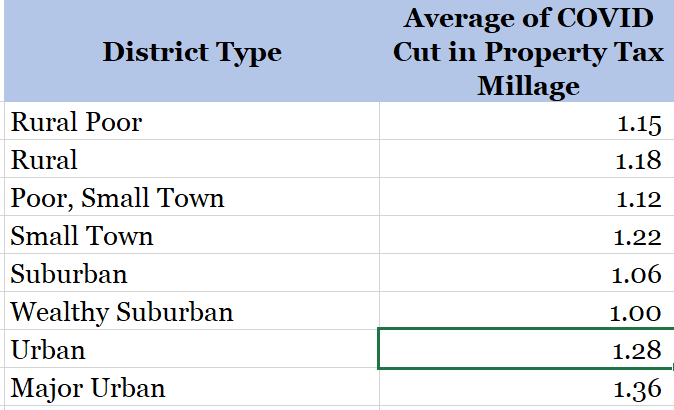
For example, on average, Ohio's poor, rural districts would have to raise 15% more local money to make up for their cut than the average welathy, suburban district. Likewise, the average major urban district would have to raise a 36% larger levy to replace its lost state revenue than the wealthy, suburban district.


Rocky River's seemingly massive 55.2% cut? In actuality, they would have to raise a 0.88-mill levy to cover that loss. Meanwhile, even though Trimble Local in tiny Noble County only gets cut by 0.7%, -- the state's smallest percentage cut -- they would need a 1.55-mill levy to cover the cost. That's nearly double the levy needed to cover state costs from a community with a 40% lower median income than Rocky River.

Younsgtown would have to come up with nearly 2 mills of local levy money to cover their 0.8% cut. Lorain needs 1.55 mills to cover its 1% cut.

You get the idea.

Any Education Cut Hurts Vulnerable Kids Most. Period. Thats' Why We Need Federal Stimulus. Now!

So while DeWine did an admirable job trying to deflect a large chunk of these cuts onto the districts that could shoulder them best, because there simply isn't enough money being sent to the state's wealthier districts, the seemingly palty percentage of state funding cuts in Ohio's most vulnerable communities are still disproportionately burdensome to them.

It's simply a function of local ability to raise revenue to replace the state money.

This is why we need a real state formula and investment in education funding -- a task that seemed so possible pre-COVID and now seems like a pipe dream.

The other issue is timing.

These cuts, assuming they go through shortly, would be deducted from payments the state will be making to districts in May and June. There are 4 payments made in these two months, with one scheduled to be made tomorrow.

So over 3 payments, districts will have to absorb all the cuts.

While it's tough to do a district-by-district anylsis of this impact quickly, overall, the bi-monthly state payment to districts is about $336 million. So this cut will mean that instead of three bi-monthly payments at the end of this school year, districts will essentially only get two.

That could mean serious logistical problems for districts, which may have already made purchases or paid salaries that the payments were expected to cover. Now that they won't, what will happen?

This will be a quite concerning offshoot of these cuts.

And again these cuts are only for this school year. Next school year, expect more. And next biennial budget expect even more.

Unless the feds step in and free up CARES Act money and pass additional stimulus money. And the state taps its significant rainy day fund.

Until then, look out. Take cover. And pray.