Showing posts with label Householder. Show all posts

Friday, December 20, 2019

Ohio House Speaker Wants Voucher Fix as Vouchers More than Double in his County.

House Speaker Larry Householder, who famously is from Perry County -- the home of the state's school funding lawsuit -- announced at his year-end press gaggle yesterday that fixing Ohio's exploding voucher crisis will be priority No. 1 next year.

"We have failed badly as far as our report card system and our testing system in this state," he said.

That's quite an admission. And commendable. However, it has also been true forever. 

Our system has always been rigged against poor districts because as we now know, the "achievement gap" is explained exclusively as a poverty issue -- and always will be as long as it is standardized tests that states use to measure educational effectiveness. 

This isn't anything earth shattering that requires sophisticated statistical analysis. It's just good horse sense. 

Look at the list of the lowest performing school districts on state tests in 2005 and look at them today. 

They are the same districts.

So why is Householder so concerned about this now? I have a theory that I think will hold up: Now that this rigged report card is affecting his districts, he's starting to realize their awful impact.

What happened is that pro school choice advocates, led by their champion, state Sen. Matt Huffman, R-Lima, reached waaay out over their skis, culminating in this year's budget disaster (which we were first to point at at Innovation Ohio, and I and we had been warning about for years).

So now, districts are losing $60 million more in state aid this November to EdChoice vouchers (vouchers originally meant to "rescue kids from failing schools") than they did last November.

And over the last two years, the number of school buildings -- even in high-performing school districts like Solon, Upper Arlington and Worthington -- has skyrocketed.

While the number of buildings has climbed dramatically from about 9 percent of all school district buildings to more than 1/3 of all buildings in two years, the number of districts that now have to worry about losing state funding to vouchers has simple gone off like the Big Bang.

So now there are 424 of Ohio's 613 school districts with at least one building qualifying for vouchers. 

Last year, there were 31! That's right. In two years, the number of districts losing funding to vouchers will jump by more than 13 times!

This explosion is extraordinary and in many places a crisis. Why? Because two years ago these districts and their kids lost zero state funding to private, mostly religious schools, Now they lose money -- in some cases significant money.

See, it's not just the kids in the "failing" buildings who lose the state money that's transferred to private, mostly religious schools. It's the kids in the high-performing buildings as well. 

Because the transfer comes out of the district's state funding pot, not the offending building's. So every kid in the district loses state funding because of the transfer, not just the kids in the low-performing building. The system punishes the highest-performing kids in the highest-performing buildings just as it does the lowest-performing kids in the lowest-performing buildings.

So now kids in 70 percent of Ohio's school districts are losing state funding to private, mostly religious and completely unaccountable schools.

Remember, even pro-voucher advocates admit that the EdChoice program actually harms student achievement.

If you look at the counties where the relative shift in funding from public to private schools has jumped the most, it's all rural counties -- including Householder's home county.
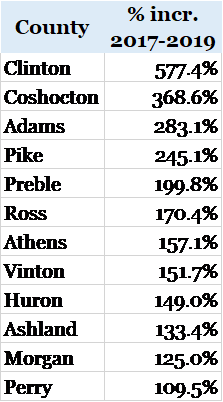
As you can see, Perry is one of 12 Ohio counties who have seen their state funding to vouchers more than double between November 2017 and November 2019. Ohio has 88 total counties. 

It is these rural counties, which can't offset much state revenue loss because they raise so little on property taxes, where EdChoice state funding transfers are just killing districts. This, I think, explains Householder's urgency. It's hurting his community. 

All politics is local indeed.

There are many ways of undoing this damage. Not allowing voucher buildings in districts that are high performing overall is one. As is requiring that buildings must be low performing on more than a single report card measure before being voucher eligible. That way kids in the district don't lose state funding because a handful of kids aren't being served in a single district building.

But Householder really nailed what the heart of the issue is: the Report Card and standardized tests. So if he effectively fixes the root problem, kudos.

And while I really don't like what's happened with the voucher explosion this year, if that's what it takes for the state to once and for all put a stake through the heart of the state's rigged, unfair, inaccurate standardized-test-based accountability system? 

Well, I'll take it. 

It's about time.

Thursday, November 21, 2019

Speaker's got a curveball. But is it a good one?

Well, that was unexpected.

During the debate on fixing Ohio's school funding system, much time has been spent poring over the Cupp-Patterson funding plan, now encapsulated in House Bill 305, which had its 6th hearing yesterday in the House Finance Committee.

And while much has also been made of how about 2/3 of the Ohio House has signed onto the bill, one conspicuously absent name is House Speaker Larry Householder, who lives in the same county where Ohio's school funding lawsuit originated.

We finally heard something from the Speaker yesterday and it threw people for a loop. He wants to potentially "redistribute" local revenue to help handle the $1.5 billion (or more) cost of fully funding the plan in HB 305.

While not a new idea (when I first ran for office in 2006, I suggested a statewide property tax to provide the local share of education's base cost), suggesting something like this out of the blue was a bit surprising.

This could be good or bad, depending on how this is done. I'll go through a few of the options and what each could mean for schools and kids.

1) The Brenner redistribution. Remember when now-state Sen. Andy Brenner suggested rolling everyone's local and state money into one pot, then redistributing it to every school, public, private and charter? Yeah, that led to big cuts in school districts and huge increases in charter schools. Couple that with his banning of additional local levies, and you can see why he had only one sponsor hearing on this bill. Householder is most likely not suggesting this.

2) Inside millage. This is something I've heard around for a couple years now. On all our tax bills, there is an automatic 10 mill charge that every property owner in Ohio pays, on top of the voted mills we pay. The inside millage is divided up among schools and local governments. He may be suggesting taking all of those mills and giving it to schools, or taking all the inside millage, sending it back to Columbus and redistributing it back out to school districts. This isn't an awesome idea because it would remove money from local governments (which have already been decimated by local government fund cuts) and agencies to fund schools. But it's much better than Brenner's disastrous plan. He could also be suggesting raising the inside millage to something like 15 or 20 mills and taking the millage above 10 to all go to schools. That would be better for local governments, but would likely be met with stiff resistance in his caucus.

3) Create a statewide property tax for basic education. This would be the best idea -- create a statewide property tax that the state would calculate to provide the local share of the cost of the new school funding plan. That way communities wouldn't (in theory at least) have to vote for more levies to pay for basic needs like books and teachers. Local levies would be used instead to pay for relative luxuries -- 8 years of French, orchestra programs, etc. This is kind of the Holy Grail for Ohio education funding. And it would eliminate the need to use endless levies to pay for education. But I'm not sure that Householder would want to create something like this that would require a constitutional amendment, which requires large numbers of votes in both legislative chambers.

4) Raiding local revenue. It would be a real world problem if his idea is to take a bunch of locally raised and voted on money, then redistribute it to other areas. It's not that the idea doesn't have merit; it's just that I live in the real world and I can't imagine the uproar if local property taxpayers are seeing their voted property taxes going across the state.

We don't know which, or combination of which idea(s) Householder is contemplating here. But he's undertaking a key attack on our unconstitutional funding system -- the overreliance on property taxes to pay for schools. There is no question as a Perry County Speaker, he gets the issue here. And I believe he wants to do the right thing to fix this mess.

If the plan he's talking about would say that the state now has a formula (under Cupp-Patterson) that accurately calculates student need, and it's going to base the local share of funding on a levy amount that doesn't have to be constantly voted on, then it's a good thing.

If he's raiding local revenue from some areas of the state and giving it to others, that creates a whole new set of challenges.

But they're not impossible to overcome. A plan like this is how Wyoming -- the state judged by Education Week as having the country's best, most adequate and equitable funding sytem in the country — pays for its school system. The state of Wyoming takes money from districts that raise more than they need locally and redistributes it to districts that don't raise that kind of revenue.

The problem with doing that in Ohio is we have a long history of keeping local revenue local. Asking our state to change its outlook on locally raised money will be quite a challenge.

So stay tuned...