Wednesday, March 11, 2020

My School My Choice Lies Again


Well, well, well. My School, My Choice – a dodgy outfit that seeks to protect profits over kids has released a candidate questionnaire filled with lies, mistruths and frankly disturbing answers from many candidates for office. I thought I should go through and show just how dishonest this questionnaire is and why we cannot let these guys return us to the days of national ridicule for our Charter School sector, which is still not awesome, but is certainly in better shape – at least in terms of accountability – than it was when these guys ran things.

Teachers union leaders often claim that public charter schools drain funds from traditional schools.
In fact, union leaders aren’t the only ones who “claim” this. Superintendents, treasurers, non-partisan analysts, Republican Education Committee Chairs and Speakers of the House have all acknowledged this fact. The other pesky thing that gets in the way of this talking point is arithmetic. Take Columbus City Schools. According to Ohio Department of Education finance reports, the state was to send $366.5 million to Columbus to educate its 72,714 students. That’s a per pupil state funding level of $5,089.28. However, when the state then removes $161 million to pay for the 19,958 students who attend charter schools from Columbus, the remaining Columbus students are left with $3,947.51 in state aid -- $1,141.77 less than the state originally intended to go to students in Columbus – money that has to be made up with local revenue or service cuts. And Columbus is not unusual. Statewide, the average per pupil state funding loss because of the charter school deduction is $198.06, which means that statewide, $314.3 million in local revenue has to be used to make up that lost revenue to children in local public schools or services get cut. In fact, there are between 80 to 100 school districts who lose overall funding because of charter schools because they don’t raise enough local revenue to make up for their state funding losses to charters.

In fact, traditional schools have more funding now than ever, while public charter schools continue to receive less funding.
The previously described phenomenon utterly shreds this canard. The average Columbus charter school student receives $8,067.28 in state funding. The average Columbus public school student receives $3,434.85 in state funding once all the charter/voucher/ESC/open enrollment deductions are included. It is precisely because charter school students receive so much more per pupil state aid than they would have received in the local public school that has led to the Cupp Patterson school funding plan to shift to a funding system that directly pays for charter school students rather than deducting the amount from kids in local public schools.

This is especially true since local tax dollars (those collected from local levies and property taxes) don’t follow public charter school students but instead stay with the traditional school district.
This isn’t even true anymore. In Cleveland, several charter schools actually do receive a share of local revenue, which voters approved many years ago. But even setting those school aside, about 1 in 10 charters spend more per equivalent pupil than school districts, even though they do not receive direct local money. More telling is this: The average charter school spends a mere $163.14 less per pupil than districts on instruction costs. However, the average charter school spends $897.12 more per pupil on non-instructional administrative costs than the average school district. Where do school districts spend more per pupil? Staff and pupil support as well as operations (busing/HVAC/etc.). But if charters would spend the same per pupil on administration that districts did, they would be able to spend more in the classroom than the average district and also spend about the same as districts on pupil and staff support. This whole argument is simply an admission that they need more money to make up for their lack of efficiency and inability to move as much money into the classroom as school districts do. The last part of this sentence also admits that charter school funding  increases the reliance on local property taxes to pay for schools – a result the Ohio Supreme Court ruled four times was unconstitutional.

There is no such thing as a for-profit charter school in Ohio as all of our charter schools are PUBLIC schools. ALL public schools (traditional brick and mortar district schools and community schools) are allowed to, and most do, use for-profit companies to provide services like textbooks, transportation, food, curriculum, and management services. Despite this, some traditional opponents of public charter schools have tried to run-around free market principles by not allowing certain services to be provided by “for-profit” companies. In other words, they think that only some companies/organizations should be allowed to provide only some services to only some public schools.
Charter schools are non profit, and while they’re called “public” in statute, federal labor panels that have examined Ohio charter schools have consistently ruled they are actually run like private organizations. However, many hire for-profit companies to run the schools. 
This is also a completely misleading statement and runs afoul of the Republican Speaker of the House Larry Householder’s own statement from last year where he said he wanted to eliminate for-profit operators from running Ohio charter schools. Here’s what he said in late January 2019:
“One thing I believe we need to look at is what many states have done, and that is that charter schools are nonprofit in the state of Ohio,” said House Speaker Larry Householder, R-Glenford, addressing a long-standing controversy among Ohio’s school-choice system. “I know they are technically nonprofit, but that second tier, those management entities, I believe should be nonprofit.”
This coming from a politician who famously had to return a significant chunk of money from disgraced for-profit operator Bill Lager of the notorious ECOT online charter school. So he hasn’t hated taking for-profit charter school money. Yet now he sees it as a serious problem. He’s hardly a left wingnut. 
The question is preposterous as well. No one is saying that a school can’t buy books from a for-profit entity. What they’re saying is that for-profit companies should not be deciding how the school is run, who gets hired, who gets fired, how much to pay for leases, etc.

In the past, some have tried to balance state budgets by proposing unfair cuts for public charter school students (like during Governor Strickland’s term, when he was forced to abandon his plans, following a My School My Choice Statehouse Rally, where 4,500 school choice supporters raised their voices against such biased cuts). With difficult budgets always looming, there is concern that state legislators would consider funding public charter school students at a level less than traditional public school students as a way to decrease state spending for primary and secondary education.
This too is a lie. I know because I’m the one who restored the eSchool funding in the 2009 budget. I didn’t do it because of My School, My Choice’s rally. I did it because the Republican Senate made it clear that if they didn’t get their funding restored, the Senate wouldn’t approve a new school funding system that promised $3 billion more for Ohio’s public school students over the next 10 years. Remember this was during the Great Recession, so any potential funding delay could have been economically disastrous. What thanks did My School, My Choice give me for restoring their funding? They stalked my kids at school and my family throughout my community. It was so bad that other for-profit charter operators called and apologized for My School, My Choice’s behavior.

Ohio’s public online schools are being held accountable; the closure of some schools is proof of that. Despite that, traditional opponents of school choice, like teachers unions and some on the far-left, seek to impose new standards on public online schools different from those used to measure other public schools.
This too is a lie. The provision that required new standards for eSchools was first passed in 2003 by a Republican legislature and governor. But those standards were never adopted by the legislature. The current Republican legislature and governor also set up a task force to figure out how to hold eSchools accountable. What these guys at My School, My Choice won’t acknowledge is for-profit operators and eSchools are on the outs … with the charter school community. Why? Because they are such a performance drag on the entire charter school sector. Ohio’s eSchools are notoriously poor performing. The Ohio Virtual Academy, which was initially run by Ron Packard – the same guy who set up My School, My Choice – can’t get their diplomas accepted by the NCAA. Packard’s new school, OHDELA, has historically been the worst performing online school in the state – even worse than the notorious ECOT. The reason conservative Republican legislators want to reign in eSchools is because they have been a blight and embarrassment to the Ohio school choice community. And while left-leaning folks want that increased accountability too, it is a broad, bipartisan belief that eSchools are tremendously failing kids throughout the state. For example, while only 9 percent of Ohio charter school graduates go on to graduate from college within 6 years of high school (compared with 32.5 percent of public high school graduates), only 6 percent of Packard’s students do – a worse percentage than any major urban school district in the state, even though Packard’s students come from all over the state. A mind-shuddering 25 of 400 eligible 2012 graduates from Packard’s online operation have a college degree today. That’s why conservative Republicans, liberal Democrats and nearly every other Ohioan wants tighter standards on these guys.

Here’s the thing, though. While every Democrat who answered this questionnaire disagreed with My School, My Choice’s falsehoods, all the Republicans agreed! That means they are utterly denying what their own House Speaker and other folks agree needs to be done on charters and online charters in particular. That’s why this questionnaire is revealing. And while there have been many victories for students and taxpayers on the charter school issue over the last 5-7 years, much work remains needed to keep the guys who want to make money off our kids from ruining all the progress this state has made. It wasn’t that long ago we were considered the Wild, Wild West of charter schools. And while we’re certainly not at the cutting edge, My School, My Choice seems bent on returning us to the days of embarrassing headlines and putrid reputations for this state’s. They must not succeed for our kids’ sake.

Thursday, February 27, 2020

Facts Matter: A Primer on Private School Voucher Misinformation

Now that we're in the midst of a pretty contentious debate about the future of Ohio's school voucher program, I thought I would take a minute to address some of the misinformation I've seen online and on social media about this topic. Again, I am not in any way trying to attack anyone individually. I have just noticed several pieces of misinformation that folks seem unwilling to address or correct. So I thought I'd set the record straight.

What about the Kids in Limbo?
Lots has been made of the parents and students who were told this year that they were eligible for vouchers and now they may not be, depending on what the legislature does. In fact, they sued the state over this issue. Look, I feel for these parents. But for too long, state lawmakers have been obsessed with ensuring that the needs of the 10-12 percent of parents and students who excerise private or charter school options are met, while all but ignoring the fact that for 30 years now we've had an indequately funded system for the 90 percent of kids who are in public schools. The impact of these choice programs on kids whose parents choose to keep their kids in the public schools is not even an afterthought in a lot of these discussions. I have been encouraged that state Rep. Jones, who chairs the conference committee that held hearings into solutions for EdChoice, actually brought up this issue during hearings (which was a welcome change). But I would urge all involved to recognize that it's not just kids and parents of voucher recipients who are in the lurch -- parents of 1.6 million public school students have been in a 30-year-long lurch that has forced them to constantly raise their local property taxes to pay for the state's inability to effectively address their kids' needs.

Vouchers Save Districts Money
This is a major piece of misinformation, so let me deal with this in parts. First, according to the Ohio Legislative Service Commission, the average EdChoice voucher cost $4,922 in per pupil state funding last year. The average public school student received $3,583. That's a roughly $1,300 difference in state aid for the same student, depending on whether they took a voucher to go to a private school or not. What does this mean? It means for every voucher taken, on average, the district that lost that state funding will have to make up for the lost revenue with local property tax revenue -- last year it was about $30 million in local revenue just to make up for the state funding lost to EdChoice. Remember that the Ohio Supreme Court ruled 4 times that relying too much on property taxes to pay for schools was unconstitutional. The EdChoice voucher program forces school districts to rely even more on property taxes to fund the students who don't take the vouchers.

So.

Yeah.

Are there districts that receive more state money than the average voucher student? Sure. But there are significantly more districts that receive less. Only looking at the districts that receive more money while ignoring the majority of districts that don't is a classic case of cherry picking data.

This isn't the Districts' Money; It's the Kids' Money
No. It's the taxpayers' money. Being used to subsidize private school tuition. This talking point is well worn, but it is wholly inaccurate and misleading. All this voucher money is moving all taxpayers' money into private schools. That's the program. It's no single child or parent's money. It's all our money. 

Vouchers have been Ruled Constitutional by the U.S. Supreme Court
While technically true, the system that Chief Justice William Rhenquist examined in 2002 bears no resemblance to the system currently in place. In 2002, there was one program costing $7.5 million, went to 4,523 students for a per pupil cost of $1,721, affected 1 of 613 school districts (Cleveland) and 129 of 3,796 public school buildings, or 3.4 percent of all Ohio school buildings.

If the current system is kept in place for next year, the cost for the state's now five voucher programs could reach $500 million, would go to more than 50,000 students at an average cost of about $6,800 per pupil overall, and about $5,000 per pupil for EdChoice, affect more than 85 percent of all school districts and 1,227 of Ohio's now 3,389 public school buildings, or 36 percent of all Ohio school buildings -- more than 10 times the building rate of 2002.


Rhenquist said in 2002 that
"[a]ny objective observer familiar with the full history and context of the Ohio program would reasonably view it as one aspect of a broader undertaking to assist poor children in failed schools … [t]he program here in fact creates financial disincentives for religious schools, with private, religious schools receiving only half the government assistance given to community schools and one-third the assistance given to magnet schools."
The statewide voucher program is nothing, I repeat, nothing like the one Rhenquist examined. The high school EdChoice voucher alone is $6,000 per pupil. The base aid amount for a public high school student is $6,020 per pupil. Where is that "financial disincentive" Rhenquist mentioned in his opinion again?

Money Should Follow the Student
While a nice talking point, this phrase is practically meaningless. Why do I say this? Because it is impossible to figure out how much money should follow each student to each school. The way money "follows the child" today is the amount of money it is estimated it should cost to pay for a student taking a voucher or attending a charter school is based on an arbitrary amount (voucher) or what the formula says a student schould cost in the district the student attends (charter). Both bear neither any relationship to the student need in the private school nor the far lower costs of educating students in charter schools. But even if you used some calculus based on student need where the student was going to attend, the amount will always be inaccurate because it will be an average of what an average student needs in a charter school or private school. So either too much or too little revenue "follows" the student to the school choice option. And currently, more often than not, far more state money flows to the choice option than the student would have received in the local public school they're leaving. Which, again, means that local revenue has to backfill the additional state revenue lost. This is something that not just I believe, it is something everyone who seriously examines our school choice funding acknowledges as a fact.

I Pay Taxes to Schools in Property Taxes, so Schools Do Fine
Again, the amount paid in taxes (unless you have a large house in a wealthy district) isn't enough to pay for the $6,000 high school voucher or $4,600 lower grade voucher, especially if more than one student takes the voucher. But even if it was, we pay for lots of public services we never use. I've never called the fire department, but I'm not going to say I shouldn't pay for fire services in my community. There are roads in Ohio I've never driven on, but I'm not going to demand money back that was used to pave them. I've never called the police, but I'm not going to demand money back from police levies. I've never used the Developmental Disabilities or Addiction Services our taxes pay for, but I'm not going to demand my money back because I haven't used them.

You get the point.

When I went through the public schools, thousands of families who didn't have kids in the schools paid for my education. And when my kids are no longer in the schools, I will pay that forward so other generations can be educated. The whole idea that "I shouldn't have to pay for schools unless my kids are in them" idea has been the biggest concern for me. Because if we continue to think like that, I fear for the complete collapse of our Social Contract that has made this the world's greatest economic superpower since World War II.

Private Schools are Better
There is just little evidence this is true, on the whole. Of course there are great private schools, just like there are great public ones. But both nationally and in Ohio, overall, especially controlling for poverty, public schools just perform better on state tests. In 8 of 10 Ohio school districts where private voucher providers reside, the school district outperforms the private option by an average of 27 percentage points. When privates outperform districts, it's in 2 of 10 cases and by only 9 percentage points. Again, there are caveats. Not every private school student is tested in Ohio, and it's only based on a single metric that's comparable between publics and privates. But the data indicate the private-is-better-than-public claim just isn't so, or is at least a lot more ocmplicated than a slogan.

Overall, there have been good discussions on both sides about this issue. However, the simple acknowledgement that these issues I've discusssed are actual facts will help the legislature more effectively deal with the issue. Operating with a false set of facts will simply get us a bad solution. And no one -- neither kids in public nor private schools -- should have to deal with that.


Tuesday, January 28, 2020

Legislature Ignores Cat 4 Storm to Avoid Cat 5

The Ohio Senate is about to vote out a so-called "fix" to Ohio's voucher explosion. However, it only really deals with the cliff that is approaching and ignores the fact that for many districts, the storm has already hit and at full force.

See, Ohio's voucher explosion is hurting districts this year. Next year, when the number of buildings eligible for vouchers could have jumped from about 500 to about 1200, would have been worse. But this year is (and this is important) still bad. The number of buildings did double this year. Just because it won't double again doesn't mean this doubling is great.

How bad is it? Well, $62 million more is leaving school districts for private school vouchers this January than left last January. And this "fix" will not slow down that increase. T
his has profound effects upon school districts, which in many cases had almost zero dollars headed out the door to vouchers just two years ago.

In addition, the loss of state revenue means school districts have to come up with local revenue to make up the shortfalls. In some cases, a lot of revenue. For example, in North College Hill outside Cincinnati, the owner of a home of median value in Ohio (about $150,000) would have to pay another $222 in property taxes just to make up for the ADDITIONAL $589,000 voucher loss between this and last year.

Here are the 25 districts that would require the most money from median home value owners in their districts to make up for the additional losses between this and last year. These calculations do not include money already headed out the door to private schools other than the increased losses this school year, which has been driven by the EdChoice debacle.

These districts run the gamut from urban districts like Toledo and Youngstown to small, more rural districts like Lowellville.

The voucher "fix" current under consideration would do nothing (I repeat) NOTHING to fix the current problem in front of our face.

Districts will still need to go to the ballot to make up for these additional losses. They're still facing massive new funding shortfalls with little to no state revenue to offset it.
This program is exacerbating the reliance on property tax issue that forced the Ohio Supreme Court to rule four times the way we fund schools violates the Ohio Constitution.

School districts must receive some sort of state funding relief from this onslaught by the voucher zealots who think that investing more and more in a program whose proponents say result in worst academic performance.

Just because you avoid a Cat 5 hurricane doesn't mean the Cat 4 you're standing in is a calm breeze.

It's still a hurricane.

And it's still dangerous.

Friday, January 10, 2020

In 2002, 75% of Ohioans said college should cost $5,000 a year. For Fall 2019, 5 cost less than $5,000 ... A SEMESTER!

One of the highlights of my journalism career was a series of stories I wrote at the Akron Beacon Journal with colleagues Doug Oplinger and Dennis Willard during the 2002 gubernatorial campaign. It was the first real examination of how Ohio's rankings on various quality of life issues had changed since 1960. And we found that we had become poorer, less healthy and less educated compared with how we stacked up with other states in 1960.

One of the hallmarks of the series (called "Ohio: Look at the State We're In") was a poll the Akron Beacon Journal commissioned from Zogby that asked Ohioans where they thought we ranked on these data points and also where they thought we should head from a policy perspective.

One of those questions was about college tuition. Here's the result from the Day 3 story (which I was the lead writer on):

"According to a poll done by Zogby International for the Akron Beacon Journal, nearly 75 percent of Ohioans felt tuition at a public university should be less than $5,000. Almost 40 percent want the ceiling at $2,500." 
So I decided to look at the Fall 2019 tuition at Ohio's public colleges and universities. Only five four-year schools had tuition below $5,000 ... per semester!

Not a single Ohio four-year college or regional campus cost less than $5,000 a year.

Even adjusted for inflation, that $5,000 in 2002 ($7,619, according to the U.S. Bureau of Labor Statistics' Inflation Calculator) was more than all Ohio public four-year tuition at every public university except Central State.

As a state, we began to turn the corner on Higher Education investment during the 2019 budget, which I commended the state for doing. But wow do we have a ways to go before we can meet that modest expectation of Ohioans from 18 years ago. A ways to go indeed.

Monday, December 23, 2019

State Data: 8 in 10 Public Districts Outperform Private, Voucher Schools in the Same Community


Image result for edchoice ohio

One of the remnants of House Bill 1 -- the landmark school funding and policy legislation during which I served as Chairman of the Primary and Secondary Education Subcommittee of the House Finance and Appropriations Committee -- was a provision that required all EdChoice voucher students to be tested the same as public school students.

This provision has allowed for there to be several years of testing data for some EdChoice students. The results are only posted if a certain number of students at a private school take vouchers. And only the EdChoice students at the private schools take the tests.

However, it is useful, I feel, to compare how students taking vouchers do vs. those who do not. The results are interesting. But there are several caveats:


  1. The test results for voucher students only calculate the proficiency rate. Nothing on student growth. And nothing about how much over proficiency the students score. For example, public school students can rate Proficient, Accelerated or Advanced. But all voucher students get is whether they are proficient.
  2. There are no test results for students in private schools who do NOT take a voucher. So the results I'm about to discuss do NOT necessarily indicate how the privates are doing overall. It is simply measuring how voucher recipients do and how proficient they are on state tests.


So here's how I did this comparison using 2017-2018 school year data (the latest available), given the caveats:


  1. I looked at all private schools eligible to take EdChoice vouchers and sorted them by mailing address, then averaged their performance by that community. So, for example, I looked at the average proficiency rate of EdChoice students in private schools with a Cleveland mailing address.
  2. I then compared their overall proficiency rate with the rate of proficient or better scoring students in the public school district that contains the private, voucher school. So all EdChoice students in private schools with a Cleveland mailing address compared with the proficiency rate of all Cleveland Municipal School District students.
  3. In cases where more than one district covered the city listed in the voucher school address, I compared the proficiency scores for the voucher school (or schools) with the lower performing district that covered that private school
  4. In cases of major urban areas (Akron, Canton, Cincinnati, Columbus, Cleveland, Dayton, Toledo and Youngstown), I compared all the private voucher schools' performance with those mailing addresses with the major urban districts'. It should be noted, though, that several of these private schools are NOT in the major urban cities. They are in suburbs, but have mailing addresses in the major urban core. But I wanted to be as conservative as possible in this comparison.

Here's what I found:

  • Of the 139 school districts that contain private schools taking EdChoice vouchers, 109 had better proficiency rates than the voucher schools. That means that 78% of the time, the public school district students outperformed the private school voucher students in the same community
  • The average difference was 27 percentage points (for example, the difference between being 50% proficient and 77% proficient) -- a massive difference
  • The average difference between districts that underperformed voucher buildings was a relatively paltry 9%. So districts outperformed voucher buildings at 3 times the scale of voucher buildings outperforming districts.
  • Overall, the average proficiency rate in the public school district was 63.5%. The average proficiency rate for an EdChoice building was 44.4%
These data are especially important now that more than 7 in 10 Ohio school districts have at least one building eligible to have students take the EdChoice voucher. 


In nearly 8 of 10 cases, that student's choice to take a voucher will result in the voucher student attending a school where they are less likely to do well on state tests than the public building they left.

Given EdChoice supporters' claims that the program "rescues" kids from "failing public schools", one would think this data would give them pause. But we've known this for years -- that EdChoice does not improve student performance; it harms student achievement.

So we'll see if this new data changes any minds.

Friday, December 20, 2019

Country's Largest Federal Charter School Grant Provides 4% of the Awarded Money

Ohio's infamous Charter School federal grant application and award from 2015 will fall well short of the nation-leading $71 million it won.

The only two years grants have been doled out -- last school year and the year before -- have resulted in less than 4% of the money being given to grow high-performing charter schools.

Why?

Because there simply aren't enough high-performing charter schools to justify anything near $71 million. As I and others said at the time of the bizarre federal award.

There are 8.

That's right.

Eight charter schools that have received money from the federal grant. That's about 2 percent of all charter schools in the state.

And only $2.8 million of the $71 million granted has been given out. Now, Ohio has already told the feds that they won't be able to spend $22 million of the $71 million. But how will they give out the remaining $46 million or so that remains in the Ohio grant?

Simple.

They won't.

What a shock that a grant that was given based on misleading information given by a guy who was trying to protect the Electronic Classroom of Tomorrow (and had to resign over it) ends up in absolute disaster for taxpayers, the feds, the state, kids and families.

Go figure.

Ohio House Speaker Wants Voucher Fix as Vouchers More than Double in his County.

House Speaker Larry Householder, who famously is from Perry County -- the home of the state's school funding lawsuit -- announced at his year-end press gaggle yesterday that fixing Ohio's exploding voucher crisis will be priority No. 1 next year.

"We have failed badly as far as our report card system and our testing system in this state," he said.

That's quite an admission. And commendable. However, it has also been true forever. 

Our system has always been rigged against poor districts because as we now know, the "achievement gap" is explained exclusively as a poverty issue -- and always will be as long as it is standardized tests that states use to measure educational effectiveness. 

This isn't anything earth shattering that requires sophisticated statistical analysis. It's just good horse sense. 

Look at the list of the lowest performing school districts on state tests in 2005 and look at them today. 

They are the same districts.

So why is Householder so concerned about this now? I have a theory that I think will hold up: Now that this rigged report card is affecting his districts, he's starting to realize their awful impact.

What happened is that pro school choice advocates, led by their champion, state Sen. Matt Huffman, R-Lima, reached waaay out over their skis, culminating in this year's budget disaster (which we were first to point at at Innovation Ohio, and I and we had been warning about for years).

So now, districts are losing $60 million more in state aid this November to EdChoice vouchers (vouchers originally meant to "rescue kids from failing schools") than they did last November.

And over the last two years, the number of school buildings -- even in high-performing school districts like Solon, Upper Arlington and Worthington -- has skyrocketed.

While the number of buildings has climbed dramatically from about 9 percent of all school district buildings to more than 1/3 of all buildings in two years, the number of districts that now have to worry about losing state funding to vouchers has simple gone off like the Big Bang.

So now there are 424 of Ohio's 613 school districts with at least one building qualifying for vouchers. 

Last year, there were 31! That's right. In two years, the number of districts losing funding to vouchers will jump by more than 13 times!

This explosion is extraordinary and in many places a crisis. Why? Because two years ago these districts and their kids lost zero state funding to private, mostly religious schools, Now they lose money -- in some cases significant money.

See, it's not just the kids in the "failing" buildings who lose the state money that's transferred to private, mostly religious schools. It's the kids in the high-performing buildings as well. 

Because the transfer comes out of the district's state funding pot, not the offending building's. So every kid in the district loses state funding because of the transfer, not just the kids in the low-performing building. The system punishes the highest-performing kids in the highest-performing buildings just as it does the lowest-performing kids in the lowest-performing buildings.

So now kids in 70 percent of Ohio's school districts are losing state funding to private, mostly religious and completely unaccountable schools.

Remember, even pro-voucher advocates admit that the EdChoice program actually harms student achievement.

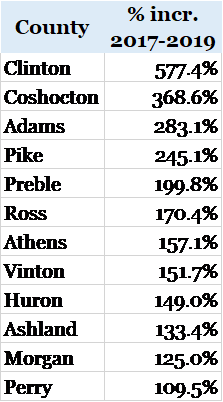
If you look at the counties where the relative shift in funding from public to private schools has jumped the most, it's all rural counties -- including Householder's home county.

As you can see, Perry is one of 12 Ohio counties who have seen their state funding to vouchers more than double between November 2017 and November 2019. Ohio has 88 total counties. 

It is these rural counties, which can't offset much state revenue loss because they raise so little on property taxes, where EdChoice state funding transfers are just killing districts. This, I think, explains Householder's urgency. It's hurting his community. 

All politics is local indeed.

There are many ways of undoing this damage. Not allowing voucher buildings in districts that are high performing overall is one. As is requiring that buildings must be low performing on more than a single report card measure before being voucher eligible. That way kids in the district don't lose state funding because a handful of kids aren't being served in a single district building.

But Householder really nailed what the heart of the issue is: the Report Card and standardized tests. So if he effectively fixes the root problem, kudos.

And while I really don't like what's happened with the voucher explosion this year, if that's what it takes for the state to once and for all put a stake through the heart of the state's rigged, unfair, inaccurate standardized-test-based accountability system? 

Well, I'll take it. 

It's about time.