Showing posts with label COVID-19. Show all posts

Monday, July 20, 2020

Ohio Charter Schools get More Per Pupil Federal COVID Relief Money than Many School Districts Received in State Aid. What Gives?


Included in the $2.3 trillion CARES Act passed in March to cope with the COVID-19 crisis was something called the Elementary and Secondary School Emergency Relief Fund, or ESSER. This fund set aside $13.2 billion for K-12 schools to cope with the new normal in preparing education spaces for COVID-19. Things like enhanced cleaning, or preparing online learning material, or maximizing spaces to ensure social distancing for potential return to school were the expenses contemplated for this money.

Every school qualified, including charter schools, for this money, some of which was passed out again last week. The money was and is essential to maintain public education through this crisis.

However, only charter schools would qualify for another program included in the CARES Act – the $669 billion Payroll Protection Program (PPP) -- a fund meant to keep small businesses and non-profits afloat during the economic shutdown. Public entities like school districts and local governments did not qualify for the program, which has been essential to keeping businesses from collapsing.

But charter schools, which are organized as 501c3 non-profits, did qualify.

So did their sponsoring organizations.

So did their management companies.

All tolled, a charter school could receive federal money four ways:

  1. Through ESSER, just like every school district in the country
  2. Directly to the school through the PPP
  3. Indirectly through their sponsoring organization through the PPP
  4. Indirectly through their management company (which could be non-profit or for-profit) through the PPP

This resulted in the typical Ohio charter school receiving as much as $817 in total federal CARES Act funding while the typical Ohio public school district only received $150.

That’s more than 5.4 times as much.

In fact, many charters received more per pupil federal aid through CARES Act funding than many public school districts received last year in state aid!

When schools that educate 90 percent of your children get 5.4 times less federal revenue to stay afloat than schools that educate 6 percent of your children, perhaps it's time to examine that federal revenue stream's equity.

Perhaps most outrageous is this result: Children in nearly 1 in 10 charters each received as much federal aid through the CARES Act as children in Columbus – Ohio’s largest school district – received in state aid this year!

There are other shocking incongruities. In no particular order:

  • Charter Schools received as much as $82.3 million in PPP funding either directly or indirectly. They only received $55 million in ESSER funding.
  • Of the bottom half of all districts and charters in per pupil CARES Act funding, only 9 were charters; 444 were districts. 
  • Meanwhile, 97 percent of Ohio charter schools were in the top half of total federal per pupil aid.
  • The top 98 per pupil federal revenue recipients were all charter schools, representing more than 1 in 3 Ohio charter schools.
  • Children in 2 of 3 Ohio school districts got less per pupil federal aid than children in the charter with the lowest total federal aid. 
  • Meanwhile, children in 116 charter schools got as much as $1,000 (or more) each in federal aid. Children in only 3 districts did (Bloomfield-Mespo in Trumbull County, Youngstown and East Cleveland -- the last two of which are state takeover districts). 
  • One charter school (SMART Academy) got as much as $26,000 per pupil in federal money. 

Not every charter school quadruple dipped. But some did. Here’s how it worked in some cases.

The Academy of Urban Scholars in Columbus

  • $108,961 through the ESSER aid that was available through the CARES Act to all Ohio schools. 
  • As much as $700,000 in direct aid from the PPP. 
  • Sponsored by the Buckeye Community Hope Foundation, which received as much as $1 million in PPP funding, the relative share of which is $22,265. 
  • They are run by the National Center for Urban Solutions, which received as much as $350,000 in PPP funding -- $213,195 of which would have gone to the Academy.
  • That’s more than as much as $1.04 million in federal CARES Act funding for the school, which has 305 students, which works out to as much as $3,424 per pupil – about the same amount as each student received in state aid last year in Putnam County’s Ottawa-Glandorf Local School District.

There is even one charter school that quintuple dipped.

Village Preparatory School Woodland Hills

  • This school received $501,215 through the ESSER aid
  • They received as much as $1 million in direct PPP funding
  • Village Prep Woodland Hills was sponsored by the Buckeye Community Hope Foundation. Village Prep’s share of the up to $1 million Buckeye received from the PPP would be as much as $35,989.
  • Village Prep is run by the Breakthrough Schools, which received as much as $1 million in PPP funding. However, Breakthrough also has a fundraising arm called the Friends of Breakthrough Schools, which received as much as $350,000 from the PPP program. Village Prep’s share of the $1.35 million total between the operator and its fundraising operation would be as much as $234,668
  • Village Prep Woodland Hills received as much as $1.77 million in federal aid for its 493 students – as much as $3,594 per student, or almost the exact amount of state aid each student received in Tuscarawas County’s Garaway Local School District this year.

Others only triple dipped, but did so at large amounts.

KIPP Columbus

  • The school received $1,081,480 in ESSER funding available to all schools
  • The school also received as much as $5 million in direct PPP funding
  • KIPP is sponsored by the Thomas B. Fordham Foundation, which received as much as $1 million in PPP funding, with KIPP’s proportionate share being as much as $256,987 of that
  • So for KIPP’s 1,373 students, it was able to draw down $6.4 million in federal CARES Act funding. That’s $4,638 per student, or as much as $1,379 more than what every student in Columbus received this year in state aid.

No school district could double, triple, quadruple or quintuple dip into federal revenue streams to help its students deal with the COVID-19 crisis.

But charter schools could, and many did.

It is unfair that charter schools – which have for years insisted they are “public schools” – be granted more opportunities to access federal funding than the schools that educate 90 percent of our children simply because of their corporate structure.

And this shows once again how Ohio charter schools are not really “public schools”.

When it benefits them to be considered “public schools”, they tap into those funds.

When it benefits them to be considered businesses, they tap into those funds.

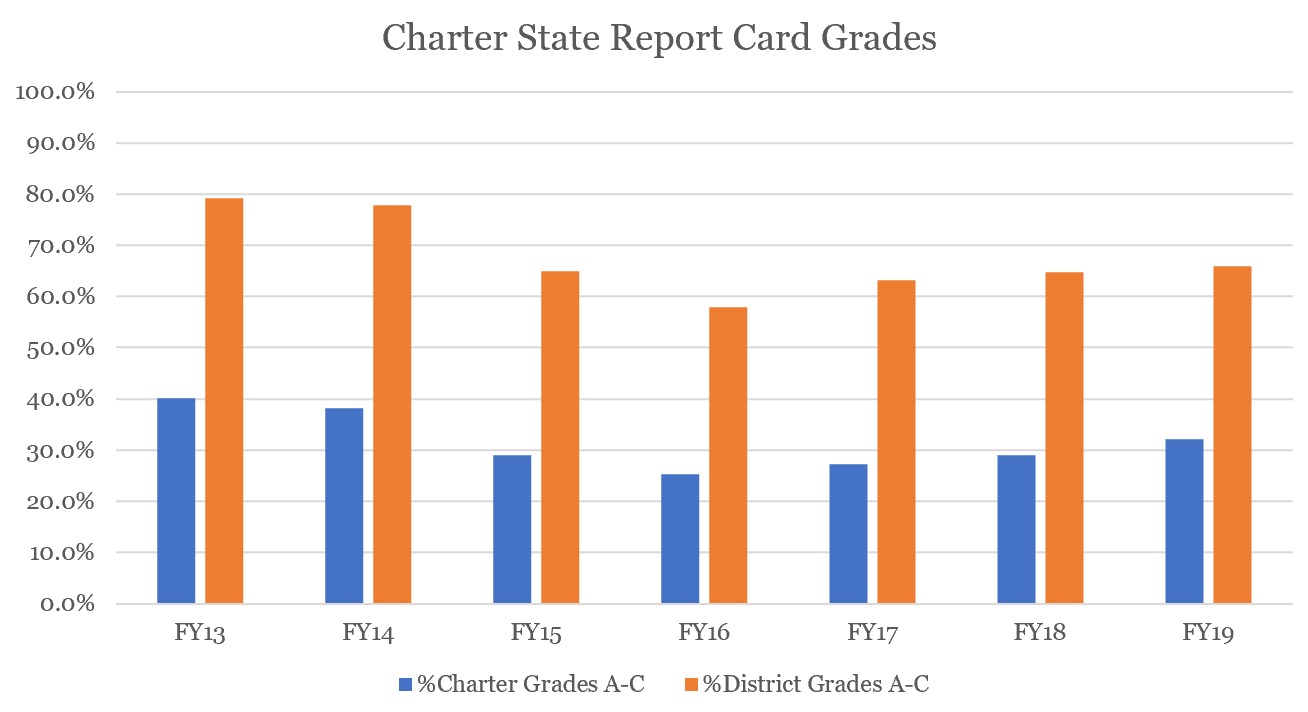
One final reminder: Barely 30 percent of charter school grades are A, B or C. Meanwhile, about 70 percent of school district grades are A, B, or C. Yet the federal CARES Act is providing 5.4 times as much money to the schools that get 70 percent Ds and Fs.

Sometimes I wonder.

Note: “As much as” will be a shorthand for acknowledging that the CARES Act funding as currently reported through the PPP is being reported as a range between two dollar amounts. I reported data for the upper most amount and qualified it by saying “as much as” because the entity could be receiving less than that, but I wanted to explain how much it could be. I would urge the Treasury Department to release exact amounts for a more accurate dollar figure. The calculation was made in the following way: for charter schools, each school was searched for its ESSER funding and whether it is receiving direct PPP funding. Then each charter school’s sponsor, as listed by the Ohio Department of Education was searched. Then each charter’s operator was searched. If a sponsor or operator was found, then the amount granted to those entities were divided by the number of students each sponsor or operator oversaw in all the schools they sponsor or operate. Then each charter school was granted a proportionate share of that overall revenue based on the number of students they had. It was assumed that every dollar received would go to benefit each student through the retention of teachers and staff meant to help educate each student. There were 16 charter schools whose student populations weren’t reported in the state’s charter school directory, or were reported as having 0 students. However, every one of those schools received ESSER funding (a total of $1 million), with some receiving direct and indirect PPP funding. However, because the state didn’t report the student population, they were not included as part of the per pupil calculations utilized in this analysis.

Thursday, July 2, 2020

COVID-19 isn't like Kid Crud. So Maybe Returning to School Won't be a Disaster.


A month ago, I would have told you that sending a bunch of kids indoors into schools during a pandemic was nuts. Dangerous, even.

But then I started reading the literature. And now I'm thinking it may not be as nuts as I originally thought.

I think one thing we all have to deal with (especially us parents) is overcoming our well-founded belief that kids are disease vectors. This is something I (and probably many of you) have experienced over the years. Our kids go to school, come home with the sniffles and suddenly we parents are down for a week or two. Who hasn't explained a persistent cough, fever, sneezing as "kid crud"?

We all have.

Which is why it just seems common sense to think that getting these little disease vectors back in school during COVID would be a horrible idea.

But it appears that, at least with COVID, the "kid crud" prejudice may not be justified.

For example:

  •  One study  found that children were the initial source of infection among the families in about 8% of households.

  • Another study looked at staff and students at five Australian primary schools and 10 high schools and found that out of 863 people who were in close contact with someone with Covid-19, only two got it
  • Another study discovered that a 9-year-old who attended three different schools and a ski class while showing symptoms of Covid-19 didn't infect anyone, which would never happen if the 9-year-old were an adult. 
  • Likewise, British researchers have found only one COVID outbreak in the entire world that could be credibly said to have started in a school.
And while some express caution about these results, with the caveat that no one study proves anything, none other than the American Academy of Pediatrics -- a legendarily cautious and small c conservative organization -- came out and all but said that kids should go back to school buildings in the fall. According to one of the authors of the AAP's school guidance:
"This virus is different from most of the respiratory viruses we deal with every year. School-age kids clearly play a role in driving influenza rates within communities. That doesn’t seem to be the case with Covid-19. And it seems like in countries where they have reopened schools, it plays a much smaller role in driving spread of disease than we would expect."
The AAP recommends taking precautions, but it also says that the mitigating efforts should be geared toward returning kids to classrooms, citing the health concerns kids have with remaining isolated, as well as the fact that in-school learning is so much better, overall, than online learning.

Look, it's been tough for me to turn at all on this issue. Letting kids get together indoors in groups during a pandemic seems completely illogical to me.

But I also have learned to trust science. And the science is saying that physically returning kids to schools, with the attendant precautions (hand washing, mask wearing, socially distancing however you can and making sure you don't go to school sick and go home if you do get sick) may actually work.

This is basically the approach our Gov. Mike DeWine is now advocating, though he isn't mandating any school or district to return full bore this fall. I will be intrested to see how much of the Cares Act money he's willing to spend to help districts and schools cope with the post-COVID reality. But at least he recognizes there will be a need, though importantly he already admits that the new money won't be enough to cover the cost.

Typical Ohio education funding.

Anyway, I know lots of parents will still doubt. Their experience with "kid crud" is so ingrained that they are like I was -- doubting every single piece of evidence that says returning to school isn't as dangerous as our experience suggests.

But the science is telling us something different. And if we want science to govern our COVID response, it's incumbent upon us to let it.

Even when it says we may have to set aside our lifelong battle with kid crud. 

Thursday, May 7, 2020

State Hides the Ball on K-12 COVID Cuts

This is why I think people are driven nuts by government.

A couple days ago, Gov. Mike DeWine announced a $300 million cut would be coming in this school year for Ohio's K-12 school districts due to the COVID crisis. Very understandable. Absent the feds granting states flexibility on CARES Act stimulus money and doing another COVID rescue package for education, states and local governments, big cuts like what DeWine announced are expected.

We'll leave the debate over the state's $2.3 billion rainy day fund for another day.

But when DeWine's Office of Budget and Management (OBM) listed the district-by-district cuts ("runs" is what we call it in the biz), the percentage cuts didn't look all that bad. Between 1% and 2.8%. Given that $300 million is about 4% of the state aid handed out this last school year, that didn't jibe to me.

That's when I noticed that OBM was comparing the amount of money cut to all money being spent in a school district. That's all money spent. State, local and federal. So, yeah, it looks like the cut isn't that bad when you look at it that way.

But it's completely misleading. Why? Because the state has zero say in how much federal and local money is spent or raised in a district. So the state is taking credit for money it didn't send to or raise in the district.

I can honestly say I've never seen a district-by-district run expressed this way. Every other run I've seen has compared how much state money districts were receiving and how much they will be receiving now.

In fact, it's how DeWine put out his district-by-district runs last year during the budget. He compared his state funding increase (from wraparound services money) with the state funding schools received the prior year. That makes the percentage increase look bigger. If he compared it with a district's overall spend, the increase would have seemed smaller.

It's a budgetary parlor trick.

On the Surface, these Cuts Look Fair

So what's the real state cut, in terms that have always been used?

The average Ohio school district will get cut 5.9%, with some getting cut 55%. Half of districts will get cut more than 3.8%. Half get cut less.

But there is a silver lining to this. The largest percentage cuts are disproporitionately in wealthier, suburban communities. The smallest percentage cuts are in poorer communities less able to withstand them. So that 55% cut? It's in Rocky River in Cuyahoga County, which doesn't get much state funding anyway because it's so wealthy. Other major percentage cuts are in Upper Arlington (53.6%), Independence (51.4%) and Inidian Hill (47.9%). All tolled, suburban and wealthy suburban districts will absorb 41 percent of all the costs, even though they only make up about 17.7% of the state's foundation funding.

In Ohio's major urban districts (Akron, Canton, Cincinnati, Cleveland, Columbus, Dayton, Toledo, Youngstown), the typical cut will be 1.8%. The poorest, rural districts will get an average 3.1% cut.

So while those cuts in Ohio's most vulnerable communities will be less, they will still be meaningful. There just isn't enough money being sent to the wealthiest schools to Robin Hood the cuts for very long.

But Ohio's Most Vulnerable Districts Still Get Disproportionately Hurt

While the percentage cut in Ohio's most vulnerable communities is less than its wealthiest ones, because there just isn't enough money being sent to the the wealthiest districts to absorb all the cuts, the relative amount being cut in Ohio's most vulnerable communities is actually higher.

Let me explain.

The way education funding works in Ohio is the state figures out how much it should cost to educate kids in your district, then determines how much of that cost you should be able to pick up based on your property tax values. The state then picks up the rest. And while there are serious problems with the way Ohio does this because the state formula for determining the cost isn't an actual formula, that's the calculus.

The issue though is everything hinges on the ability to raise local money through property tax levies. Districts that raise more ("wealthier"), have less state money coming to them. Those that raise less ("poorer"), have more state money coming. (And there are districts that aren't "wealthy" that are classified as such, like Coventry and Danbury, but that's another topic for another post).

The problem with this system is when state cuts come to districts, poorer districts' budgets are far more sensitive to state funding losses because they raise so much less locally. So a relatively modest cut in a poor, rural Ohio district could mean that district now has to go out for a larger levy (which won't likely pass) or cut services. Meanwhile, even a larger cut in a wealthier district won't have the same impact because they could raise even a tiny additional levy amount to cover it.

So even though 40.9% of all the money being cut is coming out of wealthier districts, the relative cut is worse in Ohio's poorer communities.

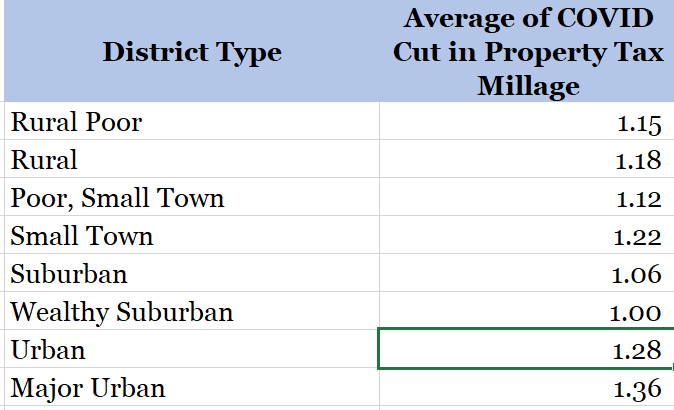
For example, on average, Ohio's poor, rural districts would have to raise 15% more local money to make up for their cut than the average welathy, suburban district. Likewise, the average major urban district would have to raise a 36% larger levy to replace its lost state revenue than the wealthy, suburban district.


Rocky River's seemingly massive 55.2% cut? In actuality, they would have to raise a 0.88-mill levy to cover that loss. Meanwhile, even though Trimble Local in tiny Noble County only gets cut by 0.7%, -- the state's smallest percentage cut -- they would need a 1.55-mill levy to cover the cost. That's nearly double the levy needed to cover state costs from a community with a 40% lower median income than Rocky River.

Younsgtown would have to come up with nearly 2 mills of local levy money to cover their 0.8% cut. Lorain needs 1.55 mills to cover its 1% cut.

You get the idea.

Any Education Cut Hurts Vulnerable Kids Most. Period. Thats' Why We Need Federal Stimulus. Now!

So while DeWine did an admirable job trying to deflect a large chunk of these cuts onto the districts that could shoulder them best, because there simply isn't enough money being sent to the state's wealthier districts, the seemingly palty percentage of state funding cuts in Ohio's most vulnerable communities are still disproportionately burdensome to them.

It's simply a function of local ability to raise revenue to replace the state money.

This is why we need a real state formula and investment in education funding -- a task that seemed so possible pre-COVID and now seems like a pipe dream.

The other issue is timing.

These cuts, assuming they go through shortly, would be deducted from payments the state will be making to districts in May and June. There are 4 payments made in these two months, with one scheduled to be made tomorrow.

So over 3 payments, districts will have to absorb all the cuts.

While it's tough to do a district-by-district anylsis of this impact quickly, overall, the bi-monthly state payment to districts is about $336 million. So this cut will mean that instead of three bi-monthly payments at the end of this school year, districts will essentially only get two.

That could mean serious logistical problems for districts, which may have already made purchases or paid salaries that the payments were expected to cover. Now that they won't, what will happen?

This will be a quite concerning offshoot of these cuts.

And again these cuts are only for this school year. Next school year, expect more. And next biennial budget expect even more.

Unless the feds step in and free up CARES Act money and pass additional stimulus money. And the state taps its significant rainy day fund.

Until then, look out. Take cover. And pray.


Wednesday, April 29, 2020

Analysis: Ohio Schools Would Get Enough Stimulus to Cover About 30% of Expected Cuts. Maybe.

Tucked away in the $2.3 trillion CARES Act was about $14.3 billion for schools. And while that sounds like a lot, it's a relative pittance compared with the overall cost of educating America's 74 million school children.

But it wasn't nothing.

The Learning Policy Institute put out an analysis of how much each state would receive from that $14.5 billion. Ohio does OK. A little above the national average on a per pupil basis, but lower than all surrounding states except for Indiana.

More telling is this: That $547.9 million is just for one year. Ohio's budget is a two-year budget. And the stimulus money is only good through the end of this calendar year, which is only half of the current school year.

So while the $547.9 million infusion would equal about 7 percent of the total amount of money sent to Ohio's school districts through the state's funding formula next year (meaning it would theoretically cover a 7 percent statewide cut), the money would likely only go the districts through the end of the year, meaning that the state's next biennial budget would not have any of this stimulus money in it.

But let's assume states could pocket this money and put it into their budgets next year. This money represents about 25-30 percent of the cuts school districts are forecasting for next year, let alone over two years. So there needs to be a significant investment in education in the next COVID aid package. In fact, many school groups are asking for a $200 billion school package.

That amount should make up for the severe cuts being forecast in Ohio and elsewhere.

Some may talk about how great it is that the CARES Act provided money to schools. Believe me, I'd rather kids have this money than not, but keep in mind it's a small percentage of the expected cuts, and it may not even be allowed to be spent during the next biennial budget, which means it won't help cover any future school revenue losses.

So.

Keep fighting.

Wednesday, April 22, 2020

Feds Hurt Kids with Latest CARES Act Maneuver

When the CARES Act passed last month, a large, $4 billion plus was slated to come to Ohio. There was a catch, though. It had to be spent on direct, non-budgeted, COVID-related expenses.

However, there is a huge need in replacing the lost revenue Ohio and local officials are feeling now that businesses are essentially at a standstill. Last month, state revenues were down $164.4 million from estimates, but remember that Ohio's stay at home order wasn't issued until March 22. So expaect a much greater fall off for this and future months.

The latest $450 billion federal bill that passed yesterday was supposed to have a provision in it allowing states and local governements to have flexibility on how that CARES Act money would be spent. In other words, allowing it to be used to fill the gaping revenue holes blowing away state, local and school budgets.

However, at the last minute, that flexibility provision was eliminated.

That means the $4 billion plus coming to the state from the CARES Act cannot be used to fill revenue holes for states, local governments or schools.

While that may mean we finally get statewide broadband access or something similar -- a new spend necessitated by COVID-related closures -- it would ignore the revenue shortfalls states, cities and schools will see.

How does this hurt kids?

Because we're starting to see stories about districts preparing for massive cuts next year. When you add the continuation of the hotly contested school voucher expansion, and places like Middletown are looking at millions of dollars in budget cuts next school year -- numbers that will only grow given the depth and breadth of this economic hit.

Now, Senate Majority Leader Mitch McConnell is suddenly concerned about budget deficits (mind you he did the previous stimulus bills and a $1 trillion tax cut without mentioning such concerns). If that holds, then the fourth round of stimulus money -- which everyone was banking on filling state budget revenue shortfalls this and and next budget cycle -- may be in jeopardy.

And if we don't have a fourth stimulus (education groups are seeking $200 billion nationally), then we could be looking at crippling school cuts that would make the 2011 cuts seem like a little finger splinter.

By way of perspective, during the 2010-2011 school year, more than 1 out of every 4 dollars the state sent to school districts was federal stimulus money. And this state revenue hole may be even bigger than the one from the Great Recession.

So you could be looking at 25-35% state budget cuts for schools. In some districts that can't raise much local revenue, that kind of funding loss would lay waste to communities, forcing some districts to consider closing, merging, or seeking other drastic measures. The hardest hit districts would be in Ohio's poor, rural communities -- Trump Country. Would Trump leave his core consitutency hanging out to dry during an election year?

We'll see.

But all who are concerned about kids must insist that whatever happens, states, local governments and schools have what they need to provide the services our families and kids need during this crisis. Playing political games at the height of this pandemic is political malfeasance of the highest order.

There now must be a fourth round of stimulus. And that money must be made available to states to fill the yawning chasm that will be created in their revenues next cycle, which for Ohio starts next year.

Call your member of Congress and our Senators. And tell them you want your kids to be as important to them as Wal-Mart and United Airlines.

And do it yesterday.

Monday, April 13, 2020

Charter Schools Again Want Their Cake and Eat It Too

For years now, I and other critics of Charter Schools have been regularly chastised for suggesting that charters are not really public schools, even though they are called public schools in state law. In fact, every judicial and quasi-judicial panel that's examined charters' organizational status has found them to be private actors, not public schools.

Now we discover that the National Alliance for Public Charter Schools is telling charters to apply for the Small Business Administration Loans in the $2 trillion CARES Act that passed last month. Why is this significant? Because the NAPCS thinks that charters could qualify for the money -- money that is not allowed to be accessed by governmental entities. It is only for "non-governmental" entities.

Public schools cannot qualify for this money.

So if charters qualify for these low to no-interest SBA loans -- like a restuarant can -- then they are definitely NOT public schools.

Yet that would not keep charters from trying to also qualify for some of the $13.7 billion K-12 stimulus money included in the CARES Act, and additional federal stimulus money that will surely be included in further stimulus bills.

Once again, charter schools are gaming their squishy governmental structure. They want to access all the money available to them based on whichever form of governance benefits them -- whether that's as a non-governmental or governmental entity.

It would be outrageous if charters would be able to access SBA loans and additional stimulus for all schools. No other public school could do this.

And if they get SBA loans, that should be credited toward their other stimlus payments.

At least.

Friday, March 13, 2020

Ohio's Charter School War fails us when we could really use them.

With all this COVID-19 talk, every Ohio Public School District is planning to move to online instruction through the end o fthe year. While that seems like a heavy lift, it really shouldn't be. Why?

Because no state has more students already attending virtual schools than Ohio.

Yet in no instance has the Ohio Department of Education or any shcool district -- despite this emergency crisis -- said, "Hey, we have a lot of online schools already, why don't we ask them for help?"

Why haven't districts sought help? Simple: Ohio's online schools perform so poorly and have garnered such bad faith in the local public school community that I am willing to bet it never crossed school leaders' minds to reach out to, for example, the Ohio Virtual Academy -- whose diplmoas aren't accepted by the NCAA -- to see if the school could help the district transition.


Instead, districts are choosing to reinvent their own wheel.

Maybe if the state had actually spent the last 20 years trying to ensure quality online education was going on, we'd be in a different place. Instead, they've avoided doing much if anything about online schools. If they had held these schools to more account, our local public schools could be smoothly transitioning to online education using our robust online education sector as a model.

Instead these schools, which educate about 35,000 students exclusively in the online realm where all 1.6 million kids will soon be, are not even an afterthought.

After years of failing online schools -- epitomized by the ECOT disaster but replicated in other states -- and constant denials of the online schools' academic and ficnanicial impact on local public schools, the relationship has seriously been poisoned, if it ever really existed.

Perhaps during this crisis, an opportunity to improve online education and develop a positive working relationship between them and local public schools will occur.

But I'm not holding my breath. And that, my friends, is the tragic fallout from Ohio lawmakers' 20-year blind devotion to a failing online school sector.

It didn't have to be this way.

But here we are.