Showing posts with label Charter Schools. Show all posts

Thursday, March 11, 2021

Let's Talk Charter Schools

Let's discuss charter schools -- a topic you've seen a lot of on this blog over the years, but has kind of gone away recently for obvious (COVID) and non-obvious (Vouchers/School Funding) reasons.

Despite House Bill 2, which was supposed to slim down our notoriously poor-performing charter school sector and the closure of the nation's largest online school -- ECOT -- which closed because the school literally stole hundreds of millions of tax dollars to educate kids they never educated, we are currently spending more on charter schools than any other year on record. 

By a mile.


According to the latest Charter School funding report from the Ohio Department of Education, we are set to spend $999.7 million. The previous record was $955 million from the 2015-2016 school year -- the high-point of the ECOT years.

Despite this massive recent increase (an extraordinary $111 million jump ... over two years), it's not because we've had more students attending charters than ever. 

No. That record remains the 2013-2014 school year when 122,130 students attended charters. 


It's because Ohio politicians have continued bumping up the per pupil amounts flowing to charters. So now kids in Ohio charters, on average, get nearly $8,500 per pupil in state aid -- about double what that same kid would receive in a local public school.

As I've recounted for more than a decade, because of the way we fund charters, that means that local property taxes have to subsidize charter school kids.

It doesn't take a Ph.D. in Rocket Science to understand that if you're removing $8,500 in state aid from a district for a kid the district was only getting about half of that from the state to educate that the difference has to come from somewhere.

This year, that subsidy is slated to be $148 million. And in some districts, it's really high. Like in Columbus where $62 million in local revenue has to subsidize the state funding deduction for charters. 

As an aside, this local subsidy problem could be fixed with House Bill 1, which would directly fund charters and vouchers, among other great things.

Anyway, don't be shocked when you start hearing charter school proponents talk during this budget cycle about charter funding "equity". 

By the way, "equity" in this sense means equality, not the equity you and I think about -- like making sure kids from disparate backgrounds and challenges receive the additional supports they need to succeed. No. When charter folks say "equity", they mean the state should pay charters what districts get from state and local revenue. 

Just keeping it real.

Anyway, the data demonstrates pretty clearly that charter schools have plenty of money right now to educate their kids. Why? Because they don't have to adhere to 150 plus state regulations, pay for buses and pay their teachers 40% less, on average, than districts with leaner benefits.

So you don't have to spend nearly as much in a charter as you do a district.

Want proof?

Let's look at the state's annual expenditure report.

Last year, here's what the average charter and district spent per pupil in six categories: Overall, Instruction, Pupil Support, Staff Support, Operation Support (buildings and buses) and Administration.


Interesting, isn't it? Charters, overall, only spend about $386 less than a school district, even though school districts raise local revenues. Something even more amazing? If you had charters spend what districts did on administration, they could spend what districts do on instruction and pupil support, and have $397 remaining! Which means they could actually spend what districts do in every category but operation support -- not a major issue because charters don't bus many, if any, kids. 

If only charters spent the same 14% of their revenue on non-instructional administrative costs rather than the 24% they currently spend.

I ask you, dear reader, do you think that charter schools need more money? Or more efficiency? 

Hmmm. Where have I heard THAT before? Oh yeah. From charter school proponents about local public school district spending. 

Anyway...

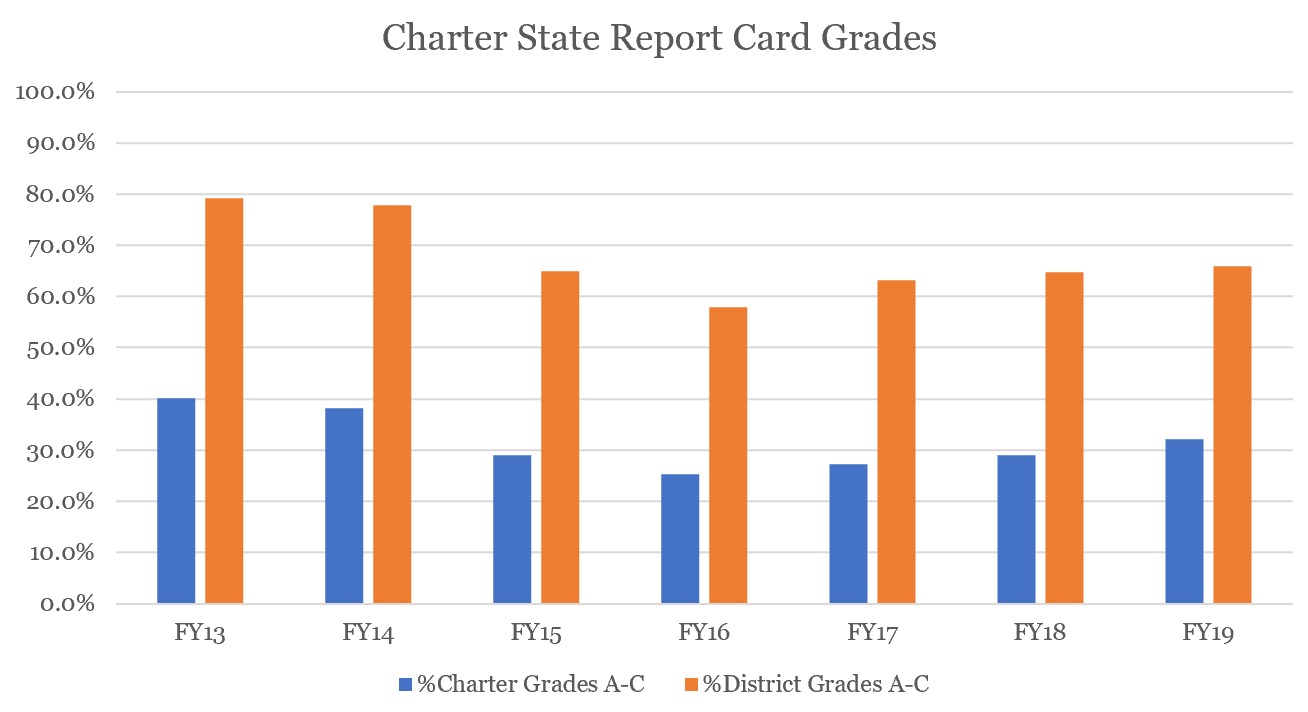
Oh yeah. One more thing. Here's a list of all A-C charter school state report card grades ever earned. 


I give you this overall horrible performance for you to mull over as the state considers investing more than $1 billion in this education sector that's produced more state report card grades of F than all others combined since we've had the A-F system.

Monday, July 20, 2020

Ohio Charter Schools get More Per Pupil Federal COVID Relief Money than Many School Districts Received in State Aid. What Gives?


Included in the $2.3 trillion CARES Act passed in March to cope with the COVID-19 crisis was something called the Elementary and Secondary School Emergency Relief Fund, or ESSER. This fund set aside $13.2 billion for K-12 schools to cope with the new normal in preparing education spaces for COVID-19. Things like enhanced cleaning, or preparing online learning material, or maximizing spaces to ensure social distancing for potential return to school were the expenses contemplated for this money.

Every school qualified, including charter schools, for this money, some of which was passed out again last week. The money was and is essential to maintain public education through this crisis.

However, only charter schools would qualify for another program included in the CARES Act – the $669 billion Payroll Protection Program (PPP) -- a fund meant to keep small businesses and non-profits afloat during the economic shutdown. Public entities like school districts and local governments did not qualify for the program, which has been essential to keeping businesses from collapsing.

But charter schools, which are organized as 501c3 non-profits, did qualify.

So did their sponsoring organizations.

So did their management companies.

All tolled, a charter school could receive federal money four ways:

  1. Through ESSER, just like every school district in the country
  2. Directly to the school through the PPP
  3. Indirectly through their sponsoring organization through the PPP
  4. Indirectly through their management company (which could be non-profit or for-profit) through the PPP

This resulted in the typical Ohio charter school receiving as much as $817 in total federal CARES Act funding while the typical Ohio public school district only received $150.

That’s more than 5.4 times as much.

In fact, many charters received more per pupil federal aid through CARES Act funding than many public school districts received last year in state aid!

When schools that educate 90 percent of your children get 5.4 times less federal revenue to stay afloat than schools that educate 6 percent of your children, perhaps it's time to examine that federal revenue stream's equity.

Perhaps most outrageous is this result: Children in nearly 1 in 10 charters each received as much federal aid through the CARES Act as children in Columbus – Ohio’s largest school district – received in state aid this year!

There are other shocking incongruities. In no particular order:

  • Charter Schools received as much as $82.3 million in PPP funding either directly or indirectly. They only received $55 million in ESSER funding.
  • Of the bottom half of all districts and charters in per pupil CARES Act funding, only 9 were charters; 444 were districts. 
  • Meanwhile, 97 percent of Ohio charter schools were in the top half of total federal per pupil aid.
  • The top 98 per pupil federal revenue recipients were all charter schools, representing more than 1 in 3 Ohio charter schools.
  • Children in 2 of 3 Ohio school districts got less per pupil federal aid than children in the charter with the lowest total federal aid. 
  • Meanwhile, children in 116 charter schools got as much as $1,000 (or more) each in federal aid. Children in only 3 districts did (Bloomfield-Mespo in Trumbull County, Youngstown and East Cleveland -- the last two of which are state takeover districts). 
  • One charter school (SMART Academy) got as much as $26,000 per pupil in federal money. 

Not every charter school quadruple dipped. But some did. Here’s how it worked in some cases.

The Academy of Urban Scholars in Columbus

  • $108,961 through the ESSER aid that was available through the CARES Act to all Ohio schools. 
  • As much as $700,000 in direct aid from the PPP. 
  • Sponsored by the Buckeye Community Hope Foundation, which received as much as $1 million in PPP funding, the relative share of which is $22,265. 
  • They are run by the National Center for Urban Solutions, which received as much as $350,000 in PPP funding -- $213,195 of which would have gone to the Academy.
  • That’s more than as much as $1.04 million in federal CARES Act funding for the school, which has 305 students, which works out to as much as $3,424 per pupil – about the same amount as each student received in state aid last year in Putnam County’s Ottawa-Glandorf Local School District.

There is even one charter school that quintuple dipped.

Village Preparatory School Woodland Hills

  • This school received $501,215 through the ESSER aid
  • They received as much as $1 million in direct PPP funding
  • Village Prep Woodland Hills was sponsored by the Buckeye Community Hope Foundation. Village Prep’s share of the up to $1 million Buckeye received from the PPP would be as much as $35,989.
  • Village Prep is run by the Breakthrough Schools, which received as much as $1 million in PPP funding. However, Breakthrough also has a fundraising arm called the Friends of Breakthrough Schools, which received as much as $350,000 from the PPP program. Village Prep’s share of the $1.35 million total between the operator and its fundraising operation would be as much as $234,668
  • Village Prep Woodland Hills received as much as $1.77 million in federal aid for its 493 students – as much as $3,594 per student, or almost the exact amount of state aid each student received in Tuscarawas County’s Garaway Local School District this year.

Others only triple dipped, but did so at large amounts.

KIPP Columbus

  • The school received $1,081,480 in ESSER funding available to all schools
  • The school also received as much as $5 million in direct PPP funding
  • KIPP is sponsored by the Thomas B. Fordham Foundation, which received as much as $1 million in PPP funding, with KIPP’s proportionate share being as much as $256,987 of that
  • So for KIPP’s 1,373 students, it was able to draw down $6.4 million in federal CARES Act funding. That’s $4,638 per student, or as much as $1,379 more than what every student in Columbus received this year in state aid.

No school district could double, triple, quadruple or quintuple dip into federal revenue streams to help its students deal with the COVID-19 crisis.

But charter schools could, and many did.

It is unfair that charter schools – which have for years insisted they are “public schools” – be granted more opportunities to access federal funding than the schools that educate 90 percent of our children simply because of their corporate structure.

And this shows once again how Ohio charter schools are not really “public schools”.

When it benefits them to be considered “public schools”, they tap into those funds.

When it benefits them to be considered businesses, they tap into those funds.

One final reminder: Barely 30 percent of charter school grades are A, B or C. Meanwhile, about 70 percent of school district grades are A, B, or C. Yet the federal CARES Act is providing 5.4 times as much money to the schools that get 70 percent Ds and Fs.

Sometimes I wonder.


Note: “As much as” will be a shorthand for acknowledging that the CARES Act funding as currently reported through the PPP is being reported as a range between two dollar amounts. I reported data for the upper most amount and qualified it by saying “as much as” because the entity could be receiving less than that, but I wanted to explain how much it could be. I would urge the Treasury Department to release exact amounts for a more accurate dollar figure. The calculation was made in the following way: for charter schools, each school was searched for its ESSER funding and whether it is receiving direct PPP funding. Then each charter school’s sponsor, as listed by the Ohio Department of Education was searched. Then each charter’s operator was searched. If a sponsor or operator was found, then the amount granted to those entities were divided by the number of students each sponsor or operator oversaw in all the schools they sponsor or operate. Then each charter school was granted a proportionate share of that overall revenue based on the number of students they had. It was assumed that every dollar received would go to benefit each student through the retention of teachers and staff meant to help educate each student. There were 16 charter schools whose student populations weren’t reported in the state’s charter school directory, or were reported as having 0 students. However, every one of those schools received ESSER funding (a total of $1 million), with some receiving direct and indirect PPP funding. However, because the state didn’t report the student population, they were not included as part of the per pupil calculations utilized in this analysis.

Monday, April 13, 2020

Charter Schools Again Want Their Cake and Eat It Too

For years now, I and other critics of Charter Schools have been regularly chastised for suggesting that charters are not really public schools, even though they are called public schools in state law. In fact, every judicial and quasi-judicial panel that's examined charters' organizational status has found them to be private actors, not public schools.

Now we discover that the National Alliance for Public Charter Schools is telling charters to apply for the Small Business Administration Loans in the $2 trillion CARES Act that passed last month. Why is this significant? Because the NAPCS thinks that charters could qualify for the money -- money that is not allowed to be accessed by governmental entities. It is only for "non-governmental" entities.

Public schools cannot qualify for this money.

So if charters qualify for these low to no-interest SBA loans -- like a restuarant can -- then they are definitely NOT public schools.

Yet that would not keep charters from trying to also qualify for some of the $13.7 billion K-12 stimulus money included in the CARES Act, and additional federal stimulus money that will surely be included in further stimulus bills.

Once again, charter schools are gaming their squishy governmental structure. They want to access all the money available to them based on whichever form of governance benefits them -- whether that's as a non-governmental or governmental entity.

It would be outrageous if charters would be able to access SBA loans and additional stimulus for all schools. No other public school could do this.

And if they get SBA loans, that should be credited toward their other stimlus payments.

At least.

Wednesday, September 25, 2019

New IO Report: More Money for Vouchers, Less Oversight of Charters

I have to admit, I was shocked at how quickly the Ohio Legislature and Governor forgot about the ECOT scandal -- the largest taxpayer ripoff in state history. Because the most recent budget that passed actually loosened regulations on charter schools.

More amazing still is the state's going whole hog in on Vouchers for families making as much as $100,000 a year. Just an unrelenting pursuit of the public funding of privately run schools. We've put out a new report at Innovation Ohio that details many of these provisions. But here's the most striking chart in the whole thing, as far as I'm concerned:

That's right. The average per pupil funding of private school students -- many of whom never really attended Ohio's public schools -- is now almost $2,000 more per pupil than the what the 1.7 million students in Oho's public school system receive.

Remember that in the landmark Zelman U.S. Supreme Court case that ruled Ohio's Cleveland voucher program constitutional, then-Chief Justice William Rhenquist said it was not a violation of the constitution's Establishment Clause because in large part the program was deisgned to help students in failing schools and the per pupil amount was a pittance compared with what public school students received from the state.

Now that 95 percent of Ohio school districts lose at least some funding to private school vouchers and the average per pupil funding for these programs far outstrips the average funding for public school students, it's right to wonder whether the current Ohio voucher program would meet muster under the Zelman decision.

Friday, September 13, 2019

Charter Schools' Overrepresentation of Failure, Underrepresentation of Success

Every time I write about the state report card, I do so with some trepidation because I don't think they're a true barometer of success, as I've said on many occasions. However, I do believe they can show us general trends about 50,000 foot views on students success.

In this vein, I'd like to point out one extraordinary thing from yesterday's release of the state's new report card: Ohio's charter schools, which represent about 10 percent of Ohio's school buildings, make up about 40 percent of Ohio's school buildinsg that received overall F grades.

Factoring out charter schools shows that among the 3,029 non-charter school buildings made up the remaining 208 F buildings, or not even 7 percent of Ohio's public school buildings. Ohio's charter schools? A full 36 percent of them received overall F grades.

But even the degree of F grades are striking. Of the 45 Performance Index percentages that are below the 33rd percentile, 35 are charter schools, which means about 10 pecrent of all charters are below the 33rd percentile on Performance Index scores -- the state's index of proficiency.

Of the 71 school buildings that received zero gap closing points, 45 were charter schools, which means that nearly 13 percent of all charters received zero points for closing achievement gaps.

The opposite trend continues on the positive end -- few charters occupy top performance positions.

Of the 281 buildings that received A grades for Performance Index, only 9 were charter schools. Again, charters are about 10 percent of all buildings, but only are 3 percent of the top scoring buildings on proficiency.

Meanwhile, of the 1,144 school buildings that received an A on Gap Closing, only 40 (3.5 percent) were charter schools, which means only about 11 percent of Ohio charter schools rank among the state's best schools for closing achievement gaps.

Shall I continue?

Needless to say, it should concern many that Ohio charter schools dominate the bottom rankings among Ohio's school buildings and appear only 1/3 as frequently as their numbers suggest they should on the top end of the performance scale.


Thursday, September 12, 2019

New Report Cards tell Similar Story

The new state report cards are out and they tell a lot of the same story they always have, namely Ohio's public school districts outperform Ohio's charter schools in nearly every way. Again, nearly all Ohio school districts lose funding and students to Ohio charter schools. So this isn't just an urban question.

Overall, two-thirds of Ohio school district grades are A, B or C. Two-thirds of Ohio charter school grades are D or F.

Meanwhile, Ohio’s local public school districts receive As in Gap Closing between disadvantaged students and those without disadvantages at three times the rate of Ohio's charter schools, had a 20 percent better rate of As in student growth and even outperformed charter schools in charter schools’ best-performing measure – student growth among the lowest-performing students.

Ohio charter schools had a stunning 93% rate of F grades in meeting performance benchmarks and nearly half of all Ohio charter schools received F grades in closing achievement gaps between the most at-risk students and those who are more advantaged. Perhaps the greatest difference can be seen in Performance Index performance (the one number that encapsulates overall proficiency) where 43% of charter schools received an F grade and only 6 of Ohio’s 608 school districts received an F.

As for school districts, they improved their percentage of As in 8 of 14 graded categories and lowered their rate of Fs in 11 of 14 categories. The biggest area of improvement came in graduation rates and closing achievment gaps. However, their biggest drop off was in student growth where last year nearly 1/2 of all districts received As. This year, only 13 percent did. We'll have to look at that more closely to discover why.

Only 4 districts received overall grades of F this year -- at 0.7%, a far better rate than Ohio charter schools' 28%. However, one of those 4 is Youngstown, which is under the Academic Distress Commission. This means that the district will now have to transition to a mayor-appointed academic distress commission Jan. 1 through a complicated process. So that's another issue that could perhaps be fixed through the apparently fast-moving distress commission reform now being discussed in the Ohio Senate.

But overall, Ohio's districts are improving in far more measures than they are slipping, and the continued strong showing in closing achievement gaps is encouraging.

However, this is where I reiterate again that these report cards are almost singularly reliant on scores earned on standardized, high-stakes tests that are notoriously tied to poverty. So while we're seeing improvements, the fact remains that the poorer your students, the less successful you will appear on this report card. That has always been true and will likley be true as long as tests that are taken for a few days during the year and are great at measuring poverty continue to be used to judge the 180-day educational experiences of children.

Tuesday, February 19, 2019

If This is Your Best Argument for More Charter Money, um....

Today, the Plain Dealer reported on an updated look at Ohio charter school performance from the Center for Research on Educational Outcomes (CREDO). The center, which is housed at the free market Hoover Institute at Stanford University, discovered that Ohio charter schools are performing about as poorly as ever.

"There is little to no progress in Ohio charter school performance," concluded CREDO Director Macke Raymond, whose comments several years ago about how the free market system hadn't worked in education caused quite a stir.

However, like most charter school analyses ever done in Ohio, CREDO did find pockets of success among brick-and-mortar charters, and blamed the overall stagnant performance on e-schools. Leave it to Aaron Churchill of the Fordham Institute to drive a truck through that mouse hole.

Here's how the PD reported it:
"After years of shortchanging charter students, lawmakers should finally move to fund brick-and-mortar charters equitably, helping to kick-start new-school formation and the rapid expansion of the state’s top-performing charters,” Churchill wrote.
Obviously trying to piggyback on his dubious claim that charters don't get enough money and have earned a raise from state lawmakers, Churchill really stretches out over his skis here. There are major caveats with CREDO's methodology (for a detailed breakdown, take a read here), but here is my major concern -- the group only looks at student growth.

That is one of MANY measures of a school's performance. And growth has always been an area where charters and districts perform more similarly. Districts still beat charters pretty well on the measure, but it's not quite the runaway contest that proficiency or graduation rates are, for example.

Here's another thing: Ohio's been artificially deflating school district performance for years now, dragging down their overall grades to better comport with historic charter school performance. Don't believe me? Take a look at the percentage of grades each sector has received each year since the state started using the A-F system in the 2012-2013 school year.

 What you can see is that since Ohio started changing its testing regime, and more heavily weighting the more charter-friendly "value added" measure, low district grades have skyrocketed. Meanwhile, charter grades have pretty well stayed the same during the same period -- overall pretty bad. Importantly, though, Districts still have less than half the rate of F grades as charters. Just saying.

This got me thinking about the whole light speed thing again.

"Huh?" you ask.

Let me explain.

According to Einstein's Theory of Relativity, it is impossible to go faster than the speed of light (though as a sci-fi fan, I sure hope it's not) because it requires infinite energy. So you can approach light speed, but never go over it.

How does this apply to state report card grades? Well, it's like this: Charter performance was so bad, it would have been impossible for them to get much worse. So they had nowhere to go but up, really. Meanwhile, school district performance was flying quite high in 2012-2013, with barely 10 percent of district grades being designated Fs. So when the state starts implementing new tests over a short period, districts have a farther way to fall, which they do (by design, I might add), which makes it seem like maybe charters are gaining on districts, when in fact district performance is simply being artificially dropped not by actual performance, but by state policy changes. 

Does anyone actually believe that districts are twice as likely to have failing grades today as they were 5 years ago? Please.

What is amazing is that charter school performance has remained remarkably consistent. And poor. Yes, their Fs and Ds jumped a bit after all the testing changes. But really, they've been at about 50 percent Fs all along. Is this because charters did a better job at handling the changes?

No. It's because they were approaching light speed already, and they couldn't have done much worse overall. So even though Churchill and others claim that charters have demonstrated their worth and earned the right for a pay raise from the state, I contend if you think they should get a pay raise now, why shouldn't it have come in the 2012-2013 school year when only 40 percent rather than 50 percent of their grades were Fs? Why would we reward their worse performance today?

Yes, it is true they've improved since the low point of 2015-2016 (the last of the three consecutive years of test switching). But they still receive a higher rate of failing grades than they did in 2012-2013 and have only seen a 17 percent drop in frequency of Fs. Districts have cut their F frequency by 22 percent.

Want another staggering data point?

Since the 2012-2013 school year, a total of 11,832 grades were handed out to the state's charter schools (only 7 schools were statewide e-schools for this whole period, by the way, so the vast majority of these grades are for brick-and-mortar schools). Of those 11,832 grades, more than half were Fs. That means since 2012-2013, charter schools have received more Fs than all other grades combined. The number of As? Barely 1,000. Out of nearly 12,000.

What grade have districts received more than any other?

As.

By more than 1,000.

And this is despite the fact that districts' performance has been intentionally Nerfed by state policymakers who desperately want charter schools to succeed even though the evidence is pretty overwhelming they aren't overall.

Can charter schools work here? I believe they can on a limited basis. Are there pockets of success?Yes. Of course. But for advocates like Fordham to contend an overall performance revolution in Ohio charter schools as the basis for an overall pay raise for this long-struggling sector that even charter advocates admit aren't improving a whole lot, stretches the bounds of reason, especially given how much the state has divested from the 90 percent of kids who aren't in charters.

Let's fund charters based on what it actually costs to educate kids there. Let's give performance bonuses where warranted. Let's do it without hurting kids who aren't in charters.

And let's see what happens.

Wednesday, February 6, 2019

The Fabrications of a Charter School Zealot

In a recent post by the usually sound Aaron Churchill, the Fordham Institute researcher takes some significant pot shots at William Phillis -- the legendary Ohio public school advocate whose work led to the Ohio Supreme Court ruling four different times that the way the state funds public schools is unconstitutional.

I played on Churchill's title for my title of this post.

Churchill's major problem with Phillis' analysis of charter school expenditures is Churchill doesn't like the inconvenient truth that the average charter school spends several hundred dollars more per pupil than the average school district.

Unfair! cries Churchill. You have to weight the average per pupil expenditure. That way it's more fair. He points to the calculation he made in his recent report arguing that more money needs to be given to charter schools as the only fair way to possibly calculate what charter schools spend.

See, here's the problem.

His "weighted" average per pupil expenditure is not an accurate reflection of how many tax dollars go to charters. If you multiply his "weighted" average by the number of students in charters, the amount isn't actually what charters spend.

If you multiply the "unweighted" amount, it does. All weighting does is make it look like charters spend less than districts.

At the end of the day, taxpayers want to know how much of their money is being spent. And in charter schools, about $400 more is being spent per pupil.

Period.

In addition, Churchill ignores the fact that charters, on average, spend about $1,200 more per pupil on administrative, non-instructional costs than school districts. Even big urban districts spend $300 less per student.

So, in other words, if Ohio charter schools reduced their administrative spending to that of Ohio school districts, even on Churchill's "weighted" calculation, they would end up spending about the same as districts.

It's funny how free market reformers like Churchill quickly disparage "bloated" school district administration, but never point out that if charters were simply more efficient at spending money in the classroom, they wouldn't be begging for more.

That's because overall, charters spend about twice the percentage of their money on administrators as school districts do, equating to about 1 in 4 dollars spent by charters.

Next, Churchill goes to the old argument that charter students have far more challenging populations than school districts. Which is generally true, on average.

However, Churchill always wants to compare charters with the state's 8 major urban school districts (Akron, Canton, Cincinnati. Cleveland, Columbus, Dayton, Toledo and Youngstown).

If one does that, about 2 out of every 3 charter schools have 100 percent economically disadvantaged. Meanwhile, only 2 major Ohio urban districts have less than 100 percent economically disadvantaged populations. On average, Ohio's urban districts have about 5 percent higher rate of minority students and about a 10 percent higher rate of economically disadvantaged students than Ohio charter schools.

So, using Churchill's argument that schools with more challenged populations should get more money, it seems that the fact urban districts spend more per equivalent pupil than charters makes sense.

Also absent from Churchill's analysis is the fact that every dollar leaving Akron and Cincinnati for a charter school last school year went to a charter that performed worse on more state report card measures than Akron and Cincinnati.

Churchill also failed to mention that while lots of folks are rightly concerned that 14 Ohio school districts received overall grades of F on the state report card last year, marking them for state takeover, if one applied that standard to Ohio charter schools, 103 of 340 charters receiving grades either received Fs or "Does Not Meet Standards" if they're a dropout recovery school (mind you that "standard" is graduating about 7 out of 100 kids in 4 years).

So 3 out of 10 Ohio charter schools would be set for state takeovers, if the state takeover law applied to them the way it does school districts.

Oh, and about $200 million of your tax dollars went to charters that would have been marked for state takeover, if they were treated like districts.

I anticipate Churchill will complain that I'm comparing all charters with all Ohio school districts. Charter proponents demand their performance only be compared with school districts and buildings that struggle the most.

However, every school district but one had at least some state money transferred to charters from their state funding. You don't get to take money from every school district, yet demand you be held accountable relative to the performance of the most struggling districts.

Sorry, Aaron.

Especially when the current system forces local property taxpayers in those districts to fork over more of their property taxes to make up for the state funding transferred to charters.

And here is the breakdown of charter and district letter grades on the state report card this last year. As you can see, about half of all charter grades are F -- almost more Fs than all other grades combined -- and more than 7 out of 10 are D or F. Meanwhile, about 6 in 10 district grades were A, B, or C.

I guess what I'm most disappointed by though is Churchill's utter lack of deference and respect for Phillis, who more than any single person in the history of the state has held politicians' feet to the fire on equal and adequate funding for all students.

Frankly, Phillis has forgotten more education funding and policy than either I or Churchill will ever know. Churchill's cheap, ad hominem attacks on this man who has spent his life fighting for all kids to receive a world-class education is truly distressing.

My advice to Mr. Churchill would be to stick with trying to knock me around. Because with Phillis he is punching way above his weight class.

Monday, April 2, 2018

Do Charters Spend More than Districts, Or What Do Medians Mean?

I try to steer clear of mumbo jumbo on this blog. I wish to simplify rather than complicate already dense, complicated topics. But when it comes to expenditures in charter schools and school districts, it matters whether you know what medians and means are. So please indulge a little nerdification here.

For those who need a refresher, means are averages. Medians are midpoints among a range of numbers. So, for example, the median of 1,2,3,4,5 is 3. The average of 1,2,3,4,5 is also 3. However, when there is a lot of variation in the numbers, averages (or means) can be thrown off. Sometimes to a great degree. So, for example, the mean of 1, 2, 3, 4, 3,000,000 is 600,000. The median remains 3, which is a much more accurate way to describe a typical number in the series.

So when you have a series of numbers with wide variations, you generally want to use medians because they answer the question of what is the "typical" number. If you don't have much variation between numbers, generally averages work better.

Which brings me to the question of which schools spend more in Ohio, charter schools or school districts. These two charts will tell you both, depending on whether you want to use medians or means.

 The graphic on the left shows the median expenditure per pupil for each school type. You'll see that generally, Ohio school districts spend a few hundred dollars more per pupil than charter schools.

The chart below the median chart shows that on average, charter schools spend more per pupil than Ohio school districts.

So, what gives and which numbers matter most in determining this issue?

Well, as you can see, the average per pupil expenditure varies wildly in charter schools, likely due to the much greater variation in their financial reporting competence than anything else. For example, in the 2013-2014 school year, the largest per pupil expenditure in charter schools was more than $1 million, which probably wasn't accurate. The largest per pupil expenditure in a school district that year was a little more than $20,000 (a tiny Lake Erie island district was over $30,000). So the variation among school districts was much smaller than the variation in charters that year. And pretty much every year since.

Except for this past school year of 2016-2017.

The variation between the highest and lowest spending charter school last year was $36,000 -- not far off from the school district variance of $24,000. In the 2013-2014 school year, the reported variation in per pupil spending at charter schools was $1.4 million. And even if you discount the handful of charters who likely erroneously reported spending more than $100,000 per pupil, the difference remained well north of $85,000.

So that means in order to be fair, you had to use medians to express what a "typical" charter or district spent to account for those variations. Which means charters spent less per pupil than districts. This year, though, there's a real question if using averages now is fair game. Because the wild variations in charters aren't there anymore.

In other words, the "typical" and "average" charter school are becoming far more similar than in the past.

Why does all this matter? Because we were told (and have been told) again and again that charter schools and the private sector that drives them perform the same or better academically at lower cost than Ohio's local public schools. And charter school advocates are now saying they need more money because they can't spend what they need to spend in the classroom.

Yet Ohio's charter school sector overall spends about the same and performs far worse. Even if you want to look at medians, is the few hundred dollars' savings worth the far worse graduation rates and worse overall academic performance in charter schools?

Again, this is not saying we should eliminate all charter schools. But we should take a hint from the earlier discussion of means and medians. If there are so many poor performing charter schools and a relative few high performers to skew overall performance and cost, shouldn't we eliminate the poor performers so the high performers can thrive?

The ECOT closure is a good start toward making Ohio's charter school sector more reflective of the ideal market-based education model that's focused on quality rather than enrollment, real or imagined.

Yet we still fall short of our kids and families who want options but are instead duped into believing a few slick brochures and smooth talking sales pitches selling them on the idea that choice rather than quality should drive their children's education. It is the quality of the option that should drive the choice. And it is up to policymakers to ensure that quality is what drives their desire for more educational options.

Because that whole "better and cheaper" argument for charters? In Ohio, that dog don't hunt.

Thursday, October 26, 2017

Are Ohio charter schools public schools? They sure don't act like it.

A recent story in the Columbus Dispatch revealed just how averse to public scrutiny the Electronic Classroom of Tomorrow is. While I can't say I was shocked, this did strike me as odd, given how much public heat ECOT has been receiving lately. Surely they are savvy enough to be as open and forthright with the public and the media as possible during their time of great duress.

But no.

Instead, they held an ostensibly "public" meeting that it appears the security guard didn't even know was going on. They initially wouldn't allow a member of the media into the board's committee meeting. Then they went into an executive session during their full meeting -- an executive session I'm willing to bet didn't comply with the notice requirements (24-hour posting and inform the media) under Ohio's Open Meetings Law.

And when the meeting was over, the school's top official wasn't able to give the reporter a copy of the documents produced for the ostensibly "public" meeting. I remind you this is a virtual school. They probably have email.

Oh, but the school's "posh" headquarters (the Dispatch's description) had plenty of pictures of politicians up in the hallways, including Ohio Supreme Court Justice Terrence O'Donnell, who is currently hearing a case against ECOT.

I often hear from Ohio charter school defenders that charter schools are "public schools". If so, why don't they act like it? Perhaps this is why the National Labor Relations Board -- the entity that works out labor disputes in the private sector has asserted jurisdiction over labor disputes in Ohio charter schools.

But lest you think this secrecy is restricted to ECOT, in 2014, the Akron Beacon Journal called 294 charter schools and asked them the following questions:

  • Who runs the building?
  • Who is that person’s supervisor?
  • Who is the management company in charge?
  • How does one contact the school board?
  • When does the board meet?
Want to guess how many refused to give all the information? If you guessed 3 out of 4 charter schools, then you win a cookie.

That's right. Only 80 of 294 charter schools willingly gave all the requested information to the Beacon Journal. This information is pretty basic and minimal.

Again, this is not how public agencies are supposed to operate. 

I ask you another question: If any group of public entities -- schools, cities, townships, villages, counties -- were this poorly responsive to you, the taxpayers that pay their bills and salaries, would you stand for it? 

And would you let them get away with calling themselves "public"?

I don't think so.

Thursday, October 19, 2017

Ohio GOP Legislators: Pay schools even if kids aren't there

Well it's come to this: Former Ohio legislators are now telling the Ohio Supreme Court that the state should pay schools for kids the schools says are there, even if they really aren't.

The filing was made on behalf of five former Republican members of the Ohio General Assembly earlier this month in a case that could well determine the very existence of Ohio's largest virtual school and the nation's largest dropout factory.

Does it surprise you that these legislators (according to Follow the Money) have received more than $50,000 in campaign contributions from Electronic Classroom of Tomorrow founder William Lager, and nearly $135,000 total from Lager and David Brennan -- Ohio's charter school Godfather?

In fact, the lead legislator on the filing is William Batchelder -- one of the longest serving state legislators in history who was Brennan's bag man on Ohio's school voucher legislation in the mid-1990s. Batchelder left the legislature in 2014. Shortly after that, he fell into a new job -- lobbying for Bill Lager. Makes sense. Lager had paid him $45,000 (not to mention the tens of thousands he paid to the Ohio House Republican Caucus during Batchelder's time as Speaker of the House). Batchelder collected $67,000 from Brennan, and even more if you include Brennan's wife, Ann.

The second legislator named is Chuck Calvert, who left the legislature the year I was elected, so I never really knew him. But he was the powerful chairman of the House Finance Committee for years. He collected $6,000 each from Lager and Brennan.

Then there's Mike Gilb -- a lawmaker from Northwest Ohio who took $4,000 from Brennan.

Jim Trakas is next, who collected $5,000 from Brennan and is now running dropout recovery schools in Cleveland that graduated 26 of 142 possible students last year.

Finally, Bryan Williams, who is now the Summit County Republican Party Chairman, replacing longtime Chairman Alex Arshinkoff. Here's a profile of Williams on the 3rd Rail Politics website, which has deep connections with ECOT and its officials. Williams took money from Brennan during his time in the legislature, which ended in 2004.

But this isn't the only issue here. What these legislators are saying is when they developed the state's nationally ridiculed charter school funding and accountability system, they didn't mean for the Ohio Department of Education to check whether the kids charter schools were claiming to educate were actually being educated. All that mattered was whether the schools claimed that the students were there.

I kid you not. These former legislators are all arguing that they meant for ECOT to get their money regardless of whether the student was even participating in an educational program at ECOT.

What an indictment of our state's charter school regime.

Oh, did I mention that four of the seven Ohio Supreme Court Justices hearing the ECOT case have taken money from Lager (Justices O'Connor, O'Donnell, French and DeWine)?

Is it any wonder why Ohio's charter school funding system feels so rigged against taxpayers? And why schools like ECOT, which perform so poorly yet are paid so richly, are such a subject of national scorn?

One more interesting and telling thing about the filing: No current legislators signed onto it.

Monday, October 9, 2017

The Quiet Importance of Ohio's Performance Index Score

Many in the charter school advocacy community have been pushing to have the state only judge charter schools by their so-called "value-added" scores -- the amount of student growth shown during the year on the state's battery of standardized tests. Among the advantages these advocates stress is how the value added scores tend to be less influenced by demographics than straight proficiency scores.

Value added measures have real limitations as well, including many critics who claim value added scores are equally problematic for accountability purposes as proficiency scores.

However, proficiency scores continue to be among the most important single state report card indicators. Why? Because according to state law, if a school district scores in the bottom 5 percent of performance index scores, charter schools can come to town. Performance index is calculated by weighting scores depending on how high or low students score on state proficiency tests.

So despite charter school advocates' admission that what testing critics have said for years -- that proficiency scores are closely tied to demographics -- and their insistence that value-added scores be the primary determinant of a school or district's success, these advocates have been silent on this fundamental provision of state law that determines whether a school district will have publicly funded, privately run schools competing for students and dollars.

Here's one reason why they may remain silent on this issue: Charter schools, which are meant to provide options to parents in districts with poor proficiency scores, have even worse performance index scores than the bottom 5 percent of districts.

According to the current list of "challenged school districts" put out by the Ohio Department of Education (the list was frozen after the 2013-2014 school year as Ohio transitions to its A-F report card), there are 24 districts that qualified then for charter schools under the performance index performance criterion. There are an additional 15 that qualify because they were part of the original pilot program (Lucas County schools) or are a big 8 urban district (Akron, Canton, Cincinnati, Cleveland, Columbus, Dayton, Toledo and Youngstown).

The median performance index score for those 24 "challenged school districts" was 83.058 (out of 120 possible) in 2013-2014. Do you know how many charter schools outperformed that score on the last report card? If you guessed 23, you'd be right.

That's 23 out of 265 charters that had performance index scores recorded by the state -- a staggeringly low 9 percent of Ohio charter schools. That does not include the 90 or so dropout recovery schools, which do not receive performance index scores, but that routinely rated as the worst performing schools in the state prior to receiving their far more lenient report card. For example, in the last year dropout schools received performance index scores (2010-2011), they scored 10 points lower than their non-dropout recovery counterparts.

The amazing thing is there are fewer charters that currently outperform Ohio's lowest performing school districts than there are currently "challenged school districts" due to their poor proficiency scores!

More than 94 percent of money being spent on Ohio charter schools with performance index scores goes to charters currently with worse performance index scores than the school districts whose scores were so bad state lawmakers called them "challenged" enough to allow charter schools to come in to offer "better" options ...
6 percent of the time!

What do you suppose will be state lawmakers' response to this conundrum -- the alleged solution is even worse performing than the problem it was meant to solve? If you guessed nothing, you're cynical. But you're probably right.

This is also why I continue to compare district performance with charter school performance.

Sorry guys.

School districts' performance on the very measures charter advocates criticize the state for using to judge their favorite schools' performance is being used by the state to determine if charters should open in certain communities.

Yet that same state metric would designate more than 9 of 10 Ohio charter schools a "challenged school district" in desperate need of competition.

For those of you who would charge this comparison is unfair because performance index scores are overall lower today than they were in 2013-2014, applying the same performance index standard for a "challenged school district" today would result in nearly 6 in 10 charters scoring worse.

Again, the designation of a "challenged school district" remains how that school scored in 2013-2014.
But regardless of which criterion you use, charters overall just don't pass muster.

Friday, October 6, 2017

Ohio Stars (Again) in National Report about Charter School Fraud

Man, I am getting sick of this. How many times do national publications have to do the Ohio Department of Education and Ohio General Assembly's work for them before real changes are instituted here about charter schools?

This time it was USA Today and Pro Publica that broke the news yesterday that Ohio charter schools consistently bill the state for students that simply are not there. And you know who knows about this and does nothing? The Ohio Department of Education. How do I know this? Because the data Pro Publica used was from the Ohio Department of Education!!!!

My God. ODE knows on certain days a handful of kids show up at a dropout recovery school that is charging taxpayers for educating hundreds of kids? Yet they do nothing. Not. A. Thing.

This isn't all ODE's fault. From the very beginning, state regulators' authority over charters has been neutered by an Ohio General Assembly that has been in the pocket of the guys who profit off the absent kids in our state's charter schools. Don't believe me?

How about this in an Akron Beacon Journal story from 2014:
"In 2003, legislation sponsored by then Rep. Jon Husted, now the secretary of state, created a buffer between the Department of Education and charter schools by placing control in the hands of “sponsors,” or “authorizers,” who generally were school-choice advocates.
They, not the Ohio Department of Education, were in charge of approving new charters, and enrollment surged from 30,000 in 2003 to 125,900 today. And they have an incentive to open more schools rather than close them because their revenue is based on the number of children in the schools they oversee."
Husted, who now wants to be Governor, wasn't done.

A 2005 report completed by the Ohio Association of Public Charter Schools found that
"The most ambitious evaluations of charter school characteristics and performance in Ohio come from a series of reports produced by the state’s independent Legislative Office of Education Oversight (LOEO) from 2000 to 2004.
LOEO’s most recent report, issued in December 2003, specifically focused on academic performance and accountability of charter schools, and found that many Ohio charters fall significantly short of meeting their promise to improve academic achievement. By and large, LOEO found that charters were doing no better than traditional public schools, and that a large minority were doing substantially worse than comparable district schools.
I ask you, dear reader, what is different from the LOEO analysis from 2003 and the analysis completed more than a decade later by the generally charter school supporting Center for Research on Educational Outcomes that found 40 percent of Ohio's charter schools were in "urgent" need of improvement and kids in Ohio charters often did far worse than their local public school counterparts?

Nothing.

We've known Ohio's charter schools in general were in trouble from the very beginning of the program. Yet little has changed in terms of overall charter school performance or oversight. This is what drives me crazy about many in our state's newfound concern over charter school performance.

Where have all these people been living? Ohio's charter schools have always been worse performing, scandal ridden and profit centers for people motivated to buy nice houses in far off places, not educate kids.

What USA Today reported is nothing new.

Perhaps things would have been different if Ohio's charter schools had continued to be evaluated by a strong state oversight agency like the LOEO.

Well, charter school cheerleader Husted couldn't have that.

So, in the landmark House Bill 66 -- the 2005 state biennial budget bill that began Ohio's recent obsession with tax cuts -- soon-to-be-House-Speaker Husted had inserted into the House version of the bill an amendment that killed the LOEO. Tellingly, the Ohio Senate took out that amendment, but it was reinserted into Conference Committee.

So the state agency that had been sounding the charter school alarm for the first years of the program -- and could have shamed Ohio lawmakers into action sooner -- was dead.

ODE got the message. Loud and clear. Cross charters and you die.

So they don't cross charters. At least not in major ways. While the department's current effort to claw back $60 million the Electronic Classroom of Tomorrow owes taxpayers for overbilling them in the 2015-2016 school year plus another $20 million from last school year is a hopeful sign, ODE's weak response to ECOT's effort to become a dropout recovery school is simply more of the same.

I guess I'm just exhausted, though. I started working at the Akron Beacon Journal in 1997 -- the same year the state adopted its charter school law. Over the last 20 years, I have seen every major non-partisan, objective examination of Ohio's charter schools come to the same conclusion: they simply don't, on the whole, offer better options for kids and parents.

Of course a few do. But ladies and gentlemen we have now spent nearly $11 billion on charter schools since I entered my professional life. And we have maybe 40-50 charters that account for a small fraction of that $11 billion that are worthy of being compared with Ohio's local public schools.

That's a horrible return on taxpayer investment. When will legislators and political leaders in this state act to really fix this. Not just nibble around the edges, or hope that non-profits with powerful financial motives to not fix it instead ignore those motives and fix it. But actually purge the innumerable scofflaws from our state.

This is embarrassing. Not because we had a charter school fraud story published in a national newspaper. But because this story has been written about Ohio's charter schools for 20 years.

And our elected leaders simply do nothing. Yet we keep electing them.

Tuesday, September 26, 2017

Ohio Urban Buildings Face Greater Challenges, Perform Same as (likely better than) Ohio Charters

I know that some have criticized me and others for comparing the woeful performance of Ohio's charter schools with the performance of all of Ohio's school districts. They claim it's unfair to compare the two (even though just about 1/2 of all the students and money going to charter schools in the 2016-2017 school year came from districts outside Ohio's 8 major urban districts -- Akron, Canton, Cincinnati, Cleveland, Columbus, Dayton, Toledo and Youngstown), even boldly saying that taking outside students into account is "preposterous".

And while I've stated for a long time that under Ohio law, charters are considered districts for funding, accountability and federal grant making purposes, and that many of the highest performing charters in the state take significant portions of their kids from outside the urban district in which they reside, I don't wish to litigate this battle.

So, as an exercise, let's grant the advocates their point for a moment and look at urban district buildings, shall we?

Here's what we find:

Ohio's urban buildings perform just about the same as Ohio's charter schools.

Here's the issue though:

  • Ohio's urban buildings typically (my short hand for median) have a 26 percent higher rate of disabled children and a 23 percent higher rate of minority children than charter schools. 
  • A remarkable 94 percent of all major urban buildings have more than 95 percent of their students classified as economically disadvantaged. Meanwhile, 65 percent of charters fit that bill.
Yet despite these greater challenges, Ohio's major urban buildings typically have nearly identical attendance rates, slightly less chronic absenteeism and just about equal report card performance, looking at percentages of A, B, C, D, and F grades. Charters have slightly higher percentages of As, Bs and Cs, and lower percentages of Ds and Fs, but the difference is statistically insignificant.


So despite the fact charters have fewer demographic barriers to success on our test-based report card and about half of their kids don't even come from the urban districts, charters are still unable to perform significantly better than their major urban counterparts -- the most challenged group of schools in the traditional public school system.

Only about 260 of Ohio's 370 charters are included in this comparison. It's clear that the other 90 -- mostly dropout recovery schools located in urban districts -- are among the worst-performing schools in the entire country. So the percentage of poor charter grades is likely far higher than the comparison I'm currently making. 

But I digress.

The bottom line is this: Ohio charter advocates want to only compare charter school performance with major urban district buildings.

Though I disagree with that approach, even if you grant the advocates the benefit of the doubt and do that comparison, Ohio's major urban buildings (who struggle far too mightily and should greatly concern us) still hold their own with their "free market" competitors, despite the 90 worst performing competitors not even being included in the competitors' ratings. Imagine, if you will, how much better Ohio's major urban district buildings would perform overall if the state would not count the bottom 24.3 percent of performers, as they currently exclude for charters. Yet urban district buildings do this while typically facing a more challenged student population.

Oh, and one more thing: Children in Ohio's urban districts are nearly twice as likely to be in a building that's classified by the state as "high performing" than children in charter schools.

So, about those major urban district buildings.

Greater challenges. Same (likely better) performance. Better chance of being in a high quality building.

How, exactly, is Ohio's charter school sector providing the meaningful, quality urban education reform we'd all like to see and were promised would come 20 years ago?

Thursday, September 14, 2017

New Report Cards Tell Similar Story

The new report cards are out, and while there are a few surprises (high performing districts like Upper Arlington receiving Fs for student growth among special education students, for instance), the overall tale the report cards tell is the same: Ohio's public school districts outperform Ohio's charter schools. This is all with the major caveat that in many cases, the report cards simply perpetuate the problem with standardized tests being so closely tied to poverty rather than academic performance. But I digress.

I know many in the charter cheering section hate when I compare district performance with charters. But just remember that all but a handful of school districts lost funding and students to charters last school year. In addition, only about 1/2 of all charter school students come from the Big 8 urban districts (Akron, Canton, Cincinnati, Cleveland, Columbus, Dayton, Toledo and Youngstown) anymore.

If you're taking kids and money from kids in all districts, your overall performance comparison should be with all those districts, not just the lowest performing districts, or the worst performing schools in those districts.

I contend the reason they don't like the comparison is because 2 out of 3 Ohio school district grades are A, B, or C. Meanwhile, 7 out of 10 charter grades are D or F.

While overall Big 8 performance is worse than charters overall (nearly 3 out of 4 big 8 grades are Fs), don't forget that significant portions of students in charter schools, including many high performers, do not come from the Big 8.

It's also interesting to note how high performing buildings in Big 8 urban districts compare with high performing charters. Using the state's standard for high performing charters located here, I found that while about 4.5 percent of all charter school students go to high performing charter schools, 7 percent of Big 8 students attend high performing buildings.

And in  terms of performance, Big 8 high performers receive significantly higher percentages of A grades than their high performing charter school counterparts.

Even though a slightly higher percentage of high performing charter school grades are A, B, or C, what you'll see is that the high performing Big 8 buildings, which have nearly 100 percent of their students from the Big 8, more than hold their own against the highest of the high flying charter schools, many of whose students do not come from the Big 8.

I will dig into other and different aspects of the report card data in the coming days.

Wednesday, July 5, 2017

Kasich Education Vetoes a Mixed Bag for Kids

While Gov. John Kasich's line-item veto of the Ohio Legislature's freeze on Medicaid has rightly eaten up much of the veto discussion, Kasich also vetoed 11 different education provisions in House Bill 49 -- the state's beinnial budget. For a complete rundown, look here. But I would like to focus on a couple things.

CHARTER SCHOOLS

In several of the vetoes regarding charter schools, Kasich said he struck the provision because it was unfair, or treated schools differently, or lowered standards. My issue with this reasoning is, well, that's kind of been the story of Ohio's charter school system. Ohio charters have been treated differently, held to lower standards and been unfairly funded at the expense of children in local public schools since 1998.

So why the sudden call to conscience? I don't know. But let me take a few of the vetoes in turn.

1) He vetoed a provision that would have allowed charters to count student growth as 60 percent of its student achievement measure rather than the current 20 percent. He claimed this was because it would hold charters to a lower standard than local schools. But that's only true if you believe that student growth is not as effective a measure as straight performance. And while there are real concerns with how student growth is calculated and used, putting more emphasis on that measure could encourage schools to spend more time with more students rather than just focusing on high fliers whose high scores would help a school's rating more than growing the lower scoring students. That's not a horrible public policy outcome. And we have always held charters to different standards than local schools -- that's been part of the point with charter law and criticism of it.

2) He vetoed a provision that would have allowed sponsors that were stripped of their ability to sponsor schools this school year to sponsor them again this year if they scored 3 out of 4 or higher on academics. His reason? Because they would still score poorly on the other bureaucratic measures under which they are now evaluated. But this is exactly the problem the legislature was trying to address -- you have some of the highest rated sponsors for academics (arguably the most important of the three charter school sponsor measures) unable to continue sponsoring schools because they don't meet the bureaucratic measures. Instead, with his veto Kasich essentially is putting a greater emphasis on whether a sponsor fills out forms correctly than whether the schools they oversee serve kids well. I fail to see how that outcome upholds quality for kids.

SCHOOL DISTRICT FUNDING

Several of Kasich's vetoes would directly harm the funding for kids in local school districts.

1) He vetoed a provision that would have helped ease the removal of Tangible Personal Property (TPP) tax reimbursement payments to districts, forcing many districts to deal with much steeper cliffs. He claimed schools have had enough time to cope with this loss. Kasich has never really understood why removing this formerly $1 billion a year payment for kids in local schools was so detrimental. I think it stems from a fundamental misunderstanding (or deliberate misunderstanding) of the 2005 law that eliminated the TPP. In exchange for the elimination of the TPP (which went mostly to kids in school districts), the state agreed to make school districts whole with Commercial Activity Tax payments until a real replacement could be developed. It's that last part of the agreement whose promise Kasich broke in 2011 when he decided to eliminate the reimbursement payments, cutting funding to kids in local school districts by $1.8 billion in that budget. The last year before Kasich, the TPP payment was $920 million. Now it's all but gone. Which is why when lawmakers claim they've increased funding to schools, they NEVER include this lost revenue. Anyway, Kasich's draconian adherence to this false narrative about TPP continues to be one of his greatest failings. And kids will suffer for it.

2) Kasich vetoed a couple provisions that would have allowed school districts to apply for state matching funds for new buildings at lower local share matches if they phased them in over time. He claimed this would have created inequities among districts. Which is a nice sentiment, but the whole reason the legislature did this is because of the current system's inequities. Some districts are caught in a nether zone where they are considered too "wealthy" for a big state match, but also too poor to fund the whole thing -- hence the current inequity. However, if they could go for a smaller bond issue, kids in those districts might be able to access the same new buildings as many other districts in the state. Again, this punishes districts who are neither wealthy nor poor, but are less wealthy than the wealthiest.

HOSING APPALACHIA. AGAIN.


Throughout Kasich's turn in the Governor's office he has found new and creative ways to hurt rural Appalachian schools. When he developed what was supposed to be his signature "Achievement Everywhere" school funding plan (a plan that was dumped unceremoniously by his own party), the plan disproportionately hurt rural Appalachian districts. He used school funding formulations that would downplay the poverty in Appalachia. And now he vetoed a provision that would allow school districts to give state tests in paper rather than computer formats. Rural Appalachian districts simply don't have enough computers to give tests over computers effectively or efficiently. We also know that kids who take paper tests tend to do better than those who take them on computers. So Kasich is forcing kids in mostly rural Appalachian districts to take more time taking tests and in a format that's biased against them. All in the name of what? "Standards"?

Part of his decision I think stems from Kasich's sharing of the school reform bias toward assessments that show kids doing worse. I've discussed this before, but just because kids to worse on a test doesn't mean that test is more accurately assessing their proficiency in a subject. Does anyone honestly believe that a test showing that only 1/3 of students are proficient readers is a more accurate read of how kids are doing than one that suggests 85 percent are?

Kasich made some decent vetoes on education provisions. His veto of a provision that would have forced College Credit Plus students (kids who take college courses in high school) to receive a C or higher to receive college credit when college students can receive credit for a D makes sense.

His veto of a provision that would have exempted some special education private schools from state assessments was generally fair.

His veto of a provision allowing Education Service Centers to sponsor schools from all over the state was also a small victory.

But overall, Kasich's vetoes were cloaked in a veneer of fairness that hides
the unfair and inequitable approach his administration has used in education policy since 2011.