Showing posts with label ECOT. Show all posts

Thursday, March 11, 2021

Let's Talk Charter Schools

Let's discuss charter schools -- a topic you've seen a lot of on this blog over the years, but has kind of gone away recently for obvious (COVID) and non-obvious (Vouchers/School Funding) reasons.

Despite House Bill 2, which was supposed to slim down our notoriously poor-performing charter school sector and the closure of the nation's largest online school -- ECOT -- which closed because the school literally stole hundreds of millions of tax dollars to educate kids they never educated, we are currently spending more on charter schools than any other year on record. 

By a mile.


According to the latest Charter School funding report from the Ohio Department of Education, we are set to spend $999.7 million. The previous record was $955 million from the 2015-2016 school year -- the high-point of the ECOT years.

Despite this massive recent increase (an extraordinary $111 million jump ... over two years), it's not because we've had more students attending charters than ever. 

No. That record remains the 2013-2014 school year when 122,130 students attended charters. 


It's because Ohio politicians have continued bumping up the per pupil amounts flowing to charters. So now kids in Ohio charters, on average, get nearly $8,500 per pupil in state aid -- about double what that same kid would receive in a local public school.

As I've recounted for more than a decade, because of the way we fund charters, that means that local property taxes have to subsidize charter school kids.

It doesn't take a Ph.D. in Rocket Science to understand that if you're removing $8,500 in state aid from a district for a kid the district was only getting about half of that from the state to educate that the difference has to come from somewhere.

This year, that subsidy is slated to be $148 million. And in some districts, it's really high. Like in Columbus where $62 million in local revenue has to subsidize the state funding deduction for charters. 

As an aside, this local subsidy problem could be fixed with House Bill 1, which would directly fund charters and vouchers, among other great things.

Anyway, don't be shocked when you start hearing charter school proponents talk during this budget cycle about charter funding "equity". 

By the way, "equity" in this sense means equality, not the equity you and I think about -- like making sure kids from disparate backgrounds and challenges receive the additional supports they need to succeed. No. When charter folks say "equity", they mean the state should pay charters what districts get from state and local revenue. 

Just keeping it real.

Anyway, the data demonstrates pretty clearly that charter schools have plenty of money right now to educate their kids. Why? Because they don't have to adhere to 150 plus state regulations, pay for buses and pay their teachers 40% less, on average, than districts with leaner benefits.

So you don't have to spend nearly as much in a charter as you do a district.

Want proof?

Let's look at the state's annual expenditure report.

Last year, here's what the average charter and district spent per pupil in six categories: Overall, Instruction, Pupil Support, Staff Support, Operation Support (buildings and buses) and Administration.


Interesting, isn't it? Charters, overall, only spend about $386 less than a school district, even though school districts raise local revenues. Something even more amazing? If you had charters spend what districts did on administration, they could spend what districts do on instruction and pupil support, and have $397 remaining! Which means they could actually spend what districts do in every category but operation support -- not a major issue because charters don't bus many, if any, kids. 

If only charters spent the same 14% of their revenue on non-instructional administrative costs rather than the 24% they currently spend.

I ask you, dear reader, do you think that charter schools need more money? Or more efficiency? 

Hmmm. Where have I heard THAT before? Oh yeah. From charter school proponents about local public school district spending. 

Anyway...

Oh yeah. One more thing. Here's a list of all A-C charter school state report card grades ever earned. 


I give you this overall horrible performance for you to mull over as the state considers investing more than $1 billion in this education sector that's produced more state report card grades of F than all others combined since we've had the A-F system.

Thursday, March 12, 2020

Ohio Bill to Ban For-Profit Charter School Operators Bipartisan

Yesterday, a bipartisan bill to address Republican House Speaker Larry Householder's desire to make all charter school operators non-profit shops was introduced.

This has been a long time coming. Only a handful of states allow for-profit companies to run charter schools. Yet more than 57% of all Ohio charter schools are run by a for-profit company -- among the largest percentages in the country.

When I was in the House, we tried to eliminate the profit motive in 2009, but couldn't thanks to a reulctant Republican Senate. It's been an issue I've brought up for years. The profit motive has inspired disgusting levels of charter school campaign contributions and allowed Bill Lager to fleece Ohio taxpayers to the tune of more than $1 billion while his for-profit management company drove ECOT into the ground.

But don't worry, he's living in a $4 million mansion in Key West and has paid back a slight fraction of the more than $100 million his school was paid to educate kids they never had, which in turn was a slight fraction of the number of phantom students the school "educated" over the previous 18 years.

The profit motive allowed former Ohio Charter School Kingpin David Brennan to have two waterfront homes in Naples next door to each other -- one for living and one for entertaining politicians.

Most of the worst performing charter schools in the state are run by for-profit operations.

However, you really don't see the damage a profit motive causes a school until you look at the schools' expenditures. For example, even though the average for-profit charter school spends $11,005 per pupil, which is $1,260 less than the average school district, for-profit charters spend an incredible 44% more on non-instructional administrative costs. Charters run by non-profit outfits spent only 9% more than the average school district.

Remember that charters generally do not receive direct locally raised tax dollars, which tells you just how generous the state is to these schools. I digress.

What does this mean? It means that our tax dollars are paying for nice cars and houses for for-profit bigwigs instead of students. Take a look at this:

The average for-profit charter spends $776 less on instruction than the average school district. Yet it spends $761 more on non-instructional administrative costs -- an almost perfect 1:1 ratio.

These schools could spend what school districts do in the classroom if they weren't so busy pocketing profits.

This bill is a nice counter to the problematic My School, My Choice questionnaire I discussed in detail yesterday. The bill demonstrates where the clear mainstream on school choice is today in Ohio. We want accountability and to remove the profit motive from charter school operations so tax dollars can more efficiently reach the classrooms and students who need those resources.

It's time for us to pay for education, not cars and houses for well-heeled political contributors, don't you think?

Friday, October 26, 2018

Data Suggests Far Worse Fake Student Problem at ECOT

New state funding reports indicate that ECOT had nearly 8,000 fake students in its last full year of operation. According to the Ohio Department of Education, its last year of operation, ECOT couldn't account for about 20 percent of its students. However, the monthly finance reports ODE puts out suggests the number may have been closer to 55 percent.

First of all, the last year ECOT was fully operational was in the 2016-2017 school year. So I'm using that as a baseline for comparison.

In the 16-17 school year, ECOT received $103.6 million for 14,208 students. This year, it's zero dollars. A lot of news stories have tried to figure out what happened to all those students. One of the challenges appears to be that they may not have actually had all those students.

Follow me here.

Looking at the changes in charter school funding and enrollment between the 16-17 year and the most recent funding report available from the Ohio Department of Education from this month shows that Ohio e-school enrollment is down 9,851 students. However, enrollment in Ohio's brick and mortar charter schools is up 2,060 students.

So overall enrollment in Ohio's charter sector is down 7,791 students.

Assuming the vast majority of those students came from ECOT, perhaps those 7,791 students may not have actually ever been there.

Why?

Because school district enrollment is down 21,860 students from 2016-2017. If those 7,791 students returned to school districts -- the most likely landing spot -- one would expect school district enrollment to have showed an increase. But it's dropped a good deal.

To be fair, without seeing actual head counts, it's tough to explain why. Was there a big graduating class in Ohio school districts in 2016-2017 that would help explain this?

ECOT graduated about 2,000 students in 2017, but even subtracting out those students from the 7,791 "missing" students means 40 percent of the ECOT total is unaccounted for -- about double the rate that was found by ODE.

So there seems to be something going on here.

I would sure like to know how many, if any of the 7,791 students ECOT claimed it had in 2016-2017 that aren't in charter schools anymore were actually ever there to begin with. Because it looks like the state's 20 percent assessment may be significantly lower than first thought.


Thursday, September 13, 2018

ECOT gets an A in Achievement because kids weren't chronically absent. Huh?

The new state report cards just came out with overall grades being issued for the first time. And outside of telling us what every report card has told us over the years -- namely that Ohio's school districts and buildings perform far better overall on state report card measures than charter schools -- there's an interesting outcome for the Electronic Classroom of Tomorrow (ECOT).

ECOT has never done well on the state report card. Of the 53 possible grades it could have received through the 2016-2017 report card, it got 46 Fs. It was especially bad in the components that make up the overall achievement component. The overall grade is determined by merging the six categorical grades (Achievement, Growth, Graduation, Cap Closing, Improving at-risk K-3 Readers, and Prepared for Success).

This year, ECOT got an A in the Achievement Component.

How can this be when ECOT has historically been the worst performing school in the state? The answer lies in the fact that ECOT closed half way through the year. So the school did not get graded on several components that it traditionally bombed. The only Achievement category indicator it was graded on was meeting state indicators -- raw test score information. Schools can be graded on up to 26 different indicators, depending on how many students the schools tested that are in each category. For example, if a school doesn't have high school students, it won't be graded on the performance of high school students.

Last year, ECOT met 0 of the 23 indicators it was measured on. This year it met one indicator. And it was only measured based on one indicator. What was that indicator?

I kid you not. It was chronic absenteeism.

Last year, 13.5% of ECOT's kids were listed as chronically absent. This year, it was 7.5%, which met the indicator and qualified as an A.

That's right. The school that ripped off taxpayers by at least $200 million because it charged for kids who were never there, or were absent for whole months and seasons of time got an A from the Ohio Department of Education because kids weren't chronically absent.

Absolutely incredible.

So when you see that ECOT got an A in Achievement on the state report card, let's perhaps take that with a grain of salt.

Wednesday, August 8, 2018

Ohio Supreme Court: ECOT can't get money for kids it doesn't educate. Really.

Well, like all courts before it, the Ohio Supreme Court came to the pretty common sense conclusion that the Electronic Classroom of Tomorrow should have to prove it's actually educating kids before taxpayers pay them to educate kids.

Really. It took an Ohio Supreme Court ruling to establish the pretty common sense idea that eschools should have to prove they are educating kids before taxpayers pay them in Ohio.

Amazing.

Here is the core of the Court's ruling that was handed down this morning. I remind my friends outside of Ohio that the fact the state's highest court had to write this sentence indicates just how far we need to come on eschool policy.
"We determine that R.C. 3314.08 is unambiguous and authorizes ODE to require an e-school to provide data of the duration of a student’s participation to substantiate that school’s funding."
What's more amazing is this: Two of the court's 7 Justices ... disagreed!

Ohio Supreme Court Justice Terrence O'Donnell speaking at ECOT's
2013 graduation ceremony. He was 1 of 2 Justices who ruled today
that ECOT should be paid to educate kids it couldn't prove it
was educating
Two Ohio Supreme Court Justices said it's fine for taxpayers to pay ECOT to educate kids it can't prove it educated. But we are living in Ohio. Oh, and does it surprise anyone that one of those two was Justice Terrence O'Donnell who spoke at ECOT's 2013 graduation -- in his Justice's robes no less -- and bragged about how ECOT founder and massive campaign contributor Bill Lager had a direct line to his office?

I digress.

But there are very interesting tidbits in the dissent. For example, it explains over and over again that when the Ohio General Assembly established the state's charter school system, it never intended for the Ohio Department of Education to figure out whether kids going to these schools were actually being educated in them. I swear. That's what the dissent said.
"It is telling that the legislature addressed many of the concerns motivating this litigation—i.e., that e-schools should have to maintain records documenting student participation—without expressly linking state education funding to the duration of online participation."
The dissenters are correct here: It is telling that the Ohio GA wouldn't tie any of this to funding at e-schools. In fact, it's pretty clear that the reason ECOT was ever held to account wasn't because of the Ohio General Assembly, or the Ohio Auditor of State, or the Ohio Attorney General. It was because the Ohio Department of Education asked ECOT a very simple question: Prove you're educating these kids.

When they couldn't, ODE asked for taxpayer money back.

Did ODE have statutory authority to do that? The Ohio Supreme Court ruled today that it did. But don't misconstrue this. The reason the court let ODE do this was because of common sense. As Chief Justice Maureen O'Connor said during oral arguments when ECOT claimed that the school should be paid even if kids enrolled there do no work: "How is that not absurd?"

But the dissent makes a good point, and lays bare one of the core issues with Ohio's highly political eschool policy: The politicians who have taken money from ECOT founder Bill Lager and OHDELA founder David Brennan for more than 20 years created a system where those two guys could be paid billions of dollars and never have to educate a single kid.

Absurd as it may be, that is exactly the system Ohio's politicians set up for their contributors.

And it is a system that finally may be changing as its absurdity is revealed and those enablers begin to be held to account.

Wednesday, July 11, 2018

Did State Policymakers Create Fund that ECOT Used to Pay Students to take Tests and Attend Graduation?

There's been plenty of justifiable outrage over the news that the Electronic Classroom of Tomorrow used taxpayer money to pay $25 to $50 for students to take state-mandated tests and attend its much ballyhooed graduation ceremonies, which often had powerful state politicians speaking.

However, missing in the reporting has been this little nugget: In the 2015 budget, for the first time ever, Ohio e-schools like ECOT were granted $25 a student for "facilities funding" -- funding e-schools still get, by the way. You might wonder what a school whose hallmark is that it's not in a building gets money for buildings like schools that are actually housed in buildings.

And you'd be right to wonder.

Here's what the Ohio Alliance of Public Charter Schools -- who in 2015 was the largest charter school advocacy group -- said about this change in 2015:
"Also provides a first time supplement for E-schools in each fiscal year of $25 per-pupil to aid with testing and counseling centers"
So the money was to be used to assist with finding testing and counseling centers.

That $25 sure matches with ECOT's policy to pay students $25 to take tests, doesn't it? So perhaps ECOT was simply taking the path the state legislature, who relied on campaign funds from ECOT founder Bill Lager, cleared for them with this crazy facilities funding.

Since it was passed, ECOT collected $873,281 in facilities funding. How much of that do you want to bet ended up paying for kids to take tests or attend graduation?

It was stunning, frankly to see in NBC 4's report that Ron Packard -- who has a history of funding some pretty smarmy stuff -- now says he's offended ECOT made these payments. But let's not kid each other here: the state legislature who was so dependent upon Lager's political largess did him a solid by kicking him $25 a kid for "testing facilities", which it looks like ECOT simply turned into money for students to take tests all kids in Ohio are required to take.

Imagine if a local public school district had done this. Imagine the frog marches for that district's public officials. Amazing.

Friday, June 8, 2018

The ECOT Myth that Won't Die: Money Following the Child

In the devastating aftermath of the criminal ECOT scandal, many charter proponents are saying it's not quite as simple as saying that $591 million left school districts for ECOT. That's because (as the myth goes), the district didn't have to educate those kids, so wasn't that a savings?

In a word, "No it is not." I guess that's four words. But whatever.

See, here's the thing. Generally, if kids leave a district for ECOT, the district still has the same fixed costs. They run the same number of buses to the same areas. They operate the same number of buildings. They still have the same number of teachers. They still need the same number of lunch ladies and secretaries. The costs for the district simply do not disappear because ECOT took a kid from the district.

However, they will, on average, have $7,288 fewer in state money to educate the kids who remain.

Where this may get complicated is in districts that lose a lot of students to ECOT. But even in these districts (like Columbus, for example), those students are spread across 12 grades. So Columbus may lose, perhaps, 10-12 teachers across the district to accommodate the 1,500 lost students (because those kids aren't all in one class or something). However, the other fixed costs remain the same. Same lunch ladies, buses, etc. So ECOT takes about $10 million a year from Columbus. Columbus does not realize a $10 million savings from that deduction. Maybe $1 million of that is reduced teaching staff. But the remaining costs are exactly the same. Period.

As Columbus School Board Member Dominic Paretti put it: if ECOT hadn't taken all that money from Columbus, the district would not have needed to go for its last two new money levies.

In the overwhelming majority of districts that lost money to ECOT, there were zero staffing impacts. So you have the same number of teachers, lunch ladies, buses, etc. with far less state money to do it.

The bottom line is this: Even if the "savings" were actually there, which they're NOT, but let's assume they are, it's not beneficial for districts. Because ECOT got about $3,000 more per pupil from the state (on average) than the district would have received for the same student, local districts have to use substantially more local revenue to cover those fixed costs that remain, even if the ECOT student doesn't. That means the districts become more reliant on local property taxes to pay for schools. This is unconstitutional. The Ohio Supreme Court has ruled that way four times.

Claiming that districts somehow benefit financially from having to go for more frequent and sizable property tax levies is simply not true. So don't let anyone claim it is.

Thursday, May 24, 2018

ECOT: The Scandal of All Time

I've been off for about a week. And what a week it's been. ECOT has officially become a criminal investigation. Formerly supportive Republican legislators can't give back their ECOT money fast enough, yet some remain stubbornly reluctant to do so.

In the meantime, the media have correctly identified ECOT and its more than $1 billion boondoggle as a crippling political albatross firmly wrapped around the Ohio GOP's neck.

Added to this is the outrage of the ostentatious auction of former ECOT personal property (including an outrageously opulent chair for founder Bill Lager to sit upon like a throne).

But there is one bit of misinformation floating around out there that I want to address and (hopefully) squash right away. And that is the idea that because Ohio Democrats were in charge of the Governor's mansion and House of Representatives in 2009 and ECOT continued to operate that somehow Ohio Democrats aren't clean on this scandal.

Since I was actually there during the 2009 budget process and was intimately involved, I thought I should clear up some things about what happened about 10 years ago.

It's very simple. Gov. Strickland's budget that year called for a 70 percent cut for Ohio eSchools. That's right. If Gov. Strickland's budget had passed unamended, ECOT funding would have been cut by 70 percent, effectively ending the school 10 years before it actually shut down, which would have saved Ohio taxpayers about $700 million that went to the school since then. Not to mention the lives of thousands of students ECOT failed to graduate.

By the way, of the 3,794 students who actually did graduate ECOT the first year of the 2009 budget, only 109 have college degrees today. Just by way of reference.

However, Ohio Republicans still controlled the Senate during the 2009 budget. I was in those budget negotiations and I can tell you that we were told in no uncertain terms that if the 70 percent cuts stayed in the budget, there would be no budget for the 2009 session -- severely crippling Ohio's potential economic recovery from the Great Recession.

Don't believe me? Here's what he Ohio Association for Public Charter schools said at the time about the ultimate budget package (which did pass with ECOT funding restored, in exchange for our economic recovery and the implementation of the Evidence Based Model of school funding that put us on the path to a constitutional school funding system for the first time in our state's history):
“The Ohio Alliance for Public Charter Schools is deeply grateful to policy-makers – particularly the Senate Majority leadership team – for preserving charter school funding.”
The next year, 2010, I was up for re-election. A shadowy group spent about $500,000 to defeat me. It was funded by eSchools like ECOT, who funded my opponent that year, Todd McKenney. Their tactics were so outrageous (harassing my family and 5-year-old son at his Trick or Treat trail, for example), the New York Times profiled them.  If we went so easy on eSchools, why was I targeted when, ostensibly, I restored their funding?

Because ECOT and other eSchools knew that I and others like me were onto their scam -- a scam that was allowed to grow exponentially under Gov. John Kasich (who spoke at ECOT's graduation in 2011) until the Ohio Department of Education started asking very basic questions about ECOT's enrollment in 2016 and 2017.

So please, pile on all you want. But do not for a second believe that we didn't try to fix the ECOT problem 10 years ago. Because we did. And Senate Republicans were willing to jeopardize our state's economic recovery, not to mention the funding for the 90 percent of Ohio students not in charter schools, to save this horrible school.

Wonder if they regret that stance today, given the scandal's mushrooming scale?

Monday, April 23, 2018

ECOT: Now it's criminal. Literally.

Mens Rea.

I believe it was the first (or one of the first) legal terms of art I learned in law school. It means "state of mind." In other words, in order to commit a crime, you have to have the proper state of mind to fit the requirements of the crime.

Why do I bring this up now? Because it now appears that we have a smoking gun indicating that officials at the Electronic Classroom of Tomorrow formed the necessary mens rea to be charged with crimes.

According to an Associated Press story today (which ran all over the place, but I'll link to my former employer's version), people at ECOT -- at one point the largest single school in the nation -- were ordered to deliberately inflate enrollment so the school could keep getting paid $100 million plus to "educate" children, even if those children weren't actually at ECOT.

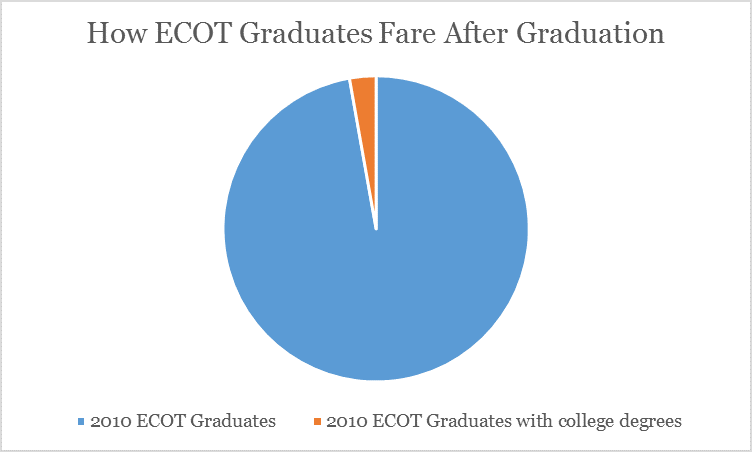
ECOT infamously did a remarkably poor job of educating those who were, by the way. How poor? Only 109 of 3,794 ECOT graduates from 2010 earned a college degree within 6 years of graduating. But I digress.

Back to the school's potential crimes.

According to the whistleblower who made this claim and worked for the software company that handled enrollment for ECOT, "school officials ordered staff to manipulate student data with software obtained following the state’s demand that it return $60 million in overpayments for the 2015-2016 school year."

That's right. ECOT was so arrogant that it ordered people to artificially inflate enrollment ... after the state had fined the school $60 million for inflating enrollment.

That's right. No question what the offenders' states of mind were. They knew it was wrong. They had been fined for doing it the previous year. And they did it anyway. Imagine what they told people to do before they were caught???? (Though, technically, they were caught in their first year of operation and on several other previous occasions, but not for as much money.)

Why the arrogance? Because ECOT's founder, Bill Lager, and other employees had invested $2.8 million in Ohio politicians since they started operations in the 2000-2001 school year.

Current Ohio Secretary of State and Lt. Gov. Candidate Jon Husted receives only known honorary degree from ECOT as Ohio Speaker of the House in 2007. Husted was one of several prominent Ohio Republican politicians who spoke at ECOT's graduation ceremonies, including Gov. John Kasich, Ohio Auditor David Yost, disgraced House Speaker Cliff Rosenberger and Ohio Supreme Court Justice Terrence O'Donnell. 


It wasn't that long ago that people went to prison for inflating enrollment figures at Columbus City Schools. What do you want to bet that the politicians who have taken a bunch of money and kudos from ECOT will do the same thing to that school's officials?

The taxpayer money involved here, if the enrollment overinflation that's been found over the last couple years is extrapolated over the course of ECOT's entire lifespan, is north of $500 million. By way of comparison, the infamous Coingate scandal from 2005-2006 ended up costing taxpayers about $50 million.

So ECOT and Lager's ripoff could be 10 times that of Tom Noe, who spent about 2 years in federal prison.

Now that we have insiders spilling the beans on the real mission of ECOT -- making money by ripping off taxpayers -- ECOT's top bananas certainly seem much closer to taking a trip up the river.

Because we now know their state of mind.

And it sure seems criminal to me.

Tuesday, March 13, 2018

John the Vindictive: How HB 512 Shows John Kasich Hasn't Changed

The image of Ohio Gov. John Kasich has shall we say "evolved" since he first took office. Within days of his 2010 election, he gave a famous speech where he warned Columbus lobbyists that his agenda would be unstoppable. He summed it up this way:
"If you’re not on the bus, we’ll run over you with the bus. And I’m not kidding."
Two months later, he told a room full of people about a story of being pulled over for not giving a passing ambulance the right of way. He called the officer who dared pull him over an "idiot."

A few months later, he passed Senate Bill 5 -- the most direct and serious attack on union rights mounted in the state for generations. But when organizers collected more than 1 million signatures and voters roundly defeated his legislation at the ballot box almost a year after his election, he started "mellowing".

And running for President.

As the last man standing against Donald Trump in the 2016 Republican primary, Kasich turned into a bit of a fuzzy warm reminder for some of what "reasonable" Republicans were -- hearkening to a time when Eisenhower could carry the Republican banner without being drummed out of office. His latest book "Two Paths" is supposed to be the marker for all reasonable Republicans who want to get things done.

But John the Vindictive has not really changed. And House Bill 512 proves it. According to a Plain Dealer story yesterday, John Kasich and current Superintendent for Public Instruction Paolo DeMaria have not met since DeMaria was named Superintendent in 2016. Nearly two years and the Governor hasn't met with the man responsible for the education of 1.8 million Ohio children?

That's weird.

It makes one wonder if Kasich wasn't happy with DeMaria's selection as State Superintendent. And maybe explains why he wants more control over the pick. DeMaria, after all, was a late addition to the finalists list for State Superintendent, indicating he wasn't Kasich's first choice.

As Kasich recently told a forum last month:
"What I really want...I want to be able to run the Department of Education," Kasich said an at Associated Press forum February 2.  "I don't think we should have this elected school board."
Could it be that Kasich instead supported Reynoldsburg Superintendent Tina Thomas-Manning, who famously put in scab teachers to fight the Reynoldsburg teacher strike? In a Plain Dealer story that reviewed the strike, her relationship with Kasich was described this way:
"Some even view Thomas-Manning, superintendent of the Reynoldsburg school district, as a puppet of Gov. John Kasich and former state Superintendent Richard Ross."
Trouble was, at the time the board was considering Thomas-Manning, the Reynoldsburg Superintendent was in a full out war with her Board of Education, with members calling for her to step down in the aftermath of the strike that tore apart the Reynoldsburg community. Not a good look if you're asking another board to hire you.

Thomas-Manning eventually did not have her contract renewed and received a $100,000 golden parachute from the Reynoldsburg Board of Education. Yet she continued to do consulting work for the district as recently as last fall.

Whatever the backroom dealings, it's clear that Kasich is pushing HB 512 to punish the department for something, or some things. One is clearly the board and superintendent's role in closing down the Electronic Classroom of Tomorrow -- a huge, online charter school run by major political donor Bill Lager.

Kasich's first high school graduation address was to ECOT in 2011.

But it appears that Kasich's indifference to the State Superintendent of Public Instruction may have additional roots in DeMaria's unanimous selection as Superintendent by the State Board. And reveal Kasich's real desire to get a more divisive, loyal, union-busting figure at the department. This was the guy who tried to destroy the teachers unions with Senate Bill 5, after all.

But the bottom line is this: With HB 512, it appears that the State Board of Education -- and the voters who put 11 of them in office -- are the latest to be run over by John the Vindictive's bus.

Monday, March 12, 2018

House Bill 512: ECOT's Revenge

Last week, I testified against House Bill 512 -- the political takeover of the state's education system. During that testimony, I mentioned how HB 512 seems an awful lot like payback against the Ohio Department of Education for forcing the Electronic Classroom of Tomorrow to return about $80 million to Ohio taxpayers for kids the former virtual school giant charged taxpayers for educating, but they couldn't prove actually participated.

It reminded me of when you buy an embarrassing item at a store and try to hide the purchase with a bunch of other, innocuous things. Yeah, you might be buying 50 things. But you're really just buying the one thing.

So, I decided to look at the political contributions from ECOT founder Bill Lager and other ECOT-affiliated people to co-sponsors of the legislation. And you'll never guess what I found. ECOT people gave 5 of the 8 HB 512 co-sponsors more than $74,000 in campaign contributions in the 2014 and 2016 election cycles.

Reineke is the primary sponsor of the bill. Blessing is the chairman of the Government Accountability and Oversight committee, which is holding hearings on the bill.

Interestingly, Koehler just announced he is no longer supporting HB 512, even though he is currently listed as a co-sponsor -- never a good sign for your legislation.

If you are trying to argue that this is a bill about kids and not punishing adults, it becomes increasingly more incredible to say that once you see just how supportive ECOT has been to the adults sponsoring this legislation.

Monday, February 19, 2018

ECOT Bills State for Students ... AFTER IT CLOSES

The Electronic Classroom of Tomorrow told the Ohio Department of Education on Jan. 23 that it still had 5,580 students, and the state should pay them for educating those students. Trouble was, the school closed Jan. 19 -- four days before that payment was sent to the department.

That's right. It appears ECOT wanted to be paid for students it said it was educating after the school had closed.

To the Department's credit, they issued no taxpayer money to the state's once largest virtual school based on their Jan. 23 request. But the fact that ECOT, even after the end had come, demanded taxpayer money for educating kids everyone knew weren't there because the school had closed, put a rather tight, ironic bow on this school's sordid history.

Remember, it was the fact they couldn't prove they educated $80 million worth of students over the last two years, which then the state demanded they repay, that led to the school's abrupt closing last month.

But that closure didn't stop ECOT from continuing to demand taxpayers give them money. According to department reports, ECOT's February monthly payment to charter schools is based on data received by the state Jan. 23 -- four days after the school officially shut down. 

Fortunately for taxpayers, the school only billed the state for 5,580 students -- not the 11,876 students the school claimed it had enrolled on Dec. 24, 2017 -- the last date ODE looked at prior to the school's closure.

So that meant that the school, if it only had 5,580 students, had been overpaid by about $11 million because the state had paid the school for educating about twice as many students for the first half of the school year. So the school only needed $41.3 million to educate those students all year. However, the state had already paid the school $52 million through January based on the larger enrollment.

And that doesn't include the $30 million payment the school was supposed to cough up in return for charging taxpayers $60 million for students the school couldn't prove it actually educated in the 2015-2016 school year (another $20 million in overpayments was discovered later by ODE for last school year).

So while the state did its job and didn't pay ECOT for kids it claimed it educated while it was closed, the fact that ECOT actually charged taxpayers for this is incredible.

What a scandal. 

Monday, February 12, 2018

ECOT argues in Supreme Court tomorrow that it should be paid for educating kids it can't prove it educated. Really.

Tomorrow, ECOT will argue before the Ohio Supreme Court that even though it can't demonstrate that more than 60 percent of the students it charged taxpayers for educating actually engaged in educational activity, it should still receive taxpayer money because they could have been educated by them. 

The state forcing the school to re-pay taxpayers $80 million for kids it can't prove ever engaged in any learning experiences at ECOT is eventually what led to the Educational Service Center of Lake Erie West to drop the mega-virtual school last month, forcing the school to close and leaving hundreds of staff and thousands of families in a lurch -- a lurch caused by ECOT founder Bill Lager's love of money and fancy houses (owned under the name NestEgg Development, LLC. I can't make this up)


And while it appears that finances will be what shuts down the state's first and largest online school (though in a welcome departure from pure finances, apparently the Insight School of Ohio, run by K-12, Inc., which also runs the Ohio Virtual Academy -- currently the state's largest online school -- will be shut down for failing kids rather than accountants), ECOT's academic performance for the kids it actually did educate was not much better than those it didn't.

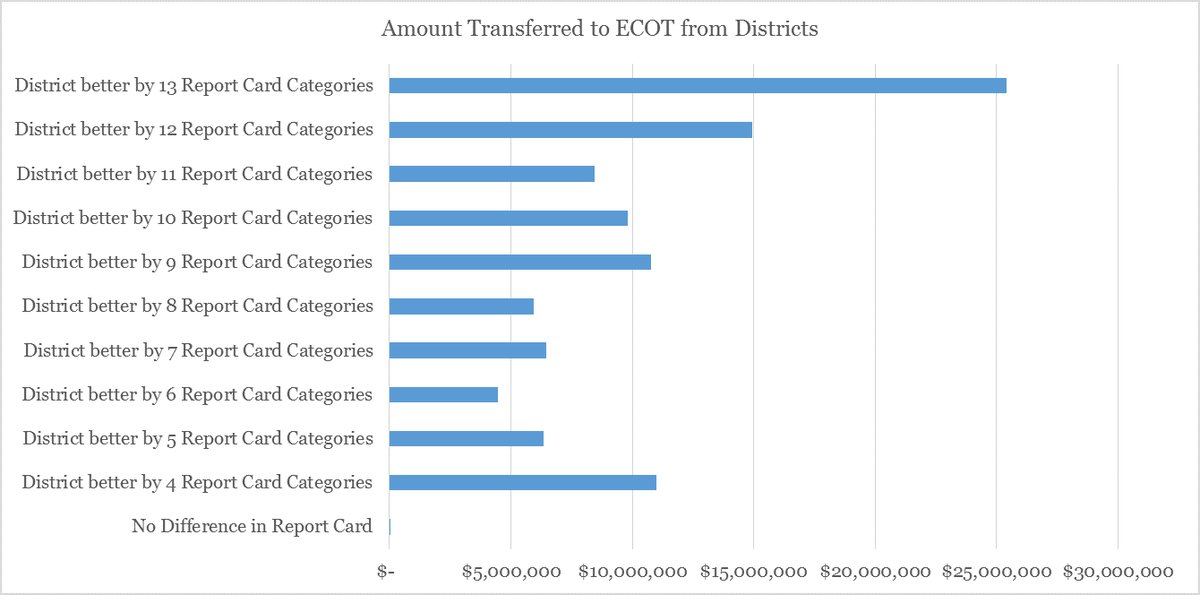
According to state data from the 2016-2017 school year, every penny sent from a school district to ECOT last year (which was more than $100 million) came from a district that outperformed the online giant by at least 4 of 13 state report card categories. And an astonishing 1 out of every 4 dollars sent to ECOT came from a district that outperformed ECOT on every comparable measure.
This is not to say there weren't success stories at ECOT. There were. But in the vast, overwhelming majority of cases, ECOT simply did not provide a better academic option for students than the districts they left.

And while they did graduate large numbers of students, they failed to graduate about twice as many as they actually graduated. Some of ECOT's paid supporters like posting impressive photos of their Schottenstein Center graduations. They never post a filled Fenway Park, which holds about the number of students ECOT failed to graduate since its opening.

One telling metric of the school's long-term impact on kids is how many ECOT graduates have a college degree within six years of graduation. 

When coupled with the fact that ECOT was charging taxpayers tens of millions of dollars to educate kids that never participated in learning at the school, it's clear that this school was not living up to expectations academically or financially.

As I wrote before, ECOT has generally not performed well on state metrics and have been unable to account for the children's learning experiences, but they have until recently been protected by powerful friends in the Ohio General Assembly and state government who benefited from ECOT founder Bill Lager's political largess.

And now the Supreme Court will decide, essentially, whether the school should be paid for educating kids it can't prove it educated and therefore remain open forever. 

Monday, October 16, 2017

State Data: Ohio Charter School Graduates Far Less Likely to Earn College Degrees than even Urban District Graduates

One of the more interesting -- and telling -- datasets now available with the state report card is how kids who graduate from Ohio's schools perform after they graduate. For example, we now know the percentage of graduates who have a college degree within 6 years, as well as how many graduates have enrolled in college within 2 years of graduation.

Looking at these two metrics, it's remarkable how bad charter school perform. Overall, Ohio school districts have 5 times the rate of students with college degrees that charters have. And Big 8 urban districts (Akron, Canton, Cincinnati. Columbus, Cleveland, Dayton, Toledo and Youngstown) have twice the rate.

Meanwhile, of the 31 Ohio charter schools that have graduates counted for this metric, 7 (23 percent) had zero graduates with college degrees within six years of graduation.

And the Electronic Classroom of Tomorrow? That's right.

Only 109 of 3,794 ECOT graduates from 2010 have a college degree today. That's an amazing 2.9 percent. Cleveland -- which had about 100 fewer 2010 graduates as ECOT (not to mention far greater rates of poverty, special education, and minority students) -- had about 3.5 times as many graduates with college degrees as ECOT.

There is only one Ohio charter school with a higher percentage of college graduates than the average Ohio school district -- The Dayton Early College Academy at 42.4 percent -- a remarkably good rate given that Dayton City overall had a 13.6 percent rate. DECA's rate is about the same as suburban districts like Gahanna-Jefferson and North Olmsted, which, considering that about 98 percent of their students come from Dayton, is a great achievement.

But remember that DECA is the exception, not the rule.

Not surprisingly, the number of charter graduates who have been enrolled in college within two years of their high school graduation is also far lower in charters overall than school districts.

Barely 1 in 5 Ohio charter school graduates are enrolled in college within 2 years of graduating high school. More than 3 in 5 school district graduates are, while 2 in 5 urban school district graduates are.

Ultimately, education is about preparing children for lifelong success, not just test scores. Earning a college degree substantially increases lifetime earnings and decreases the likelihood of citizens needing to access the social safety net, as well as running into trouble.

According to this data from the state report card, Ohio charter schools, overall, hurt their students' ability to achieve the million dollar promise of a college education and instead contribute to their students' ability to access the social safety net over their lifetimes.

After $11 billion spent on charters since 1998, is this really the best we can do?

Thursday, September 28, 2017

Shocked. Shocked, I Tell You. ECOT Owes Taxpayers MORE Money.

Put this in the Perfectly Predictable bin. Looks like the Electronic Classroom of Tomorrow (ECOT) could only account for about 81 percent of the students it billed taxpayers for "educating" last school year. And this was in a year when ECOT should have been extra careful because the year before it could only account for 40 percent of the students it billed taxpayers.

So now the school, which produces more high school dropouts than any other school in the nation, owes another $15 million ON TOP of the $60 million it already owed taxpayers. All I can say is the school should be grateful the state isn't going back for the previous 15 years of enrollment figures because if they did, ECOT would likely be shown to have fleeced Ohio taxpayers to the tune of more than a half billion dollars.

All while top state officials spoke at their graduation ceremonies -- ceremonies that included not even four out of 10 kids who were eligible to walk across the stage.

This comes on top of the news that not a single of the $103 million that went to ECOT last year from Ohio's public school districts came from a district that the school outperformed  on the state report card. And nearly one in four dollars sent to ECOT came from a school district that outperformed ECOT in every available measure.

A few more nuggets:

  • A spectacularly low 2.9 percent of ECOT's 2010 graduates had a college degree within 6 years of graduation. Only New Miami Local in Butler County had a lower rate among Ohio's 613 school districts.
  • An even more spectacularly low 0.3 percent of ECOT students attained an industry recognized credential. Most of the 24 school districts with the same or lower rates are districts like Hudson and Dublin that are wealthy and whose students are geared toward college, as that group's 40 percent rate of attaining college degrees within 6 years indicates (as noted above, ECOT's rate as 2.9 percent)
  • Their Performance Index score -- the accumulated index the state uses to determine  proficiency -- was lower than any district
  • The school's student growth index was -39.5. A score between -1 and 1 is considered a year of growth
  • ECOT -- a virtual school without walls, buses, lunch ladies, or janitors -- received $7,291 per pupil in state funding last school year -- an amount greater than 85 percent of school districts. And if they did not educate 19 percent of their students as the Ohio Department of Education now claims, their per pupil funding for the kids that they did "educate" jumps to $8,923 -- an amount greater than 96 percent of Ohio school districts
This school is an embarrassment to this state. And even to this nation. The Ohio General Assembly has allowed this hog to wallow far too long. It's time to shut down this school. I'm sorry. I'm sure some kids have been saved at ECOT. I'm sure some parents love it. It's these parents and kids who should be most upset with ECOT's continued bumbling and malfeasance, though, not we who report its existence. 

All I lost were my tax dollars. 

But every time ECOT does something like this, it harms these students' diplomas and what I'm sure was a lot of hard work. But remember this is not these kids' or parents' fault; it is the fault of Bill Lager -- the politically connected ECOT founder and for-profit operator who Ohio's taxpayers have made a millionaire many times over; it is the fault of the Educational Service Center of Lake Erie West, who could instantly solve this issue by canceling its oversight of the school, but instead has pushed to give the school an easier report card; and it is the fault of compliant politicians who thought it was more important to keep a campaign finance gravy train going than it was to stand up for kids.

State Auditor David Yost, for example, has been coming down hard recently on ECOT. But here's what he said just two short years ago (remember, I and we at Innovation Ohio reported as far back as 2011 that ECOT and Ohio's other eSchools were a problem):
"It's not your failure that defines you. It's the success that flowed from your decision to enroll in ECOT ... You tell them I'm the employee you're looking for. I'm organized and I'm disciplined and I get the job done because that's the way we do it at ECOT."

Wednesday, September 27, 2017

ECOT gets easier report card. Old one shows 1 in 4 ECOT dollars come from districts that outperform them in EVERY measure.

Now that it appears the Electronic Classroom of Tomorrow -- the state's largest online school and the nation's largest producer of high school dropouts -- will be classified as a dropout recovery and prevention school (without a hint of irony) by the Ohio Department of Education, it is useful to look at just how dreadful ECOT's performance has been.

In the 2016-2017 school year, ECOT received $103 million in state money meant for kids in Ohio school districts, but which went instead to ECOT. Not a single penny came from a district that performed worse in more report card categories than ECOT. Only $2,204 of the $103 million came from a district whose performance was the same.

But here's the amazing stat: More than $25 million of that $103 million came from districts that outperformed ECOT in EVERY SINGLE COMPARABLE REPORT CARD CATEGORY!

That's right. One out of every 4 dollars going to ECOT comes from a district that in every way outperforms ECOT -- the largest single chunk of state funding transfers to the school.

Yet with this dropout designation, they will be allowed to remain open and unaccountable for many more years. And in an absolute indictment of Ohio's horrific dropout recovery laws, ECOT will now become one the state's highest performing dropout recovery schools.

This is just embarrassing. I hope the legislature takes note and addresses this shameful performance, not just by ECOT, but also the state's regulatory scheme that has allowed this school to thrive when all manner of data tells us to shut it down.

Tuesday, September 12, 2017

ECOT's Dropout School Application Looks Like My Son's T-ball Registration Form

Look, I know you shouldn't judge a book by its cover, but would you look at the "application" the Electronic Classroom of Tomorrow filled out to become a dropout recovery school so it could escape scrutiny and continue collecting hundreds of millions of our hard-earned tax dollars while continuing to be the nation's top producer of dropouts?

It looks like my son's T-ball registration form.

And look at the school's population estimates: 15,000 total students and 8,000 dropout program participants. Really? Perfectly round numbers? Don't the people of ECOT have actual enrollment figures, complete with the students' ages? It sure seems to me that they're kind of spitballing this.

Want more proof?

They actually scratched out their sponsor's identification number, wrote out the number above the scratched out number ... AND TURNED IT IN! 

What, there wasn't any Wite-Out available? Man, $100 million doesn't pay for what it used to, I guess.

Would you let your kids turn in this work to their teacher?

ECOT not only turned this in to ODE, but the school could receive hundreds of millions of taxpayer dollars as a result.

Incredible.

I don't know. I kind of expected more from ODE's application process. If you can apply to become a dropout recovery school and essentially escape all accountability and scrutiny, shouldn't it be a little more rigorous than something that looks like it was written on the back of a napkin? Or at least didn't have grammar school errors on it?

Am I just sensitive?

Or is this just par for the course for a school that owes Ohio taxpayers $60 million because it couldn't prove it educated 60 percent of the kids it claimed to educate in the 2015-2016 school year?


2013 Ohio State Study Shows ECOT Bad at Preventing or Recovering Dropouts. Now ECOT wants to Specialize in It.

Four years prior to the school's application to be considered a dropout recovery school this summer, the Electronic Classroom of Tomorrow -- the state's oldest and largest online school -- was found to be Ohio's leading producer of high school dropouts while only recovering 1.5 percent of those dropouts.

In a 2013 report completed by Ohio State University's Education Research Center, the authors concluded that between 2006-2010, ECOT produced 13,000 dropouts, or 21.5 percent of all dropouts in Ohio's charter schools. In 2010 alone, ECOT had 2,908 dropouts -- nearly double the number of the Cleveland Municipal School District's 1,600. At the time, Cleveland had nearly double the students enrolled as ECOT had, according to the report.

In the interest of fairness, the ECOT enrollment data included in the report differs greatly from reported enrollment data at the Ohio Department of Education. It is not clear from the report how the researchers reached their enrollment figures when they calculated the dropout rate, but it appears they only included students who were 16 years or older.

In addition, the researchers found that of those 2,908 students, only 75 returned to ECOT. Of the 13,000 lost during the previous 5 years, ECOT only recovered 194 -- a dreadful 1.5 percent recovery rate.

The researchers concluded that
"it is clear that the Electronic Classroom of Tomorrow strongly influences the dropout numbers of this region (Ohio's urban districts). Reducing dropouts at this one school could improve the problem significantly."
What is critical to remember is that this study compared ECOT's impact on dropout prevention and recovery with urban districts in the state -- traditionally the top producers of high school dropouts among Ohio school districts. And among even those, ECOT was particularly awful.

If ECOT's 53 percent dropout rate reported by the Ohio State researchers held consistent for all its eligible students since the school opened in the 2000-2001 school year, ECOT could be said to have produced about 40,000 dropouts during its existence.

That's about how many people live in Lima.

Yet now ECOT, which the state has known for at least four years is the largest single contributor to Ohio's dropout problem while recovering barely any of those dropouts, wants to be called a dropout prevention and recovery school -- a special designation that brings with it plenty of protections from accountability and perpetual existence.

As the Plain Dealer reported today, ECOT's claims to have an impossibly difficult population of students to educate are clearly out of line with its actual population. If ECOT received the dropout designation, it would have among the least challenged populations in any dropout recovery school. Yet it would be paid far more than any other.

The Ohio Department of Education, which is reviewing ECOT's application, should heed the warnings it received four years ago and not allow ECOT to hide from scrutiny, insisting instead that ECOT improve its performance dramatically for its kids.

Perhaps the department should at least insist that ECOT stop producing the most dropouts of any school in the nation before it says ECOT should specialize in preventing and recovering dropouts.

That, I believe, would be a great place to begin.

Friday, August 25, 2017

How to Turn an Ineffective Charter Sponsor into a High Performing One: Make ECOT a Dropout School

In a little-noticed detail of the Electronic Classroom of Tomorrow's (ECOT) attempt to become a Dropout Recovery School, potentially the greatest beneficiary of the shift would be ECOT's sponsor -- the Educational Service Center of Lake Erie West.

Here's how.

Under current law and the school's current configuration, the ESC of Lake Erie West is hammered on its sponsor evaluation grades because such a large percentage of the students it oversees come from ECOT. According to the Plain Dealer, "Poor grades, largely from the 15,000-student ECOT, dragged that ESC's rating down to 'ineffective.'"

ECOT and its allies tried to change the House Bill 2 provision that weighted enrollment during the evaluation because they wanted the 15,000 student school's grade to be counted just as heavily as a school with 60 or 100 students.

The legislature did not grant that request, so ECOT's poor grades have a tremendously negative impact on the ESC of Lake Erie West's ability to sponsor schools and collect their 3 percent sponsorship fee.

This put the ESC in a bind because as an "ineffective" rated sponsor, it had to improve its rating in three years or get shut down, yet if they cut ECOT loose, they would lose about $3 million in fees they currently collect -- a gravy train for the ESC.

Switching the school to a dropout recovery school solves the problem. Why? Because performance is so dreadful at dropout recovery schools, and state regulation so lax, that even ECOT's poor performance would grant them exceedingly high grades under the much more lenient dropout recovery accountability system.

So the weighted system that hurt the ESC when ECOT was getting Ds and Fs under the regular report card will not help the ESC because those Ds and Fs will turn into As under the more lenient system.

And all they need to do is change the school's designation.

For example, ECOT's graduation rate of 39.6 percent rates as a very low F on the regular state report card. However, under the dropout recovery report card, that 39.6 percent four-year graduation rate "exceeds standards", which means it will be graded on the sponsor report card the same as an A on the regular report card. The ESC will then have that "A" weighted by the 15,000 students in ECOT, making the A a kind of Mega-A.

So, not only does this let ECOT suddenly promote itself as receiving the highest grades possible by the state (even though there's no real improvement), but it allows the ESC to continue collecting millions all while having its sponsorship grade improve dramatically, potentially allowing it to collect millions more in sponsorship fees from additional schools.

But nothing has changed at ECOT.

Just because dropout recovery schools are worse performing than ECOT doesn't mean ECOT is high performing. It means that once again, ECOT is gaming a system its politically connected founder, William Lager, helped create with legislative blessing.

Those who suffer most are the students and parents at ECOT who will undoubtedly be roped into thinking ECOT is a high-performing school for their kids, even though it is a national embarrassment.

Only in Ohio's feebly regulated dropout recovery school system would ECOT be considered anything other than a failure.

Wednesday, August 23, 2017

ECOT's Latest Gambit May Already Be In Trouble.

I wondered when this was coming. But apparently, the Electronic Classroom of Tomorrow -- the most scandal-ridden charter school in the state that owes taxpayers $60 million in overpayments from just one year of instruction -- now wants to be classified as a dropout recovery school.

The problem is, they can't do it unless they once again manipulate student counts. They either have to suddenly drop about 1,200 students off their rolls, or find thousands more students. While that can certainly happen, my guess is they will have to perform all kinds of enrollment gymnastics to do it. Of course, they've been pretty good at that in the past.

Why would they have to do this contortion? Because as a charter school, they have to accept everyone who comes through their virtual door, just like a local public school. They can't just drop a bunch of kids so they can get a new state designation that can save their financial bacon.

Why would they want to do this? Changing to a dropout recovery school means that the state can never really close ECOT, and their grades won't hurt their sponsor -- the Education Service Center of Lake Erie West. Oh, and they can just keep expanding and expanding without fear of recourse.

Dropout recovery schools have been a major embarrassment to Ohio for years. And they are the recipients of one of the last bastions of legislative loopholes for politically connected charter school operators. In order to avoid being shut down, they can improve their graduation and test passage rates by 10 percent a year in two consecutive years. However, this benefits the worst performing schools because improving from a 1.7 percent graduation rate to a 2.1 percent graduation rate over two years is much easier (it can mean simply getting 1 or 2 more kids to graduate) than going from 40 percent to 48 percent.

So, ECOT can't graduate 4 out of 10 kids, which is a failing grade as a start-up charter school as they are currently classified. But their putrid graduation rate would "exceed expectations" as a dropout recovery school.

Kind of tells you just how bad our dropout recovery regulations are, doesn't it?

Of course ECOT wouldn't answer questions about the switch, like why it took them 20 years to suddenly realize they would better serve kids as a dropout recovery school. But here's the other thing: to be classified as a dropout recovery school, the ECOT contract with their sponsor now says that "50 percent of students must be 16 or older, and behind by at least one grade level, or have experienced a crisis that interferes with them attending a traditional school."

State regulations say that dropout recovery schools -- in order to have the designation -- need to have the following requirements:

Any community school in which the majority of students are enrolled in a dropout prevention and recovery program operated by the school that meets the following criteria:
a) The program serves only students not younger than sixteen years of age and not older than twenty-one years of age;
b) The program enrolls students who, at the time of their initial enrollment, either, or both, are at least one grade level behind their cohort age groups or experience crises that significantly interfere with their academic progress such that they are prevented from continuing their traditional programs;
c) The program requires students to attain at least the applicable score designated for each of the assessments prescribed under division (B)(1) of section 3301.0710 of the Revised Code or, to the extent prescribed by rule of the state board of education under division (D)(6) of section 3301.0712 of the Revised Code, division (B)(2) of that section;
d) The program develops an individual career plan for the student that specifies the student's matriculating to a two-year degree program, acquiring a business and industry credential, or entering an apprenticeship;
e) The program provides counseling and support for the student related to the plan developed under division (A)(4) of that section during the remainder of the student's high school experience; and
f) The program's instructional plan demonstrates how the academic content standards adopted by the state board of education under section 3301.079 of the Revised Code will be taught and assessed;

I don't think ECOT -- as currently constituted -- can meet this definition, unless they un-enroll a bunch of kids.

According to ECOT's student enrollment count from October 2016 -- the latest count data available -- ECOT had 13,895 kids enrolled. Of that, 8,167 kids were in grades K-10. That means nearly 6 in 10 kids were likely under 16 years of age, let alone behind by a grade level or going through a crisis.

Now, those other non-age requirements are pretty simple to achieve, but in order for ECOT -- as currently constituted -- to meet those definitions, they have to drop at least 1,200 students and argue that every single 11th and 12th grader in their school is behind by a grade level or in a crisis.

So they will probably need to un-enroll more kids.

Of course, they could also target their ads toward recruiting more 16+ dropout students. But in either case, they will have to once again manipulate their enrollment figures to figure out a way to continue plundering taxpayer money.

Shameful.