Wednesday, January 5, 2022

Voucher Lawsuit Filed, Voucher Proponents Dissemble

Now that a group of 100 school districts have formally sued the state over the EdChoice Voucher program, it's time for voucher proponents to trot out their favorite canard -- vouchers give students of color opportunities they wouldn't otherwise have. And to oppose vouchers is to oppose opportunities for students of color.

Total crock.

The reason this canard is so pernicious is simple: It's not true, and in fact, the opposite is true. Vouchers are disproportionately distributed to white students, leading to greater overall segregation in public school districts and communities of color with substantially fewer state resources to educate students in those communities.

This is the stat that voucher proponents love to quote, and it's what Greg Lawson (a guy I actually like personally, despite our profound policy differences on this and nearly every issue) from the Buckeye Institute articulated in the Dispatch story yesterday:

"Greg Lawson of the Buckeye Institute said the data on who takes vouchers varies from school to school, but overall more minority students use EdChoice. 

Ohio is about 82% white, according to data from the U.S. Census Bureau. But 50% of the students who take an EdChoice scholarship identify as white or non-Hispanic, according to the Ohio Department of Education. 

'The choice is there for everybody regardless of what demographic box they check,' Lawson said."

What Greg and others "forget" is that EdChoice doesn't apply to every school district in the state. In fact, according to data from last school year, only 164 of Ohio's 613 school districts lost any state funding to the EdChoice Voucher transfer last year -- a $164 million deduction from districts' state aid. However, 95% of that funding came from just 38 school districts. Want to take a gander at the demographic makeup of those 38 districts? You guessed it. Overwhelmingly non-white. How overwhelmingly? 

Try 68% non-white.

Sounds a whole lot different from the 82% white stat Greg mentioned, doesn't it? In fact, of those 38 districts, only Wilmington was close to the 82% white stat.  

Why would he try to repeat the 82% stat when only 1 district in the entire state that loses substantial state aid to EdChoice fits that description?

Because if only 50% of the voucher recipients are non-white, yet the communities from which the students come are almost 70% non-white, it kinda kills the whole "giving people of color an opportunity" argument.

Yeah.

The lawsuit addresses this nicely by looking at community and school makeups. However, another way to look at it is at test takers because that's the only demographic data we have readily available for voucher recipients. As the Cincinnati Enquirer reported a couple years ago, so many voucher recipients were never in the public schools to begin with that large-scale demographic breakdowns are next to impossible.

Here's what we do know. In Lima, about 35% of students in the public school are white. Yet there are 5 private schools taking EdChoice vouchers from Lima -- all taking at least $242,000 or more from Lima City Schools' state aid. Here are their proportion of white EdChoice recipients: 

Temple Christian                    100% White

Lima Central Catholic            71% White

St. Charles                               82% White

St. Gerard                                80% White

St. Rose                                    34% White

Again, this demonstrates pretty clearly that vouchers, rather than granting students of color greater opportunities, instead are granting white students greater opportunities to leave their more racially integrated public schools and attend a more racially segregated private school option. And in the meantime, it's leaving districts with substantial majorities of non-white students with less state revenue with which to educate them.

Sounds like the program actually results in a bad overall outcome for communities of color, doesn't it? 

(Notice how voucher proponents never discuss the impact of their program on students who don't participate in it. I digress.)

This is not just a recent phenomenon, either. In 2002, Policy Matters Ohio looked at the Cleveland Voucher program, which at the time was the only voucher program in the state and served as the model for the 2005 creation of the EdChoice voucher. What did they find?

"Students in the voucher program, in addition to being more likely to come from private schools or from higher-performing public schools, are less likely to be African-American than students in the district at large. Just 53 percent of Cleveland voucher students were African-American in this school year, while 71 percent of Cleveland Municipal School District students last year were African American, according to a separate analysis by Catalyst and the Northern Ohio Data and Information Service at Cleveland State University’s Levin College of Urban Affairs."

Seems that for more than 20 years now, legislators have known that vouchers are disproportionately going to white students, yet they have done nothing to address this. 

Someone might want to ask them about that.

Oh yeah. One more thing. It was interesting to read that not even the outrageously histrionic Aaron Baer mentioned in the Dispatch the whole original argument for the voucher program to begin with: it provides better options for kids in "failing" public schools. 

That's because we now know, thanks to more than a decade of comparative testing, that vouchers actually harm student achievement.

Even the Fordham Institute -- an avowed voucher proponent -- agreed in 2016 when it found that vouchers actually reduced student achievement. This was affirmed in 2020 when the Cincinnati Enquirer looked at test scores of voucher recipients and compared those scores with scores of students in the communities in which the private school resided. The paper found that 88% of the time, the public school students outperformed the private school students.

To voucher proponents now what matters now is the choice, not the outcomes from that choice apparently.

So let me bottom line this program: it leads to more racial segregation, deprives communities of color much needed state educational aid and provides less successful student outcomes. 

But hey, let's throw hundreds of millions more of our tax dollars at this thing

Maybe that'll help.

Or...maybe someone ought to sue.

Wednesday, April 28, 2021

Desperate Times Call for Desperate Arguments, or How To Avoid Investing in Students


The Ohio House of Representatives included the Fair School Funding Plan (FSFP) in its version of the state's biennial budget last week. And already State Senators are pooh-poohing the work of the House Speaker and others -- work that took nearly 5 years to complete. 

Why you'd rip apart the life's work of a House Speaker of your own political party, I have no idea. But let's move on.

There seems to be a common argument being made against the Fair School Funding Plan -- an argument that I thought I'd debunk for you here, Dear Reader.

It goes something like this: The FSFP bases its annual teacher salary -- the largest cost driver of the formula -- on old data. Therefore, when it's calculated in later years, the salaries will skyrocket. Therefore, the formula will cost double, triple, no infinitely more! than the current $1.8 billion plus price tag.

This is utter nonsense.

Between the 2005-2006 school year and this past one, teacher salaries have increased at about 1/3 the rate of inflation, not the huge percentages some in the Senate claim.

And while, yes, additional federal and state money from the American Recovery Plan and the FSFP, respectively, may lead to salary increases, they'll also lead to more teachers being hired, which tends to be at lower salary grades. 

One more thing. The FSFP does not include in its average salary calculation any salaries over $95,000 a year. So let's say half the districts in the state decide to pay their teachers $1 million a year. Not a single one of those salaries will be included in the teacher salary calculation used by the FSFP. 

Not. A. One.

This is a bogus argument meant to stymie the first real hope in over a decade of finally fixing the state's school funding system -- a system that remains unconstitutionally over reliant on property taxes. We're currently at the highest level of local property tax reliance since 1985.

I think what's at play here is very simple: State Senators have been used to underfunding education for so long that when you suggest that (gulp) state aid should actually track with student need, they blanche. 

"Can't you spend what you did 25 years ago and get better results?" they ask. Because that's essentially what they've done and demanded for the last quarter century.
.

The FSFP actually says, "Let's get the money necessary to meet kids' needs today and into the future."

But State Senators don't know how to cope with that. You know. Providing the money that's needed. They just want to provide the money they think kids deserve. Because that's what they've always done.

I'm thrilled the Ohio House decided to break that three-decade-long cycle.

Now let's work on the State Senate to get them to see the light too. Now's the time.

Thursday, March 11, 2021

Let's Talk Charter Schools

Let's discuss charter schools -- a topic you've seen a lot of on this blog over the years, but has kind of gone away recently for obvious (COVID) and non-obvious (Vouchers/School Funding) reasons.

Despite House Bill 2, which was supposed to slim down our notoriously poor-performing charter school sector and the closure of the nation's largest online school -- ECOT -- which closed because the school literally stole hundreds of millions of tax dollars to educate kids they never educated, we are currently spending more on charter schools than any other year on record. 

By a mile.


According to the latest Charter School funding report from the Ohio Department of Education, we are set to spend $999.7 million. The previous record was $955 million from the 2015-2016 school year -- the high-point of the ECOT years.

Despite this massive recent increase (an extraordinary $111 million jump ... over two years), it's not because we've had more students attending charters than ever. 

No. That record remains the 2013-2014 school year when 122,130 students attended charters. 


It's because Ohio politicians have continued bumping up the per pupil amounts flowing to charters. So now kids in Ohio charters, on average, get nearly $8,500 per pupil in state aid -- about double what that same kid would receive in a local public school.

As I've recounted for more than a decade, because of the way we fund charters, that means that local property taxes have to subsidize charter school kids.

It doesn't take a Ph.D. in Rocket Science to understand that if you're removing $8,500 in state aid from a district for a kid the district was only getting about half of that from the state to educate that the difference has to come from somewhere.

This year, that subsidy is slated to be $148 million. And in some districts, it's really high. Like in Columbus where $62 million in local revenue has to subsidize the state funding deduction for charters. 

As an aside, this local subsidy problem could be fixed with House Bill 1, which would directly fund charters and vouchers, among other great things.

Anyway, don't be shocked when you start hearing charter school proponents talk during this budget cycle about charter funding "equity". 

By the way, "equity" in this sense means equality, not the equity you and I think about -- like making sure kids from disparate backgrounds and challenges receive the additional supports they need to succeed. No. When charter folks say "equity", they mean the state should pay charters what districts get from state and local revenue. 

Just keeping it real.

Anyway, the data demonstrates pretty clearly that charter schools have plenty of money right now to educate their kids. Why? Because they don't have to adhere to 150 plus state regulations, pay for buses and pay their teachers 40% less, on average, than districts with leaner benefits.

So you don't have to spend nearly as much in a charter as you do a district.

Want proof?

Let's look at the state's annual expenditure report.

Last year, here's what the average charter and district spent per pupil in six categories: Overall, Instruction, Pupil Support, Staff Support, Operation Support (buildings and buses) and Administration.


Interesting, isn't it? Charters, overall, only spend about $386 less than a school district, even though school districts raise local revenues. Something even more amazing? If you had charters spend what districts did on administration, they could spend what districts do on instruction and pupil support, and have $397 remaining! Which means they could actually spend what districts do in every category but operation support -- not a major issue because charters don't bus many, if any, kids. 

If only charters spent the same 14% of their revenue on non-instructional administrative costs rather than the 24% they currently spend.

I ask you, dear reader, do you think that charter schools need more money? Or more efficiency? 

Hmmm. Where have I heard THAT before? Oh yeah. From charter school proponents about local public school district spending. 

Anyway...

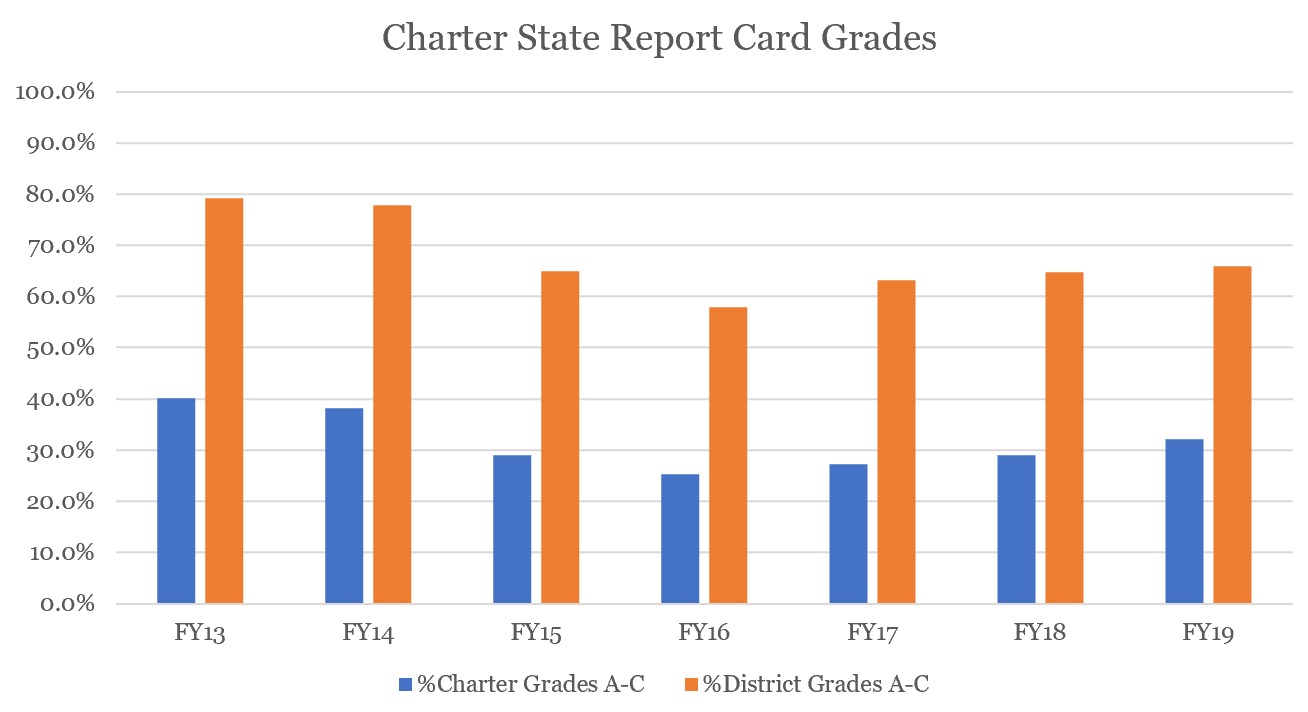
Oh yeah. One more thing. Here's a list of all A-C charter school state report card grades ever earned. 


I give you this overall horrible performance for you to mull over as the state considers investing more than $1 billion in this education sector that's produced more state report card grades of F than all others combined since we've had the A-F system.

Friday, July 24, 2020

Next Speaker Could Be Author of New School Funding Plan. Phoenix Rising?


State Rep. Robert Cupp
State Rep. Rick Carfagna
Apparently, one of the leading names to come out of the Larry Householder collapse amid the state's largest ever, $60 million public bribery scandal is Robert Cupp. Yes THAT Robert Cupp -- the Cupp in the Cupp-Patterson school funding plan.

While I had some reservations about the plan -- namely its equity and some basic calculations -- it is undoubtedly the best school funding plan to come around in over a decade and would put us in a much better school funding place than we are today.

The plan had significant legislative support, but never from Householder, who was (correctly) concerned about the plan's equity.

So does this mean the Cupp-Patterson could soon rise from the ashes if Cupp is sitting in the Lincoln Chair?

Before you get too excited, Cupp isn't the only rumored name out there. Another is State Rep. Rick Carfagna. I don't know what he knows about K-12 funding, but I worked with him on the state's higher education budget last cycle, and I came away impressed.

He listens.

He learns.

He spent several meetings trying to educate the higher education subcommittee on finance (which he chairs) about how higher education funding works -- not an easy task.

While he wouldn't have the instant, deep knowledge of school funding that Cupp does (the state's district profile report that outlines data for every school district in the state bears his name), I'm sure Carfagna would be willing to listen to the school funding needs of this state.

Just not sure it would happen this year.

As for Cupp, his choice would be very interesting. If he's picked, one way the House could begin to  put the Householder mess behind them is to pass the Cupp-Patterson education reform plan. Do something Householder was opposed to (for the right reasons, I might add, but still...) while doing something big and bold for kids and families.

It would certainly change the topic.

The plan's fate in the Senate is less certain.

But passing the Cupp Patterson plan through the House (it's already had tons of hearings) would be a major step forward for education funding in this state. And who better to push it through than one of the plan's namesakes?

Oh yeah. There's one final complication.

Cupp took $24,000 from First Energy.

Carfagna?

$0.

Wednesday, July 22, 2020

Larry Householder is as corrupt as the day is long. But on Education Policy, he fought the good fight.


Look, we all knew what we were getting into with Larry Householder's return to the statehouse, which effectively ended yesterday when he was arrested by the FBI as the ringleader of a $60 million bribery enterprise.

He had already left the speakership under a cloud of suspicion in 2004. And around Capital Square, it was pretty much assumed -- only partially in jest -- that if you wanted to get anything done, it had to be quick because his dalliances with corruption were sure to draw law enforcement attention.

No more was this felt than in my sector -- Education Policy.

Larry Householder has long been an advocate for fixing our state's broken education funding system, though (importantly) he never got it done. He has stood up for funding of poor kids and black and brown kids. He has been a voucher skeptic and called for the end of for-profit charter schools.

Yet he took tons of money from ECOT -- a for-profit school involved in a $200 million scandal that still dwarfs Householder's caper, by the way.

But it is on school funding that Householder really wanted to leave a mark. It's often told that he claimed it would take a "Perry County Speaker" to fix the problem first addressed by a Perry County judge in the DeRolph case in 1994.

He was the one resisting the Cupp-Patterson education funding plan, even though an overwhelming majority of legislators were for it, because he thought it didn't do enough for kids in poor districts -- a sentiment I shared.

He's also the one who kept the voucher expansion plan championed by state Sen. Matt Huffman from going through and insisted on direct funding of all vouchers so it wouldn't come directly out of school districts' bottom lines.

He didn't like Ohio's overtesting of kids, nor was he a fan of the state report card. He even publicly called out its bias against poor kids and black and brown kids. In fact, he said the reason people flipped out over the voucher expansion was because wealthy suburban schools were suddenly facing the issues that poor and black and brown districts have been facing for years.

Yes, he had a fondness for ECOT (and founder Bill Lager's campaign money). And that was a problem. But he famously called for the end of for-profit charter school operators, like Lager.

On education policy, Larry Householder was one of the few Republican lawmakers I've witnessed who not only got school funding, but wanted to do something real to fix it and had the power to do so.

But wow. Was he corrupt.

He's getting what he richly deserves. But I guess what I'll always think about Larry Householder -- whose prodigious political talent was eclipsed apparently only by his insatiable appetite for money and power -- is what a waste.

He could have fixed school funding.

He could have instituted a better, more reasonable testing and accountability system.

He could have brought sanity to our out-of-control voucher problem.

He could have eliminated the for-profit charter school operators who have ripped off taxpayers for three decades.

He could have done so many good things for schools, kids and parents. Instead, he preferred shaking down companies to maintain power.

It's a sad day for Ohio. But I'll think of Larry Householder's fall as another unfortunate and significant step backward in our state's four-decade-long struggle with school funding.

It's up to us to chart a new path forward. Hopefully with legislators who, like Householder, get school funding, but without the voraciously corrupt appetites.

Monday, July 20, 2020

Ohio Charter Schools get More Per Pupil Federal COVID Relief Money than Many School Districts Received in State Aid. What Gives?


Included in the $2.3 trillion CARES Act passed in March to cope with the COVID-19 crisis was something called the Elementary and Secondary School Emergency Relief Fund, or ESSER. This fund set aside $13.2 billion for K-12 schools to cope with the new normal in preparing education spaces for COVID-19. Things like enhanced cleaning, or preparing online learning material, or maximizing spaces to ensure social distancing for potential return to school were the expenses contemplated for this money.

Every school qualified, including charter schools, for this money, some of which was passed out again last week. The money was and is essential to maintain public education through this crisis.

However, only charter schools would qualify for another program included in the CARES Act – the $669 billion Payroll Protection Program (PPP) -- a fund meant to keep small businesses and non-profits afloat during the economic shutdown. Public entities like school districts and local governments did not qualify for the program, which has been essential to keeping businesses from collapsing.

But charter schools, which are organized as 501c3 non-profits, did qualify.

So did their sponsoring organizations.

So did their management companies.

All tolled, a charter school could receive federal money four ways:

  1. Through ESSER, just like every school district in the country
  2. Directly to the school through the PPP
  3. Indirectly through their sponsoring organization through the PPP
  4. Indirectly through their management company (which could be non-profit or for-profit) through the PPP

This resulted in the typical Ohio charter school receiving as much as $817 in total federal CARES Act funding while the typical Ohio public school district only received $150.

That’s more than 5.4 times as much.

In fact, many charters received more per pupil federal aid through CARES Act funding than many public school districts received last year in state aid!

When schools that educate 90 percent of your children get 5.4 times less federal revenue to stay afloat than schools that educate 6 percent of your children, perhaps it's time to examine that federal revenue stream's equity.

Perhaps most outrageous is this result: Children in nearly 1 in 10 charters each received as much federal aid through the CARES Act as children in Columbus – Ohio’s largest school district – received in state aid this year!

There are other shocking incongruities. In no particular order:

  • Charter Schools received as much as $82.3 million in PPP funding either directly or indirectly. They only received $55 million in ESSER funding.
  • Of the bottom half of all districts and charters in per pupil CARES Act funding, only 9 were charters; 444 were districts. 
  • Meanwhile, 97 percent of Ohio charter schools were in the top half of total federal per pupil aid.
  • The top 98 per pupil federal revenue recipients were all charter schools, representing more than 1 in 3 Ohio charter schools.
  • Children in 2 of 3 Ohio school districts got less per pupil federal aid than children in the charter with the lowest total federal aid. 
  • Meanwhile, children in 116 charter schools got as much as $1,000 (or more) each in federal aid. Children in only 3 districts did (Bloomfield-Mespo in Trumbull County, Youngstown and East Cleveland -- the last two of which are state takeover districts). 
  • One charter school (SMART Academy) got as much as $26,000 per pupil in federal money. 

Not every charter school quadruple dipped. But some did. Here’s how it worked in some cases.

The Academy of Urban Scholars in Columbus

  • $108,961 through the ESSER aid that was available through the CARES Act to all Ohio schools. 
  • As much as $700,000 in direct aid from the PPP. 
  • Sponsored by the Buckeye Community Hope Foundation, which received as much as $1 million in PPP funding, the relative share of which is $22,265. 
  • They are run by the National Center for Urban Solutions, which received as much as $350,000 in PPP funding -- $213,195 of which would have gone to the Academy.
  • That’s more than as much as $1.04 million in federal CARES Act funding for the school, which has 305 students, which works out to as much as $3,424 per pupil – about the same amount as each student received in state aid last year in Putnam County’s Ottawa-Glandorf Local School District.

There is even one charter school that quintuple dipped.

Village Preparatory School Woodland Hills

  • This school received $501,215 through the ESSER aid
  • They received as much as $1 million in direct PPP funding
  • Village Prep Woodland Hills was sponsored by the Buckeye Community Hope Foundation. Village Prep’s share of the up to $1 million Buckeye received from the PPP would be as much as $35,989.
  • Village Prep is run by the Breakthrough Schools, which received as much as $1 million in PPP funding. However, Breakthrough also has a fundraising arm called the Friends of Breakthrough Schools, which received as much as $350,000 from the PPP program. Village Prep’s share of the $1.35 million total between the operator and its fundraising operation would be as much as $234,668
  • Village Prep Woodland Hills received as much as $1.77 million in federal aid for its 493 students – as much as $3,594 per student, or almost the exact amount of state aid each student received in Tuscarawas County’s Garaway Local School District this year.

Others only triple dipped, but did so at large amounts.

KIPP Columbus

  • The school received $1,081,480 in ESSER funding available to all schools
  • The school also received as much as $5 million in direct PPP funding
  • KIPP is sponsored by the Thomas B. Fordham Foundation, which received as much as $1 million in PPP funding, with KIPP’s proportionate share being as much as $256,987 of that
  • So for KIPP’s 1,373 students, it was able to draw down $6.4 million in federal CARES Act funding. That’s $4,638 per student, or as much as $1,379 more than what every student in Columbus received this year in state aid.

No school district could double, triple, quadruple or quintuple dip into federal revenue streams to help its students deal with the COVID-19 crisis.

But charter schools could, and many did.

It is unfair that charter schools – which have for years insisted they are “public schools” – be granted more opportunities to access federal funding than the schools that educate 90 percent of our children simply because of their corporate structure.

And this shows once again how Ohio charter schools are not really “public schools”.

When it benefits them to be considered “public schools”, they tap into those funds.

When it benefits them to be considered businesses, they tap into those funds.

One final reminder: Barely 30 percent of charter school grades are A, B or C. Meanwhile, about 70 percent of school district grades are A, B, or C. Yet the federal CARES Act is providing 5.4 times as much money to the schools that get 70 percent Ds and Fs.

Sometimes I wonder.


Note: “As much as” will be a shorthand for acknowledging that the CARES Act funding as currently reported through the PPP is being reported as a range between two dollar amounts. I reported data for the upper most amount and qualified it by saying “as much as” because the entity could be receiving less than that, but I wanted to explain how much it could be. I would urge the Treasury Department to release exact amounts for a more accurate dollar figure. The calculation was made in the following way: for charter schools, each school was searched for its ESSER funding and whether it is receiving direct PPP funding. Then each charter school’s sponsor, as listed by the Ohio Department of Education was searched. Then each charter’s operator was searched. If a sponsor or operator was found, then the amount granted to those entities were divided by the number of students each sponsor or operator oversaw in all the schools they sponsor or operate. Then each charter school was granted a proportionate share of that overall revenue based on the number of students they had. It was assumed that every dollar received would go to benefit each student through the retention of teachers and staff meant to help educate each student. There were 16 charter schools whose student populations weren’t reported in the state’s charter school directory, or were reported as having 0 students. However, every one of those schools received ESSER funding (a total of $1 million), with some receiving direct and indirect PPP funding. However, because the state didn’t report the student population, they were not included as part of the per pupil calculations utilized in this analysis.

Thursday, July 2, 2020

COVID-19 isn't like Kid Crud. So Maybe Returning to School Won't be a Disaster.


A month ago, I would have told you that sending a bunch of kids indoors into schools during a pandemic was nuts. Dangerous, even.

But then I started reading the literature. And now I'm thinking it may not be as nuts as I originally thought.

I think one thing we all have to deal with (especially us parents) is overcoming our well-founded belief that kids are disease vectors. This is something I (and probably many of you) have experienced over the years. Our kids go to school, come home with the sniffles and suddenly we parents are down for a week or two. Who hasn't explained a persistent cough, fever, sneezing as "kid crud"?

We all have.

Which is why it just seems common sense to think that getting these little disease vectors back in school during COVID would be a horrible idea.

But it appears that, at least with COVID, the "kid crud" prejudice may not be justified.

For example:

  •  One study  found that children were the initial source of infection among the families in about 8% of households.

  • Another study looked at staff and students at five Australian primary schools and 10 high schools and found that out of 863 people who were in close contact with someone with Covid-19, only two got it
  • Another study discovered that a 9-year-old who attended three different schools and a ski class while showing symptoms of Covid-19 didn't infect anyone, which would never happen if the 9-year-old were an adult. 
  • Likewise, British researchers have found only one COVID outbreak in the entire world that could be credibly said to have started in a school.
And while some express caution about these results, with the caveat that no one study proves anything, none other than the American Academy of Pediatrics -- a legendarily cautious and small c conservative organization -- came out and all but said that kids should go back to school buildings in the fall. According to one of the authors of the AAP's school guidance:
"This virus is different from most of the respiratory viruses we deal with every year. School-age kids clearly play a role in driving influenza rates within communities. That doesn’t seem to be the case with Covid-19. And it seems like in countries where they have reopened schools, it plays a much smaller role in driving spread of disease than we would expect."
The AAP recommends taking precautions, but it also says that the mitigating efforts should be geared toward returning kids to classrooms, citing the health concerns kids have with remaining isolated, as well as the fact that in-school learning is so much better, overall, than online learning.

Look, it's been tough for me to turn at all on this issue. Letting kids get together indoors in groups during a pandemic seems completely illogical to me.

But I also have learned to trust science. And the science is saying that physically returning kids to schools, with the attendant precautions (hand washing, mask wearing, socially distancing however you can and making sure you don't go to school sick and go home if you do get sick) may actually work.

This is basically the approach our Gov. Mike DeWine is now advocating, though he isn't mandating any school or district to return full bore this fall. I will be intrested to see how much of the Cares Act money he's willing to spend to help districts and schools cope with the post-COVID reality. But at least he recognizes there will be a need, though importantly he already admits that the new money won't be enough to cover the cost.

Typical Ohio education funding.

Anyway, I know lots of parents will still doubt. Their experience with "kid crud" is so ingrained that they are like I was -- doubting every single piece of evidence that says returning to school isn't as dangerous as our experience suggests.

But the science is telling us something different. And if we want science to govern our COVID response, it's incumbent upon us to let it.

Even when it says we may have to set aside our lifelong battle with kid crud. 

Tuesday, June 30, 2020

Don't Sleep on Charter Schools


I know there's been lots of commentary and news coverage of vouchers lately.

However, I don't want anyone to forget about the massive charter school program we still have in this state.

Just because ECOT is gone doesn't mean our charter school problem is.

I'm going to post a bunch of charts for you to look at. In short, here's what they show:

  • This past school year was the first time in five years that charter school enrollment and the number of charter schools in operation increased over the previous year
  • This school year, 606 of Ohio's 612 school districts lost at least some funding to Ohio's charter schools -- that's a record 99 percent of school districts.
  • This past school year was the first time in three years that the state funding to charters eclipsed $900 million
  • Meanwhile, per pupil funding to charters has steadily increased every year since 2013, largely remaining unabated despite fewer students attending charters, with a record $8,393 per pupil this year, compared with the $4,846 in state aid kids in local public schools receive.
  • Likewise, a record $2.8 million per charter building was paid out this school year 
  • More than $400 million in local tax dollars had to subsidize charter schools this last school year because the state funding to them was so much more than kids in lcoal public schools receive


So while the fallout from the historic charter school reforms from House Bill 2 and the collapse of ECOT led to definite movement down in terms of numbers of charter schools and enrollment in them, those trends started reversing this year. And despite those downturns, per pupil and building funding kept marching up and up. 

However, because of COVID, expect the enrollment and funding trends to continue going up. Why? Because the state won't be issuing a report card for this year and perhaps next year, though we'll see.

That will mean that charters in danger of closing for persistent academic failure will have at least a 2, maybe 3 year reprieve. Liekwise, charter sponsors in danger of losing their ability to run charter schools will receive a similar reprieve.

So that means that charters won't be closing as frequently (though COVID may force clsoures for non-academic reasons, and, in fact, that's why all but 52 of the 307 Ohio charter schools have closed over the years).

And need I remind everyone how poor charter school academic performance has been relative to local public schools.


So while vouchers deserve much of our attention, don't sleep on the budget hog that continues to be Ohio's Charter Schools. They remain a concern and drain on Ohio's state budget and kids' educational opportunities.


Wednesday, June 24, 2020

What If Ohio Re-Focused on Education away from Prisons?


I know I haven't done much on the historic protests around the country. But I wanted to kind of put in Ohio budget terms what their goals about de-emphasizing law enforcement spending could mean for our communities.

So I dug into some spreadsheets.

The Ohio Legislative Service Commission (one of Ohio's finest bureaucratic institutions) puts out a spreadsheet every year tracing Ohio revenue and spending since the 1974-1975 fiscal year. So it's possible to trace the historic legislative appropriations patterns for the last 35 years.

What's amazing to discover is that while Ohio's commitment to K-12 and (especially) higher education has dropped since 1975, the percentage of the state budget going to corrections has skyrocketed from 5 percent in 1975 to nearly 15 percent of the non-human services budget in 2021.

I am excluding human services because spending there has exploded due to changing Medicaid rules and state spending requirements over the last 35 years.

And while K-12 has dropped by about 3 percentage points, most of the transfer in priority to corrections has come from the state's higher education budget, which has dropped in state commitment by 25 percent. These are the two areas of the state budget that can actually prevent incarcerations.

The state has decided to triple the commitment to its prisons and drop the value it places on preventing people from going to prison by more than 10 percent.

What does this mean?

Very simply, it means that we have more prisoners. Which shouldn't shock anyone.

What if we changed the focus, though, and spent the same relative amount on education and prisons as we did 35 years ago?

The results are stunning.


That's right. Another $875 million for higher education and $518.4 million for K-12

What could that buy?

Let's look at higher education first.

An additional $875 million would:
  • Cover every student's tuition at every community and technical college in the state, plus every student's tuition at Central State and Shawnee State
  • Cover every student's tuition at Ohio State University and Cleveland State University
  • Allow for a flat, 29 percent tuition cut at every 4-year public university in the State of Ohio
Now K-12.

An additional $518.4 million would:
  • Allow school districts to cut property taxes on the typical Ohio home by more than $100 a year, on average
  •  Nearly pay for all the social-emotional, security and community liaisons called for in the Cupp-Patterson school funding model currently sitting in the House Finance and Approrpriations Committee
  • Pay for every teacher in Akron, Canton, Cincinnati, Cleveland and Columbus under the Cupp Patterson model
You get the idea. It would get us a lot. Without a single additional tax increase or new revenue stream. With simply the same budget priorities we had 35 years ago

Re-focusing away from incarcertaion and back on education, as we did 35 years ago, would provide tremendous benefits for our kids and communities. 

This is exactly what the protestors are asking us to do -- stop investing so much in law enforcement and instead invest in what we know reduces the need for law enforcement.

They have a point.

Re-emphasizing education as a funding priority would grant more folks greater opportunities at the American Dream, regardless of where they come from. That's what we should all get behind.

Wednesday, June 17, 2020

Private School Enrollment Drops 14 percent since 2008. Why has their funding jumped 135 percent?


If you ever wondered what power looks like, I give you Ohio's private school lobby. Why do I say that?

Because on what other planet, in what other universe, in what other industry would increasing investment by 135 percent over 11 years in a service that lost 14 percent of their customers over the same time be tolerated?

Because that's exactly what's happened here in Ohio with your money.

Here's the data: In October 2008, the Ohio Department of Education counted about 171,319 students in Ohio's non-public schools. Meanwhile, in October 2019, ODE reported 146,054.

That's a 14.7 percent enrollment drop.

Meanwhile, in the 2008-2009 school year, Ohio taxpayers sent $291,530,743 to private schools through busing, administrative cost reimbursements, auxiliary services and vouchers (SEE note below on what these are). This year, that number will balloon to $685,853,844.

Graphically speaking, here's what that increase looks like vs. the commensurate enrollment drop.

Crazy, right?

'Well, that's all driven by voucher funding, Steve. The funding for non-vouchers is actually pretty in-line with enrollment," you might say.

And you would be wrong.

Yes, the busing, administrative cost reimbursment and auxiliary services lines haven't exploded the way vouchers have (from $58 million in the 2008-2009 school year to more than $420 million today), but the increase is still significantly greater than what private school enrollment would seem to dictate.

That increase to serve fewer kids seems to not make much sense.

"Yeah, but what about public school kids, Steve. We've seen an increase in funding to public school kids since then too and their enrollment hasn't increased," you might say.

And you would be incredibly incorrect.

First of all, the Ohio Constitution requires the state to fund a publicly accountable education system -- a system that was found to be inadequately funded by the Ohio Supreme Court four different times. 

Nothing in the Ohio Constitution requires the state to provide a plug nickel to the state's private schools, which are not audited or held to nearly the same accountability standards as public schools.

But even ignoring that, in October 2008, there were 1,679,369 students enrolled in Ohio's public schools. In October 2019, there were 1,659,251. So there was an enrollment drop of 1.2 percent, which considering how many more students take vouchers and attend charters today than 2008, is kind of impressive.

And given that, funding for those students has basically kept pace with inflation. Meanwhile, public funding of Ohio's private schools has way outstripped inflation, even though enrollment has dropped in those schools by more than 12 times.

What has this meant on a per pupil basis?

In the 2008-2009 school year, Ohio taxpayers sent the equivalent of $1,702 per private school student to private schools. This school year, that number will be $4,696 -- or about $600 more than the state sends every kid in Cincinnati, Columbus, Northern Local in Perry County (the school funding lawsuit district), the average small town Ohio school district, and 46 percent of all Ohio school districts.

It's true. Not every private school student benefits from all this money.

Which is kind of worse.

It means that private school students who do get public funding receive substantially more than even the numbers I'm quoting here. And I remind you that the overwhelming majority of the schools receiving this money are religiously affiliated.
Not to open up that can of worms.

So how can the state justify a more than doubling of the investment in Ohio's private schools when enrollment in these schools is significantly falling?

Call your legislator. Ask them. See what they say. And as much as I bristle at referring to education in business terms, I would like to use the pro-privatizer language here to make a point: See how they justify taking your money and putting it into a business that's hemhorraging customers, especially in a business where we can't even find out how that money is being spent.

I'll be waiting for their responses.

Eagerly.

Note: Ohio Department of Education enrollment data is not an exact science. If the headcount is above zero and below 10, the department reports "<10". So the exact enrollment count can't be easily discerned. What I did was take the median figure of 5 for every "<10" in the enrollment count sheet. But, like the U.S. Census, the actual enrollment count is a fairly narrow range of about 10,000 or so students. I used the same methodology for each year I examined. Also, transportation funding spreadsheets at ODE did not go back to the 2008-2009 school year, so I used the earliest one I could find for the 2011-2012 school year. Administrative cost reimbursements and auxiliary services have been Ohio budget line items for years. Administrative cost reimbursement is described by ODE as "the actual mandated service administrative and clerical costs incurred by such school during the preceding school year". Auxiliary services are costs for physicians, psychologists, and other additional services that are borne by the private school and taxpayers subsidize.

Wednesday, June 10, 2020

Ohio Gets National Credit for Fair School Cuts. But is it Warrented?

I can't tell you how many calls I've gotten from national news outlets about Ohio's school cuts. Especially about how "fair" they have been compared with the generally flat cuts other states have done. And while I have contended that Ohio at least tried to be fair, school districts with the most needy kids still get hurt the most.

All while protecting Charter Schools and vouchers, but that's another blog for another day.
 
Compounding the issue is the fact these cuts have come over the final three state payments to school districts from this year. So that's about $100 million off each payment for each of the final three payment periods.

That's a roughly 30 percent loss during the last three bi-monthly payments. Prior to the cuts, districts typically got about $336 million in their bi-monthly payments. Now it's about $236 million.

So that means districts have had to deal with essentially a 30 percent drop in their expected state aid during the height of the pandemic. That's bad for all districts and kids.

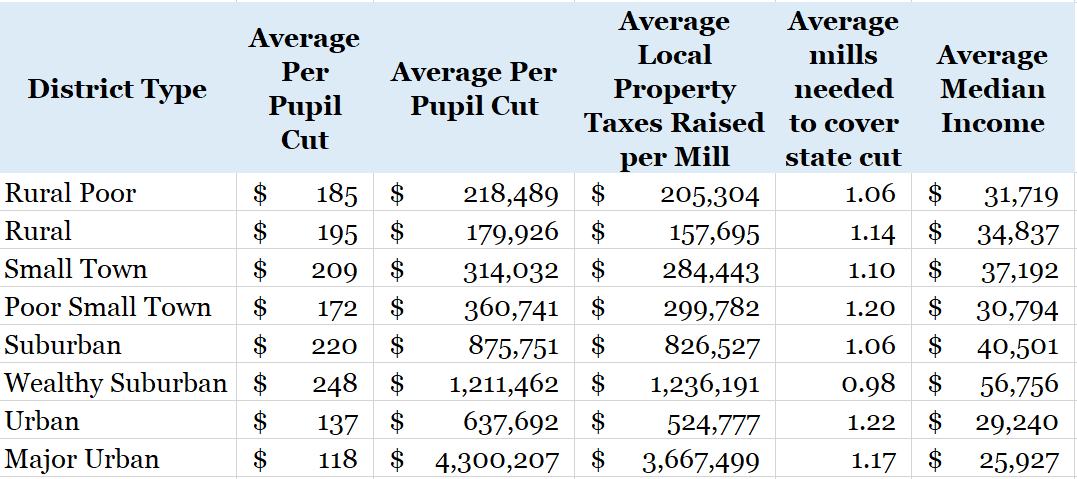
But if you want to see why the cuts still disproportionately harm kids in Ohio's neediest communities, look at the districts that lose the most money relative to their ability to offset those cuts using local revenue. A district-by-district spreadsheet of these cuts exists here

As you can see from the chart I've put together, the average wealthy suburban district loses more per pupil funding and almost double the total funding of the average urban district. Seems fair, right?


Yet in order to cover that loss, the urban district has to come up with almost 25 percent more local funding than the wealthy district. And they have to come up with that money by asking folks who barely make half as much money.

Same goes for major urban districts -- Akron, Canton Columbus, Cleveland, Cincinnati, Dayton, Toledo, and Youngstown. Even though folks living there make substantially less than half of what folks living in wealthy suburban districts earn, they have to tax themselves at about a 20 percent higher rate than the wealthy communities do to cover the state losses. 

Which community do you think has a better shot at recovering their lost state revenue with local revenue? That's a rhetorical question.

Is this outcome better than it could have been? 

Absolutely. 

The governor's office should be commended for doing what they could to try to make this distribution as fair as possible. But I think what this demonstrably proves is that there simply isn't enough money in wealthy districts to offset the disproportionate pain felt by our state's poorer communities when cuts come. And with more cuts expected for this coming school year, not to mention next year's biennial budget, the urgency of federal intervention to protect kids in our most vulnerable communities because clear and obvious.

In our poorest rural, small town and urban districts, folks who make substantially less money than folks in our wealthiest districts have to come up with substantially more local revenue to offset any state cuts -- regardless of state efforts to soften the blow.

This is why we need a school funding formula that makes sense and relies less on local revenue to fund schools. This is why the Ohio Supreme Court was absolutely correct when it ruled four times that the way Ohio funds schools is unconstitutional.

And, unfortunately, this is exactly why the system remains so 18 years after the final court ruling.

But on the immediate, COVID-emergency horizon, it speaks to the absolute necessity of federal funding to help alleviate this pain that will be felt in our most needy communities. 

Congress -- specifically the Senate -- must act. 

Now.

Tuesday, June 2, 2020

Confronting EdChoice: A Chance for Public Education to Protect their Kids

You know I don't typically toot my own horn on this blog. I like to do my analysis, make my point (or points) and move on.

However, there is a crisis facing public education in Ohio. And that crisis is the EdChoice Voucher program. This is a program that when I left the legislature in 2010 cost taxpayers $60 million. It is now about $150 million, and it's only growing.


Unlike Charter Schools, when taxpayer money is used by private schools to subsidize their tuitions, the state doesn't audit how the money is spent.

But even worse than that, it hurts kids who don't take the voucher -- kids who tend to be less well off, less white and with more special needs.

Every kid in 3 of 4 Ohio school districts receive less state and local revenue because of this and other voucher programs. 

This is not just an issue for large, urban school districts. Only 1 poor, rural or small town district lost any money to EdChoice vouchers in 2010. It's now throughout our rural communities and the money has jumped from $10,400 in 2010 to more than $850,000 today. 

As districts face huge budget cuts in the coming school years, it behooves them to defend every dollar they can so their students have all they need to succeed. That's why the folks at Real Choice Ohio, which fought for years to help districts cope with charter school losses to great success, have started a series of workshops to help districts educate and inform parents nd their communities about the dangers of the EdChoice vouchers to their kids and other kids' futures.

The first pillar of these conferences deals with the overall problem facing districts and the kids theiy serve. I am helping to lead this pillar, complete with Power Point presentations and I will be moderating an all-star panel on the EdChoice and voucher problem next week.

Signing up is easy and cheap -- $100 for all 4 pillars, which covers 5 participants. I would urge any school district officials, teachers and parents who are concerned with the threat these voucher pose to public education to sign up and join us.

We must push back. Together. I look forward to working with all of you.


Wednesday, May 27, 2020

Vouchers Especially Hurt Poor Kids

As has been recently reported in the Columbus Dispatch and other places, a group of public education advocates is looking to sue the state over the EdChoice voucher system -- an argument I've been making for years.

But in the article, pro-voucher forces make a curious argument -- that those seeking to undo the harm voucher do to primarily poor and special need kids are actually trying to hurt those kids.

“It’s an all-time low for government school activists to try to rip low-income and special-needs students out of their schools right now,” said Aaron Baer, president of Citizens for Community Values. 

“It’s clear that this special-interest group cares less about what’s best for kids, and more about their own narrow social agenda. Ohio’s EdChoice program is a lifeline to tens of thousands of families. It allows underprivileged and underserved children the opportunity to find an education that best meets their needs.”
First of all, it's not "government school"; it's "public school", which means our school. None other than Thomas Jefferson described it this way in the Land Ordiannce of 1785. "Public school" were Jefferson's words.

But I digress.

Here's the problem. Yes. It's true that poor and special needs students get vouchers and attend private schools using them. However, in order for that to happen, poor and special needs students in the public schools who don't take the voucher are left with fewer resources for their educations because the vouchers exist.

This is why, for example, as a state legislator I always voted against the special needs voucher that eventually became the Jon Peterson Voucher program. Because it set aside 1/3 of the money the state spent on special needs students to serve 3 percent of the special needs kids. So the voucher program would leave 97 percent of special needs students with only 2/3 of the money they needed.

Let's look at Parma with its 47% economically disadvanatged and nearly 2/3 minority populations.

Prior to losing voucher money and students, kids in Parma were slated to receive $13,663 per pupil in state and local funding for their educations. However, once all the vouchers were removed from the district, along with the students, kids in Parma only got $13,426. That's a $236 per pupil loss in total aid, which means there wasn't enough locally raised revenue to make up for the revenue these kids lost to the state's voucher programs.

So while some poor and special needs students certainly got vouchers, far more poor and special needs students in Parma got $236 less than they needed because of the vouchers.

In fact, in nearly 3 of 4 Ohio school districts, every poor and special needs student got less overall funding because of the voucher.

But what about those 1in 4 districts that saw greater per pupil revenue because of vouchers, you may ask? Well in those districts, the reliance on local property taxes increased as much as 10 percent, forcing those districts to tax themselves at higher rates to make up for the lost state evenue brought on by vouchers (all districts had to do this to some degree).

So in these districts (which also tend to be poorer), the need to go for levies increased at a substantially higher rate. Need I remind everyone that the Ohio Supreme Court has ruled four times that increasing reliance on local property taxes to pay for schools is unconstitutional?

I know I don't have to remind the folks who want to file this litigation because they're the same ones that won that major victory for kids in the late 1990s and 2000s.

So vouchers either directly harm poor and special needs students by cutting their overall education fudning, or force poorer communities to tax themselves at higher rates to make up for the loss of state aid from the state's voucher programs -- in clear violation of the Ohio Supreme Court's four rulings.

Oh yeah, and in 8 of 10 Ohio school districts where private voucher providers reside, the school district outperforms the private option by an average of 27 percentage points. When privates outperform districts, it's in 2 of 10 cases and by only 9 percentage points.

So not even the claim that these are better overall options for kids is true. But at leats those pushing for vouchers are willing to make sure that more than a million students in Ohio's public schools get fewer resources than they need. 

Tuesday, May 19, 2020

For-Profit Colleges Chew Up Ohio CARES Act Higher Ed Money


While much of the focus on the $2.3 trillion CARES Act has been on the K-12 funding provided in it, the $13.5 billion in higher ed money was also a large inevstment. However, according to data compiled by the University of Wisconsin, in Ohio, students in for-profit colleges have received more than double the amount of per student funding than students in Ohio's public and private, non-profit colleges and universities.

This is not the outcome that was needed.

Here is the average per student CARES Act funding by college type:


What's also interesting is private, non-profit colleges received more CARES Act, taxpayer funding than Ohio's public universities.

In fact, there is only 1 four-year public university of 14 (Central State) and 8 2-year public colleges (of 69) that received more CARES Act per student funding than the average for-profit college.

How for-profit colleges and private, non-profit colleges receive more per student CARES Act funding than public colleges and universities is shocking. One would think that public stimulus funding should benefit publicly funded institutions more than the non-taxpayer funded institutions.

But what do I know.

Thursday, May 7, 2020

State Hides the Ball on K-12 COVID Cuts

This is why I think people are driven nuts by government.

A couple days ago, Gov. Mike DeWine announced a $300 million cut would be coming in this school year for Ohio's K-12 school districts due to the COVID crisis. Very understandable. Absent the feds granting states flexibility on CARES Act stimulus money and doing another COVID rescue package for education, states and local governments, big cuts like what DeWine announced are expected.

We'll leave the debate over the state's $2.3 billion rainy day fund for another day.

But when DeWine's Office of Budget and Management (OBM) listed the district-by-district cuts ("runs" is what we call it in the biz), the percentage cuts didn't look all that bad. Between 1% and 2.8%. Given that $300 million is about 4% of the state aid handed out this last school year, that didn't jibe to me.

That's when I noticed that OBM was comparing the amount of money cut to all money being spent in a school district. That's all money spent. State, local and federal. So, yeah, it looks like the cut isn't that bad when you look at it that way.

But it's completely misleading. Why? Because the state has zero say in how much federal and local money is spent or raised in a district. So the state is taking credit for money it didn't send to or raise in the district.

I can honestly say I've never seen a district-by-district run expressed this way. Every other run I've seen has compared how much state money districts were receiving and how much they will be receiving now.

In fact, it's how DeWine put out his district-by-district runs last year during the budget. He compared his state funding increase (from wraparound services money) with the state funding schools received the prior year. That makes the percentage increase look bigger. If he compared it with a district's overall spend, the increase would have seemed smaller.

It's a budgetary parlor trick.

On the Surface, these Cuts Look Fair

So what's the real state cut, in terms that have always been used?

The average Ohio school district will get cut 5.9%, with some getting cut 55%. Half of districts will get cut more than 3.8%. Half get cut less.

But there is a silver lining to this. The largest percentage cuts are disproporitionately in wealthier, suburban communities. The smallest percentage cuts are in poorer communities less able to withstand them. So that 55% cut? It's in Rocky River in Cuyahoga County, which doesn't get much state funding anyway because it's so wealthy. Other major percentage cuts are in Upper Arlington (53.6%), Independence (51.4%) and Inidian Hill (47.9%). All tolled, suburban and wealthy suburban districts will absorb 41 percent of all the costs, even though they only make up about 17.7% of the state's foundation funding.

In Ohio's major urban districts (Akron, Canton, Cincinnati, Cleveland, Columbus, Dayton, Toledo, Youngstown), the typical cut will be 1.8%. The poorest, rural districts will get an average 3.1% cut.

So while those cuts in Ohio's most vulnerable communities will be less, they will still be meaningful. There just isn't enough money being sent to the wealthiest schools to Robin Hood the cuts for very long.

But Ohio's Most Vulnerable Districts Still Get Disproportionately Hurt

While the percentage cut in Ohio's most vulnerable communities is less than its wealthiest ones, because there just isn't enough money being sent to the the wealthiest districts to absorb all the cuts, the relative amount being cut in Ohio's most vulnerable communities is actually higher.

Let me explain.

The way education funding works in Ohio is the state figures out how much it should cost to educate kids in your district, then determines how much of that cost you should be able to pick up based on your property tax values. The state then picks up the rest. And while there are serious problems with the way Ohio does this because the state formula for determining the cost isn't an actual formula, that's the calculus.

The issue though is everything hinges on the ability to raise local money through property tax levies. Districts that raise more ("wealthier"), have less state money coming to them. Those that raise less ("poorer"), have more state money coming. (And there are districts that aren't "wealthy" that are classified as such, like Coventry and Danbury, but that's another topic for another post).

The problem with this system is when state cuts come to districts, poorer districts' budgets are far more sensitive to state funding losses because they raise so much less locally. So a relatively modest cut in a poor, rural Ohio district could mean that district now has to go out for a larger levy (which won't likely pass) or cut services. Meanwhile, even a larger cut in a wealthier district won't have the same impact because they could raise even a tiny additional levy amount to cover it.

So even though 40.9% of all the money being cut is coming out of wealthier districts, the relative cut is worse in Ohio's poorer communities.

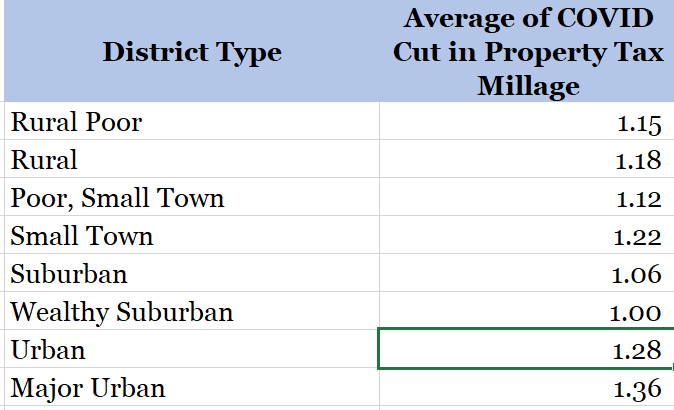
For example, on average, Ohio's poor, rural districts would have to raise 15% more local money to make up for their cut than the average welathy, suburban district. Likewise, the average major urban district would have to raise a 36% larger levy to replace its lost state revenue than the wealthy, suburban district.


Rocky River's seemingly massive 55.2% cut? In actuality, they would have to raise a 0.88-mill levy to cover that loss. Meanwhile, even though Trimble Local in tiny Noble County only gets cut by 0.7%, -- the state's smallest percentage cut -- they would need a 1.55-mill levy to cover the cost. That's nearly double the levy needed to cover state costs from a community with a 40% lower median income than Rocky River.

Younsgtown would have to come up with nearly 2 mills of local levy money to cover their 0.8% cut. Lorain needs 1.55 mills to cover its 1% cut.

You get the idea.

Any Education Cut Hurts Vulnerable Kids Most. Period. Thats' Why We Need Federal Stimulus. Now!

So while DeWine did an admirable job trying to deflect a large chunk of these cuts onto the districts that could shoulder them best, because there simply isn't enough money being sent to the state's wealthier districts, the seemingly palty percentage of state funding cuts in Ohio's most vulnerable communities are still disproportionately burdensome to them.

It's simply a function of local ability to raise revenue to replace the state money.

This is why we need a real state formula and investment in education funding -- a task that seemed so possible pre-COVID and now seems like a pipe dream.

The other issue is timing.

These cuts, assuming they go through shortly, would be deducted from payments the state will be making to districts in May and June. There are 4 payments made in these two months, with one scheduled to be made tomorrow.

So over 3 payments, districts will have to absorb all the cuts.

While it's tough to do a district-by-district anylsis of this impact quickly, overall, the bi-monthly state payment to districts is about $336 million. So this cut will mean that instead of three bi-monthly payments at the end of this school year, districts will essentially only get two.

That could mean serious logistical problems for districts, which may have already made purchases or paid salaries that the payments were expected to cover. Now that they won't, what will happen?

This will be a quite concerning offshoot of these cuts.

And again these cuts are only for this school year. Next school year, expect more. And next biennial budget expect even more.

Unless the feds step in and free up CARES Act money and pass additional stimulus money. And the state taps its significant rainy day fund.

Until then, look out. Take cover. And pray.